
Incident Response Plan Malaysia: Step-by-Step Guide for 2026
Why Every Malaysian Organisation Needs an Incident Response Plan
A cybersecurity incident is inevitable. The question is not “if” you’ll experience a breach, data exfiltration, or system outage — it’s “when.” An Incident Response Plan (IRP) is your roadmap for responding quickly and effectively when an incident occurs. A well-prepared organisation can detect and contain an incident within hours; organisations without a plan may not discover the breach for weeks or months.
Additionally, Malaysian regulations now mandate incident response capabilities:
- Cyber Security Act 2024: CNII entities must have documented incident response procedures.
- PDPA Data Breach Notification: You must notify the PDPC and affected individuals “without undue delay” — a well-planned response enables this.
- Bank Negara Malaysia (BNM) RMiT Section 10.58: Financial institutions must have an incident response plan tested at least annually.
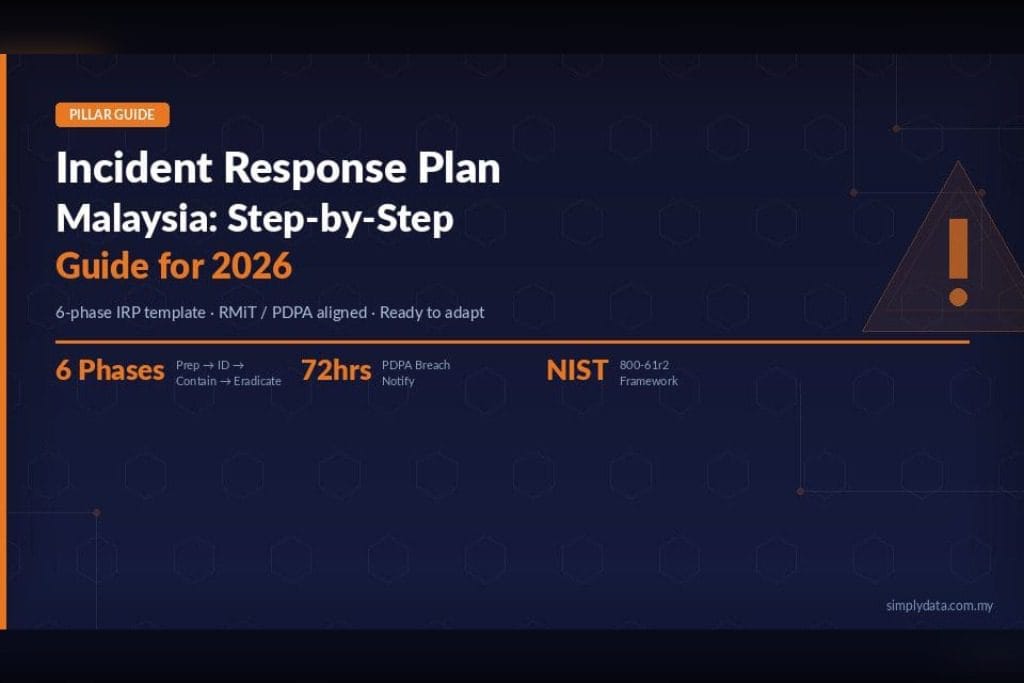
The Six Phases of Incident Response
Phase 1: Preparation
Preparation begins before an incident occurs. This phase includes:
- Tools and Technology: Ensure monitoring and detection tools are deployed (SIEM, EDR, firewall logging).
- Playbooks and Procedures: Document step-by-step procedures for responding to common incident types (ransomware, data breach, insider threat, etc.).
- Team and Contacts: Identify IR team members and establish contact lists for key personnel, law enforcement, cyber insurance, and external consultants.
- Tabletop Exercises: Conduct mock incident response drills annually to ensure the team is prepared.
Phase 2: Identification and Detection
The goal is to detect an incident as quickly as possible. This requires:
- Monitoring: 24/7 monitoring of security logs, system logs, and network traffic.
- Alerting: Automated alerts when suspicious activity is detected.
- Triage: Quickly determine if a security alert is a false positive or a real incident.
- Escalation: Route confirmed incidents to the incident response team immediately.
Phase 3: Containment
The goal of containment is to stop the attack and prevent further damage:
- Short-term Containment: Immediately isolate infected systems, disable compromised user accounts, block suspicious IP addresses.
- Long-term Containment: Apply patches, reset credentials, deploy additional monitoring, and remove persistence mechanisms (backdoors).
Phase 4: Eradication
Eliminate the attacker’s presence and close the vulnerability that allowed initial access:
- Remove all malware and backdoors from the environment.
- Rebuild compromised systems from clean backups or fresh installations.
- Patch the vulnerability that was exploited for initial access.
- Verify that eradication was successful through forensic analysis.
Phase 5: Recovery
Restore systems and data to normal operations:
- Restore data from clean backups (if available).
- Bring systems back into production in a staged manner.
- Monitor recovered systems closely for signs of re-compromise.
- Communicate with affected users and stakeholders about the status of recovery.
Phase 6: Lessons Learned
Conduct a post-incident review to improve future response:
- Document the timeline of the incident (when was it detected, how long did each phase take).
- Identify root causes — how did the attacker gain initial access?
- Assess the effectiveness of your response — what worked well, what could be improved?
- Update your incident response plan, detection rules, and security controls based on lessons learned.
Building Your Incident Response Plan: Template Structure
Section 1: Overview and Objectives- Purpose of the IRP
- Scope (what incidents are covered)
- Goals (detect, contain, eradicate, recover)
- Incident Commander — oversees the entire response
- Security Lead — leads technical investigation and eradication
- Communications Lead — manages internal and external communications
- Legal/Compliance Lead — ensures regulatory obligations are met
- Management Representative — provides executive support and resource authorisation
- Severity levels (Critical, High, Medium, Low)
- Incident types (ransomware, data breach, system compromise, DDoS, insider threat)
- Escalation criteria
- Monitoring infrastructure and tools
- Alert definitions and thresholds
- Escalation procedures
- Detailed playbooks for each incident type
- Evidence preservation procedures
- Forensic investigation checklist
- PDPC notification procedures (for data breaches)
- Law enforcement notification (police, CyberSecurity Malaysia/MyCERT)
- Customer notification procedures
- Internal communication and status updates
- Backup and restore procedures
- System validation procedures
- Post-recovery monitoring
- Lessons learned meeting agenda
- Root cause analysis framework
- Improvement action tracking
Testing Your Incident Response Plan
An IRP that’s never tested won’t work when needed. Conduct:
- Tabletop Exercises (Quarterly): Team discusses hypothetical scenarios without activating actual systems.
- Simulated Incidents (Annual): Deploy a test malware sample or simulate a breach scenario in a controlled environment.
- Full-Scale Exercises (Annual): Execute the complete incident response workflow in response to a real (but minor) security event.
Simply Data Managed SOC service provides incident detection and initial response, and we work with your IR team to escalate and manage incidents. We also offer incident response plan development and tabletop exercise facilitation. Contact us to develop your incident response capability.
Incident Response Plan Malaysia: NACSA and MyCERT Reporting Requirements
A compliant incident response plan Malaysia must include mandatory notification procedures aligned with local regulations. NACSA (National Cyber Security Agency Malaysia) requires CNII entities to report significant cybersecurity incidents under the Cyber Security Act 2024. Your IRP must include clear escalation paths, notification timelines, and evidence preservation procedures that satisfy NACSA’s reporting requirements.
MyCERT (Malaysia Computer Emergency Response Team) provides 24/7 incident response assistance and technical coordination for Malaysian organisations. Reporting to MyCERT at the onset of an incident enables threat intelligence sharing that benefits the broader Malaysian cybersecurity ecosystem. Your incident response plan should include MyCERT’s contact details and define which incidents require immediate reporting versus post-incident notification.
What is incident response plan Malaysia?
Incident Response Plan Malaysia encompasses cybersecurity practices tailored for Malaysian businesses, covering PDPA, BNM RMiT, ISO 27001, and the Cyber Security Act 2024. Simply Data provides certified managed security services to help Malaysian organisations achieve and maintain compliance with all relevant frameworks.
How much does incident response plan Malaysia cost in Malaysia?
The cost of incident response plan Malaysia in Malaysia varies by scope, organisation size, and service model. Simply Data offers transparent, scalable pricing for Malaysian SMEs and enterprises. Contact us for a customised quotation tailored to your requirements and budget.
How do I get started with incident response plan Malaysia?
Begin with a cybersecurity assessment to identify gaps against relevant frameworks (PDPA, RMiT, ISO 27001, CSA 2024). Simply Data team of certified professionals will guide you with a phased implementation roadmap and managed services — contact us for a free initial consultation.