
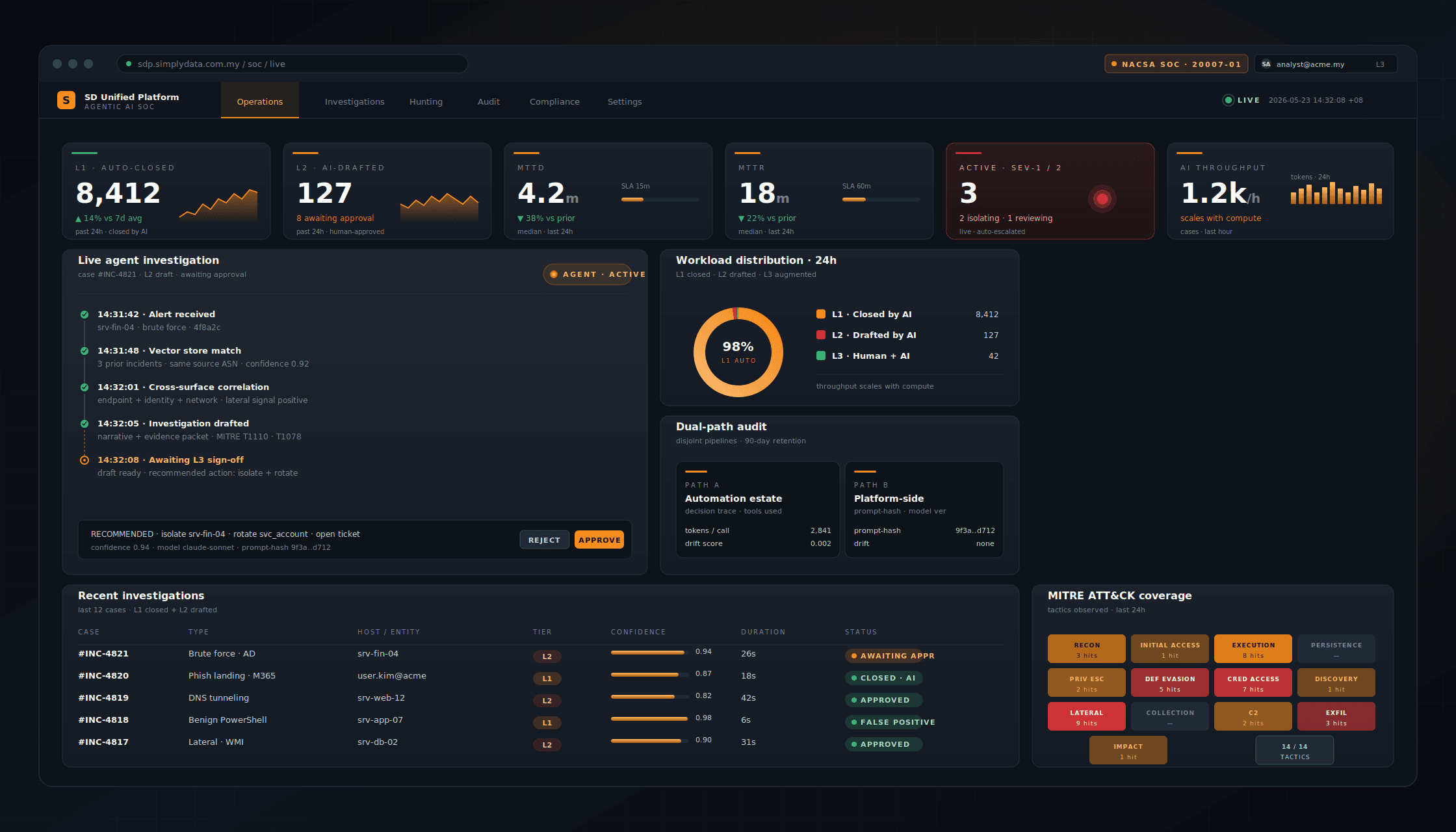
An Agentic AI SOC is a Security Operations Centre where AI agents — not just analysts — execute the investigation workflow. SD Unified Platform delivers an Agentic AI SOC where L1 alerts are closed autonomously, L2 investigations are AI-drafted and human-approved, and L3 threat hunting is AI-augmented. Every AI decision is captured to a dual-path audit trail with prompt-hash drift detection and 90-day retention. Operated under NACSA SOC Licence 20007-01.
What is an Agentic AI SOC?
A traditional SOC operates on a ticket queue. An alert fires, an analyst picks it up, runs a playbook by hand, and either closes it or escalates it. Throughput is bound by analyst headcount and shift coverage.
An Agentic AI SOC replaces the hand-cranked playbook with AI agents that reason, retrieve context, and act. The agent does not just summarise the alert — it pulls prior-incident context from a vector store (a searchable memory of past incidents), correlates telemetry across endpoint, network, and identity surfaces, drafts the investigation narrative, attaches evidence, and either closes the case or hands a fully-built packet to a senior analyst for sign-off.
The result is a SOC where throughput scales with compute, not headcount; where every alert receives consistent depth of investigation; and where senior analysts spend their time on judgement calls and novel threats, not on copy-pasting log lines.
SD Unified Platform delivers this model in production today, under NACSA SOC Licence 20007-01.
L1 + L2 automation, L3 augmentation
SDP implements a three-tier automation model that matches how senior SOC engineers actually think about workload.
L1 — Automated triage (closed by AI)
The agent receives the raw alert from the ingestion pipeline. It correlates against prior incidents indexed in a sovereign vector store, classifies severity, validates against false-positive heuristics, and either closes the alert with a documented reason or escalates to L2. Every decision is captured to the AI audit log with token rollup, model version, and prompt hash.
Typical L1 outcomes: – False positive — closed. Benign PowerShell sessions matching prior false-positive patterns, expected admin activity, scheduled task noise. – Low severity — closed with note. Single-source anomalies with no lateral indicators. – Escalate to L2. Cross-host correlation, unknown binary execution, identity-anomaly signals.
L2 — Automated investigation (drafted by AI, approved by humans)
The agent pulls telemetry across the customer estate, builds the investigation narrative, attaches evidence (process trees, network flows, identity events, threat intel matches), and drafts the customer-facing ticket. A senior analyst reviews the AI-drafted packet and either approves it for customer delivery or expands the scope.
This is the productivity unlock. Senior analysts no longer write investigation reports from blank pages — they review, refine, and approve.
L3 — Human-augmented hunting (driven by humans, accelerated by AI)
Senior threat hunters drive ad-hoc investigations through the AI Threat Hunting chat interface. Reasoning-grade models walk lateral-movement chains, validate hypotheses against telemetry, and pivot between MITRE ATT&CK techniques. Humans steer; AI computes.
Learn more about AI Threat Hunting →
Two AI audit pipelines (Path A + Path B)
SDP captures every AI call across two disjoint audit pipelines. This is one of the strongest differentiators of SDP versus commodity MDR — most vendors expose aggregate usage statistics; SDP exposes per-call observability.
Path A — Automation estate audit
Every AI call made by the SOC automation orchestrator is captured to the Path A audit log. This includes L1 triage decisions, L2 investigation drafts, Early Warning System CVE relevance scoring, and any other workflow-driven AI execution.
Path B — Platform-side audit
Every AI call made by the SDP application server (alert summarisation in Security Command Centre, narrative generation in Reporting, dashboard threat analysis, asset classification) is captured to the Path B audit log.
Both pipelines record:
- Caller identity and tenant scope
- Model name and version
- Prompt hash (for drift detection)
- Input and output token counts
- Latency
- Decision outcome
- Cost (where applicable)
- Optional PII-redacted payload (NRIC, passport, IBAN, email)
A silent-drop counter on the platform health endpoint surfaces audit pipeline failures without grep-the-logs forensics.
Per-call token rollup + prompt-hash drift detection
Every AI call is hashed by prompt template. SDP rolls up token usage per tenant, per model, per prompt template, per day. Two outcomes:
- Cost transparency. Customers and Simply Data operators see exactly which prompts cost what. No mystery AI bill.
- Prompt drift detection. If a prompt template is silently changed — by a developer, by a config drift, by an accidental commit — the hash changes and the rollup separates the new template from the old. This protects against the “we changed the prompt and now AI quality dropped 30%” failure mode that plagues unaudited AI estates.
For regulated industries — banking under BNM RMiT, insurance under MAS TRM-equivalent regimes, healthcare under PDPA — this audit depth is increasingly a procurement requirement, not a nice-to-have.
90-day audit retention (configurable)
The default retention window for AI audit logs is 90 days. Regulated customers can extend this to match retention obligations under PCI-DSS v4.0.1, BNM RMiT, ISO 27001:2022, or sector-specific guidance.
Audit logs are stored in the same TLSv1.3-pinned dedicated database hosts that hold customer telemetry, with AES-256-GCM encryption at rest and role-aware access control.
Why agentic (vs traditional SOC)
The economic case for Agentic AI SOC is straightforward.
Traditional SOC at scale: Headcount scales linearly with alert volume. A Malaysian MSSP onboarding three new banking customers needs to hire three more L1 analysts, then a shift lead, then a queue manager. Quality slips because new hires need 6-12 months to reach productive depth. Burnout rates in L1 roles exceed 35% annually across the industry.
Agentic AI SOC at scale: Compute scales with alert volume. New customers onboard in days, not quarters. L1 quality is consistent — the agent does not get tired at 03:00. Human analysts move up the value chain to L2 review and L3 hunting, which are intellectually rewarding and easier to retain.
For Malaysian customers facing BNM RMiT 14-hour incident reporting windows and PDPA breach notification obligations, the speed of Agentic AI SOC is not a luxury — it is the difference between a Saturday-morning notification and a Saturday-afternoon regulatory penalty.
Where Agentic AI SOC fits in the SDP module map
Agentic AI SOC is not a standalone product — it is the engine inside SD Unified Platform. The relevant SDP modules are:
- Security Command Centre (SCC) — the operator surface where AI-triaged alerts land for human review.
- AI Threat Hunting — the chat-driven L3 hunt module that lets senior hunters drive multi-step investigations with reasoning-grade AI.
- SOAR (Security Orchestration, Automation & Response) — the playbook execution layer that turns AI investigation outcomes into automated response actions (hash blocking, isolation, kill).
- SD Monitoring — the unified data ingestion layer that feeds the agentic AI with telemetry across endpoint, network, identity, and SaaS surfaces.
- SDP-Portal — the customer-facing surface where the agentic AI work product becomes hard MTTD/MTTR evidence, ticket timelines, and downloadable compliance packs.
This integration is what separates SDP from a “we sprinkled AI on top of a SIEM (Security Information & Event Management)” story. The agentic AI is wired into every module of the platform with a single audit chain, a single RBAC (role-based access control) model, and a single compliance evidence pipeline.
Risk + safety posture
Agentic AI in a SOC is not risk-free. Simply Data has engineered specific guardrails into SDP:
- No autonomous customer-facing action. AI agents close internal triage decisions. AI agents do not push response actions (hash block, isolate, kill) to customer endpoints without operator sign-off in the standard flow. Customers can opt-in to faster autonomous flows for specific high-confidence patterns, with full audit.
- PII redaction at the boundary. Optional in-line redaction of NRIC, passport, IBAN, and email addresses before content leaves Simply Data infrastructure for AI inference. Opt-in per tenant; opt-out where regulatory or operational context requires the unredacted prompt.
- Model versioning + prompt versioning. SDP captures the model version and the prompt hash for every AI call. When a model is updated or a prompt is edited, the change is visible in the audit log. There is no silent model upgrade that changes triage behaviour without forensic visibility.
- Silent-drop monitoring. A counter on the platform health endpoint surfaces audit pipeline failures (e.g. an AI call that completed but failed to write its audit row). Operators see the counter; an unexplained spike triggers investigation.
- Human-in-loop for L2 and L3. The standard flow keeps a human in the loop for all customer-facing outputs. Autonomous closure is restricted to internal triage decisions with high-confidence patterns.
These are the controls a regulator is going to ask about when they audit an MSSP using AI in incident response. SDP is engineered to give clean answers.
Comparison: Traditional SOC vs Agentic AI SOC
| Dimension | Traditional SOC | Agentic AI SOC (SDP) |
|---|---|---|
| L1 triage | Analyst opens each alert, runs playbook by hand | AI agent closes or escalates each alert with documented reason |
| L2 investigation | Analyst writes investigation narrative from scratch | AI agent drafts narrative; analyst reviews + approves |
| L3 hunting | Analyst types ES queries by hand, pivots manually | Analyst drives chat-style hunt; AI walks the chain |
| Throughput | Bound by headcount + shift coverage | Bound by compute + AI quota |
| Quality consistency | Variable — depends on analyst experience + fatigue | Consistent — same model, same playbooks |
| MTTD / MTTR | Typically 30-180 minutes for novel alerts | Typically sub-15 minutes for known patterns; AI-augmented for novel |
| Audit trail | Ticket comments, free-text notes | Per-call structured audit with prompt hash + token rollup |
| Cost transparency | Hidden in headcount | Visible per call, per tenant, per prompt |
| Onboarding new customers | Hire + train more analysts (weeks-months) | Configure tenant + ingest sources (days) |
| Regulator audit response | “Let me check the tickets” | Time-bounded query against the AI audit log |
Why Customers Choose Simply Data Agentic AI SOC
Six outcomes that matter to procurement, compliance, and operations teams.
Throughput That Scales With Compute
New customers onboard in days, not quarters. L1 quality is consistent — the agent does not get tired at 03:00. Onboarding speed becomes a procurement advantage.
Regulator-Ready AI Governance
Every AI decision logged with prompt-hash drift detection, token rollup, and per-call audit. BNM, NACSA, and PDPA auditors get clean answers — not folder dumps.
Data Sovereignty by Default
Customer telemetry, audit logs, and investigation packets remain on Malaysian soil. AI model calls are transient and routed through a single audited choke point.
Keep Your Existing Security Stack
Vendor-agnostic across EDR (Endpoint Detection & Response), NDR (Network Detection & Response), SIEM, and identity vendors. No reseller lock-in. Customers keep the security investments they have already made.
14-Hour RMiT Compliance
BNM RMiT 14-hour incident reporting met by design. Per-incident AI evidence chain queryable on demand for material-incident notifications.
No Mystery AI Bill
Per-call cost visibility per tenant, per prompt, per day. Customers and operators see exactly which prompts cost what.
Frequently Asked Questions
What is an Agentic AI SOC?▾
An Agentic AI SOC is a Security Operations Centre where AI agents — not just analysts — execute the investigation workflow. The AI agent reasons over telemetry, drafts investigation narratives, and either closes the case or hands a fully-built packet to a senior analyst.
How is SDP Agentic AI SOC different from a traditional SOC?▾
SDP automates Tier-1 alert triage and Tier-2 investigation drafting. Senior analysts review AI-drafted packets and drive Tier-3 hunting through a chat interface. Traditional SOCs run all three tiers by hand.
Is SDP Agentic AI SOC NACSA licensed?▾
Yes. Simply Data operates SDP under NACSA SOC Licence 20007-01.
How does SDP audit AI decisions?▾
SDP captures every AI call across two disjoint audit pipelines (Path A automation, Path B platform-side) with per-call token rollup, prompt-hash drift detection, opt-in PII redaction, and 90-day default retention.
Can the AI close alerts without a human?▾
For Tier-1 alerts with high-confidence false-positive or low-severity classifications, yes. Every closure is captured to the audit trail with model, prompt hash, evidence, and reason.
Does customer data leave Malaysia?▾
No customer data is stored outside Malaysia. AI model calls are transient. Storage of telemetry, audit logs, and investigation packets remains on Malaysian-sovereign infrastructure.
What is prompt-hash drift detection?▾
SDP hashes every prompt template by content. If a prompt is silently changed, the hash changes and the audit rollup separates the new template from the old.
How does Agentic AI SOC help with BNM RMiT compliance?▾
BNM RMiT requires 14-hour incident reporting for material incidents. Agentic AI SOC dramatically shortens time-to-detection and time-to-investigation.
Other SDP Modules
Explore the rest of SD Unified Platform.
Get Your Free Consultation Now!
We’re here to help! Contact us to learn more about Agentic AI SOC and SD Unified Platform.
Talk to a Simply Data engineer
Pre-launch briefings include a live walk-through of Agentic AI SOC on a sanitised demo tenant. Engineers — not sales reps — answer technical questions.
Reserve a Demo Briefing →Or reach us directly: