What is AI Cybersecurity? A Complete Guide (2026)
Cyber threats in Malaysia are no longer just the work of opportunistic hackers. Today, attacks are AI-assisted, automated, and built to slip past the defences that most organisations rely on.
In 2025, Simply Data Security Operations Centre analysed over 120 billion security logs across more than ten industries. What we found confirmed what many security leaders already suspect: the speed and sophistication of modern attacks have outpaced traditional security tools.
AI cybersecurity is the response to that reality. It uses artificial intelligence technologies including machine learning, deep learning, and natural language processing to detect and respond to threats faster than human analysts can manage alone. The global AI in cybersecurity market was valued at approximately USD 25.4 billion in 2024 and is projected to reach USD 93.8 billion by 2030. That growth reflects a simple truth: AI in security is no longer optional. It is foundational.
This guide explains how AI cybersecurity works, what it can and cannot do, and what Malaysian businesses need to know before evaluating AI-powered security services.
The Problem with Traditional Cybersecurity
To understand why AI cybersecurity matters, you first need to understand where traditional security falls short.
Most conventional security tools are built around signature-based detection. They compare incoming traffic or file behaviour against a database of known threats. When the threat landscape was smaller and slower, this worked reasonably well. Today, it does not.
Signature-based systems have two major weaknesses:
- They cannot detect zero-day threats. These are attacks that exploit vulnerabilities before anyone has documented them. If the signature does not exist, the tool cannot catch it.
- They generate too many false alarms. Analysts get buried in alerts, genuine threats get missed, and teams burn out.
The numbers tell the story. According to Simply Data 2025 Malaysia Cybersecurity Threat Report, our SOC processed over 12.4 million triggered alerts in a single year. Of those, only 3,945 were real incidents. That is roughly 3,000 alerts for every one confirmed threat, a ratio that makes manual analysis unsustainable.
At the same time, attackers are adopting AI themselves. Phishing campaigns are now generated at scale using generative AI tools. Microsoft 365, the number one attack surface in Malaysia according to our data, accounting for 32% of all incidents, is a primary target for AI-driven credential attacks.
The conclusion is simple. If attackers are using AI, defenders need to as well.
What the Cyber Security Act 2024 Means for Malaysian Businesses
Malaysia’s Cyber Security Act 2024, enforced from September 2024, introduced mandatory licensing requirements for cybersecurity service providers and incident reporting obligations for National Critical Information Infrastructure (NCII) entities.
To meet these requirements, organisations need:
- Continuous monitoring of their environment
- Documented incident response capabilities
- Demonstrable risk management processes
Manual, signature-based approaches are increasingly insufficient to satisfy these standards. AI-powered SOC services, particularly those backed by a NACSA-licensed provider, provide the foundation that compliance demands.
Simply Data holds both CREST certification and NACSA licences (No. 20007-01 and 20007-02). All our services are designed to support compliance with the Cyber Security Act 2024, BNM RMiT, and the PDPA Amendment Act 2024.
If you are not sure where your organisation stands, our NCSB Risk Assessment is the right place to start. It helps you understand your current compliance position and identify gaps before they become problems.
How Does AI Cybersecurity Work?
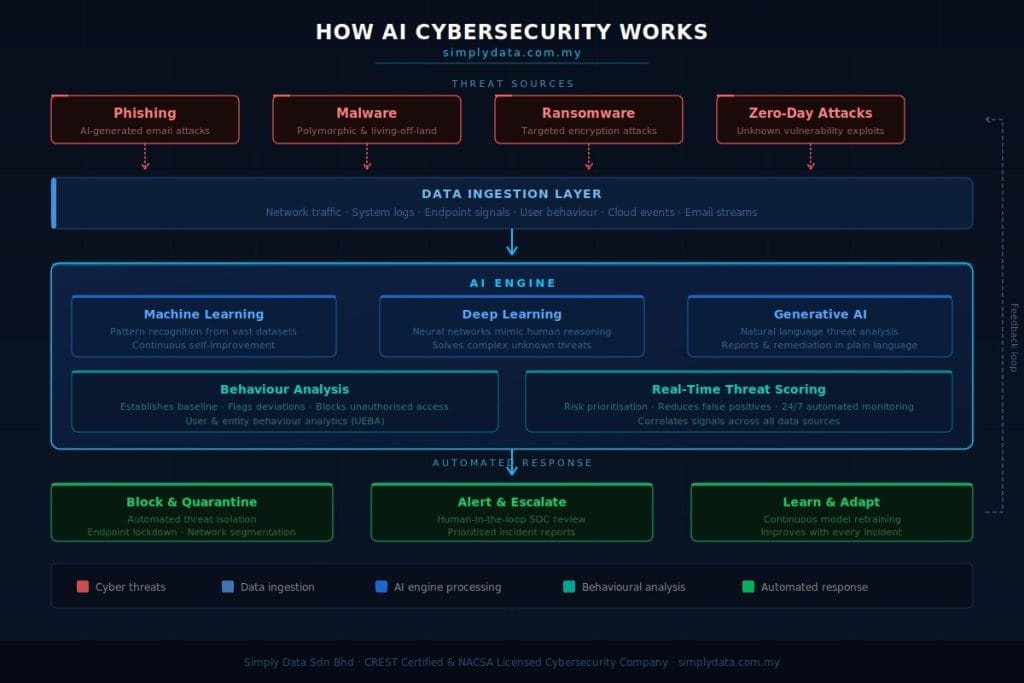
AI cybersecurity works through a continuous cycle:
- Data is collected from across an organisation’s environment
- AI models process that data to identify patterns and anomalies
- Automated responses are triggered based on the findings
- Human analysts review results and feed learnings back into the system
Here are the key AI technologies that power this cycle.
Machine Learning
Machine learning trains algorithms on large volumes of security data so they can make predictions about new events.
Instead of checking against a fixed list of known threats, machine learning models learn what “normal” looks like for your specific environment. When something deviates from that baseline such as an unusual login location, unexpected data movement, suspicious process activity, the system flags it, even if that exact attack pattern has never been seen before.
In an SOC, machine learning powers the correlation engines that connect individual alerts into a coherent incident picture. This saves analysts significant time during investigations.
Deep Learning and Neural Networks
Deep learning is a more advanced form of machine learning. It uses multi-layered neural networks to tackle more complex problems.
In cybersecurity, deep learning is particularly useful for malware analysis. It can tell the difference between malicious code and legitimate software, even when attackers have disguised or packed the malware to avoid detection. It is also used to detect subtle patterns in network traffic that point to command-and-control activity.
The trade-off is that deep learning models require more training data and computing power, and their outputs can be harder to explain than simpler approaches.
Generative AI
Generative AI brings natural language interaction to security operations.
Instead of writing complex queries in a SIEM tool, analysts can simply ask questions in plain English: “Show me all failed login attempts from external IPs in the last 24 hours targeting the finance team.”
This changes what junior analysts can do. Tasks that previously required senior expertise investigations, report writing, alert summarisation, remediation guidance can now be completed much faster and by a wider range of team members.
Simply Data AI Threat Hunting capability, built into the SD Unified Platform, uses this approach. It enables chat-driven threat investigations without requiring specialist query knowledge.
Agentic AI
Agentic AI is the next step. Rather than assisting analysts, AI agents autonomously carry out multi-step tasks on their own.
They triage incoming alerts, correlate findings with threat intelligence, run response playbooks, and escalate only what genuinely needs a human decision.
Simply Data Agentic AI SOC is built on this model. AI agents handle the high-volume, time-sensitive work freeing our human analysts to focus on complex threat hunting and strategic investigation.
In Malaysia’s banking sector, the average attacker dwell time is 21 days. Every hour matters. Agentic AI closes that gap.
Key Use Cases of AI in Cybersecurity
AI is now applied across nearly every area of cybersecurity. Here are the use cases delivering the most value.
- Identity and Access Management: AI learns the normal patterns of how users sign in what time, which device, which location. When a login looks unusual, it can automatically trigger a second verification step or block access entirely. In our 2025 data, compromised accounts were among the most common ways attackers gained initial access across all monitored industries in Malaysia.
- Endpoint Security: AI-powered endpoint tools go beyond blocking known malware. They watch what processes are actually doing in real time. This is how they catch living-off-the-land attacks, where attackers use legitimate tools like PowerShell to carry out malicious actions.
- Cloud Security: As more Malaysian organisations move to AWS, Azure, and Google Cloud, the attack surface grows. AI-driven Cloud Security Posture Management (CSPM) pulls together configuration data, access logs, and activity telemetry from across cloud environments to catch misconfigurations and suspicious activity that point-in-time assessments would miss.
- Threat Detection via XDR and SIEM: Extended Detection and Response (XDR) solutions use AI to connect signals from endpoints, email, identity systems, and cloud apps into a single incident timeline. This dramatically cuts mean time to detect (MTTD). Simply Data Managed Detection and Response (MDR) service is built on this model.
- Data Security: AI rapidly scans data repositories to identify and label sensitive content personal data, financial records, intellectual property and monitors for unauthorised access or exfiltration. This directly supports compliance with Malaysia’s PDPA Amendment Act 2024, which introduced mandatory breach notification requirements.
- Incident Investigation and Response: During active incidents, AI surfaces the most relevant events across multiple data sources and organises them into a clear timeline. In Simply Data DFIR engagements, AI-assisted triage significantly reduces the time between engagement start and root cause identification.
- Cyber Deception: AI-powered deception technology generates convincing fake assets servers, credentials, files that look like real infrastructure. When an attacker interacts with a decoy, the system produces high-confidence alerts and detailed telemetry on attacker behaviour. Simply Data SD Cyber Deception service converts attacker reconnaissance into actionable threat intelligence.
- Dark Web and Attack Surface Monitoring: AI continuously scans dark web forums, paste sites, and criminal marketplaces for leaked credentials, stolen data, and early warning signs of targeted campaigns. In 2025, Simply Data threat intelligence feeds tracked 33.2 million malicious indicators of compromise from dark web sources.
Benefits of AI Cybersecurity
Here is why more organisations in Malaysia are making the shift to AI-powered security.
- Speed: AI analyses telemetry in real time at a scale no human team can match. Threats that would take analysts hours to correlate manually can be surfaced in minutes. In a ransomware attack where full encryption can happen in hours, detection speed directly determines how much damage gets done.
- Accuracy: AI uses pattern recognition, anomaly detection, and contextual awareness together to reduce both false positives and false negatives. Analysts spend less time chasing phantom alerts, and fewer real threats slip through.
- Scalability: AI-powered security grows with your infrastructure without needing a proportional increase in headcount. This matters especially for Malaysian SMEs and mid-market companies that need enterprise-grade protection but cannot build enterprise-scale security teams.
- Stronger analyst capability: Generative AI acts as a force multiplier. Junior analysts can handle investigations that previously required senior expertise. Senior analysts can focus on higher-value work. Skills gaps, a challenge in Malaysia’s cybersecurity talent market, become less of a constraint when AI handles the routine workload.
AI Cybersecurity vs AI Security: What Is the Difference?
These two terms are often confused. They are not the same thing.
AI for cybersecurity means using AI to protect your organisation’s environment: detecting threats, automating response, hunting for attackers, and reducing analyst workload. This is the primary focus of this article.
AI security means protecting your AI systems themselves making sure that AI models, training data, and AI-powered applications cannot be tampered with or exploited. Adversarial attacks, model poisoning, and prompt injection are all AI security threats.
Both matter. As AI becomes more embedded in business operations, securing those AI systems is just as important as using AI to secure everything else.
AI Cybersecurity Market: Growth and Context
The market data confirms how rapidly AI is becoming central to security investment.
The global AI in cybersecurity market was estimated at approximately USD 25.4 billion in 2024. Projections for 2030 range from USD 94 billion to USD 135 billion depending on the source, with consistent CAGR estimates of 24 to 25%. The main drivers are cloud adoption, digital transformation, regulatory pressure, and the growing sophistication of AI-powered attacks.
North America leads the global market today, but Asia-Pacific is among the fastest-growing regions. In Malaysia specifically, the MyDIGITAL agenda and Malaysia’s Cyber Security Act 2024 are accelerating enterprise investment in security. Our own observations across Malaysian client engagements reflect this shift: organisations are increasingly moving away from point-in-time assessments toward continuous, managed security coverage through MDR and SOC-as-a-Service, prioritising detection and response capability as their primary security investment.
Best Practices for Implementing AI Cybersecurity
If you are evaluating AI cybersecurity tools or services, here are the principles worth following.
- Start with your security gaps, not the technology. AI amplifies good security. It cannot fix a fragmented architecture or compensate for unpatched systems. Run a Security Posture Assessment first to understand your actual risk landscape before selecting tools.
- Choose integration over point solutions. AI delivers the most value when it can analyse data from across your entire environment endpoints, cloud, email, identity, and network together. Tools that operate in silos produce incomplete pictures. Look for platforms or managed services that bring multiple data sources together before applying AI analysis.
- Keep humans in the loop. The best AI cybersecurity deployments use AI for speed and volume, and humans for judgment and context. In Simply Data Agentic AI SOC, AI agents and human analysts work together each doing what they do best.
- Set generative AI policies before you start. If your team uses AI tools with natural language interaction, make sure employees know what data they are and are not permitted to share in prompts. Confidential data, customer records, and internal system details should never go into public or unvetted AI interfaces.
- Test your defences regularly. AI models drift as your environment changes. Review model performance, alert thresholds, and detection coverage on a regular schedule. Phishing Simulation and VAPT engagements are valuable complements to AI monitoring because they test whether your defences actually catch real attack techniques, not just the patterns the model was trained on.
What to Know Before Deploying AI Cybersecurity
Once you have selected the right approach, here is what to expect during the deployment itself. Organisations that go in with realistic expectations are better positioned to configure, deploy, and operate these tools effectively.
1. Fine-tuning improves accuracy over time.
AI models learn from data, which means their accuracy improves as they are exposed to more of your specific environment. Early in a deployment, models may require calibration to reduce false positives and align with your organisation’s normal activity patterns. This is an expected part of the process, not a flaw. Working with an experienced deployment partner shortens this calibration period significantly.
2. AI cybersecurity is most effective as part of a broader strategy.
The same generative AI capabilities that help defenders detect and respond to threats are also available to attackers, who use them to craft more convincing phishing emails, generate malicious code, and automate reconnaissance at scale. Simply Data threat intelligence data shows a meaningful increase in AI-assisted attacks against Malaysian organisations over the past two years. This reinforces the value of layered defences: AI-powered detection works best when combined with strong security baselines, regular VAPT, and a capable human-led SOC.
3. The most effective security model combines AI and human expertise.
AI excels at processing high volumes of data, identifying patterns, and handling repetitive detection tasks at speeds no human team can match. Complex incident investigations, contextual judgment calls, and strategic decisions are where experienced analysts add irreplaceable value. This is the model that Simply Data Agentic AI SOC is built around: AI handles volume and speed, human analysts handle context and decision-making, and the two work together rather than in isolation.
4. Clear AI usage policies protect your organisation.
Generative AI tools create a new category of data governance consideration. Without clear policies in place, employees may inadvertently share confidential information, customer data, or internal system details through AI prompts. Establishing explicit guidelines on what data can and cannot be shared with AI tools, and communicating those guidelines before deployment, ensures that AI enhances your security posture rather than introducing new exposure.
Emerging Trends in AI Cybersecurity
The AI security landscape is moving fast. Here is what is already shaping how leading organisations are building their security programmes for 2026 and beyond.
- Agentic AI in security operations. SOCs are shifting from human-led workflows supported by tools, to AI-led workflows supervised by humans. Routine triage, playbook execution, and first-line investigation are increasingly handled autonomously. Simply Data has already deployed this model through its Agentic AI SOC.
- Proactive threat hunting at scale. AI enables teams to move from waiting for alerts to actively hunting for attacker presence using threat intelligence-driven hypotheses. Simply Data AI Threat Hunting capability operationalises this approach.
- Smarter deception technology. Static honeypots are being replaced by dynamic AI-generated decoys that adapt to an attacker’s behaviour in real time making it much harder for adversaries to tell what is real and what is a trap.
- Hybrid security roles. Demand is growing for security professionals who combine cybersecurity knowledge with AI literacy analysts who can interpret model outputs, tune detection logic, and work alongside autonomous agents.
- Regulatory scrutiny of AI decision-making. Regulators are increasingly focused on how AI tools make decisions in security contexts particularly around bias, explainability, and data handling. Malaysian organisations should expect future frameworks to require documentation of how AI-driven security decisions are made and reviewed.
Frequently Asked Questions
1. What is AI cybersecurity?
AI cybersecurity is the use of artificial intelligence technologies including machine learning, deep learning, and natural language processing to detect, respond to, and mitigate cyber threats faster and more accurately than traditional methods alone.
2. Will AI replace cybersecurity professionals?
No. AI handles high-volume, pattern-based work very well. But cybersecurity still requires human judgment for complex investigations, novel attack scenarios, and strategic decisions. The most effective security operations combine AI efficiency with human expertise.
3. How is machine learning used in cybersecurity?
Machine learning models learn what normal behaviour looks like in a given environment network traffic, login timing, application usage and flag deviations. This allows security systems to detect threats based on behaviour rather than known signatures, making them effective against zero-day attacks and new malware variants.
4. What is the difference between AI cybersecurity and traditional cybersecurity?
Traditional cybersecurity relies on signature-based detection and manual analysis. It is slow and largely ineffective against new or sophisticated threats. AI cybersecurity analyses large volumes of data in real time, detects behavioural anomalies, and automates response actions significantly reducing detection and response times.
5. Why should Malaysian businesses invest in AI cybersecurity?
Malaysian businesses face a growing volume of sophisticated, AI-assisted attacks. Regulatory requirements under the Cyber Security Act 2024, BNM RMiT, and the PDPA Amendment Act 2024 demand continuous, demonstrable security monitoring. AI-powered security provides the speed, coverage, and scalability that traditional approaches cannot deliver.
6. What are the risks of using AI in cybersecurity?
The main risks are: false positives from models that have not been properly tuned; over-reliance on AI without human oversight; attackers using AI to evade AI-based defences; and poor governance around how sensitive data is shared with AI tools. These risks are manageable with the right implementation approach and continuous model validation.
Conclusion
AI cybersecurity is not a future aspiration. It is already the standard for organisations that face modern threats and that includes most Malaysian businesses today.
The question is not whether to adopt AI-powered security. It is how to do it well: with the right integration, the right human oversight, and the right partner.
Simply Data brings together CREST-certified analysts, a purpose-built Agentic AI SOC, and the SD Unified Platform combining threat intelligence, AI-driven detection, and automated response in a single managed service. Whether you need full SOC coverage, AI-enhanced VAPT, or a starting point through a Security Posture Assessment, we can help.
Contact Simply Data for a free consultation and find out what AI cybersecurity looks like in practice for your business.