
What Is MDR? Managed Detection and Response Malaysia 2026 — Complete Guide
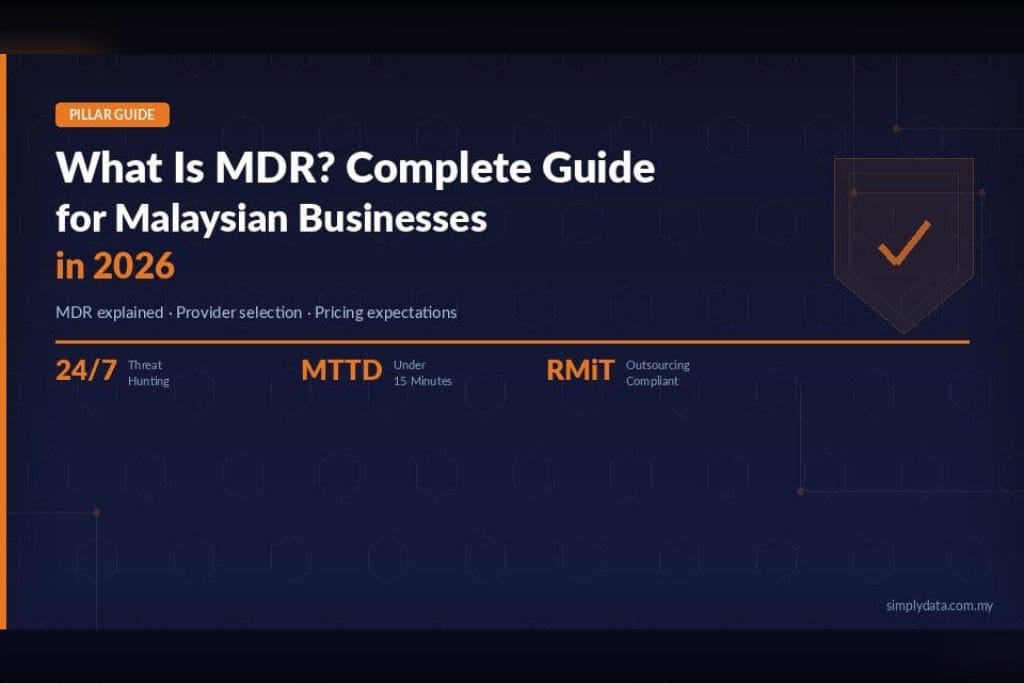
A managed detection response Malaysia (MDR) service gives your organisation 24/7 threat monitoring, rapid incident response, and expert security operations — without the cost of building an in-house SOC. As cyber threats targeting Malaysian businesses continue to escalate, MDR has become an essential layer of defence for organisations that need enterprise-grade security but lack the resources to staff it internally.
Key Takeaways
- MDR (Managed Detection and Response) provides 24/7 threat monitoring, investigation, and active response — not just alerting
- MDR is distinct from a traditional MSSP: MDR analysts actively contain threats; MSSPs primarily forward alerts
- Malaysian businesses subject to BNM RMiT, PDPA, and the Cyber Security Act 2024 benefit directly from MDR’s continuous monitoring and breach notification capabilities
- Simply Data is a NACSA-licensed MDR provider operating a fully local SOC — no data leaves Malaysia
- MDR for Malaysian SMEs starts from approximately RM 8,000 per month depending on endpoint count and scope
What Is Managed Detection and Response (MDR)?
Managed Detection and Response (MDR) is a fully managed cybersecurity service that combines advanced threat detection technology with human expertise to monitor, detect, investigate, and respond to threats across your organisation’s IT environment. Unlike traditional security monitoring services that simply forward alerts, MDR analysts actively investigate suspicious activity and take containment actions on your behalf — often stopping threats before they cause damage.
The core components of an MDR service are: a Security Information and Event Management (SIEM) platform that aggregates logs and security telemetry; Endpoint Detection and Response (EDR) agents on workstations and servers; network detection capabilities; and a team of security analysts working 24 hours a day, 7 days a week, 365 days a year. When a genuine threat is detected, the MDR team does not simply send an email alert — they investigate the incident, validate it, and take response actions such as isolating an infected endpoint, blocking a malicious IP, or terminating a suspicious process.
How MDR Works: The Technology and Human Layer
An effective MDR service operates across three integrated layers:
- Telemetry Collection: EDR agents on all endpoints, SIEM connectors for cloud services (Microsoft 365, Azure, AWS), firewall and network device log ingestion, and identity provider (Active Directory, Entra ID) monitoring. The richer the telemetry, the more accurately threats can be detected and correlated across your environment.
- Detection and Correlation: The SIEM correlates events across all telemetry sources and applies detection rules aligned to the MITRE ATT&CK framework — a globally recognised taxonomy of attacker techniques and procedures. Simply Data SOC uses Elastic Security as its SIEM, with custom detection rules built specifically for threats targeting Malaysian organisations, including regional APT group TTPs and Malaysia-specific phishing lures.
- Human Investigation and Response: When the SIEM generates a high-fidelity alert, a Tier 1 SOC analyst investigates within minutes. If validated as a real threat, it escalates to Tier 2 for deeper analysis and, if necessary, Tier 3 for threat hunting and containment. Response actions — such as endpoint isolation or credential invalidation — are taken with your prior authorisation via a pre-agreed response playbook.
What Is Included in a Managed Detection Response Service?
A comprehensive MDR service from Simply Data includes the following capabilities:
- 24/7 SOC Monitoring: Continuous monitoring by certified security analysts across all shifts, including Malaysian public holidays
- SIEM Deployment and Tuning: Elastic Security SIEM deployed, integrated, and continuously tuned to reduce false positives and improve detection fidelity
- EDR Management: EDR agents deployed, managed, and monitored on all in-scope endpoints
- Threat Intelligence Integration: Malaysian-specific threat intelligence feeds and regional APT indicators of compromise (IOCs) integrated into detection rules
- Incident Investigation and Response: Full investigation workflow for confirmed incidents, with detailed incident reports and root cause analysis
- Breach Notification Support: Assistance with PDPA and Cyber Security Act 2024 breach notification obligations, including evidence packaging for regulatory submission
- Monthly Reporting: Executive-level security posture report covering alert volumes, incident trends, mean time to detect (MTTD), and mean time to respond (MTTR)
- Threat Hunting: Proactive hypothesis-driven hunting for threats that have evaded automated detection — typically conducted monthly or following significant threat intelligence updates
MDR vs In-House SOC: Cost and Capability Comparison
Many Malaysian organisations face the build-versus-buy question: should you build an internal Security Operations Centre (SOC) or subscribe to an MDR service? The answer depends on your budget, risk profile, and timeline:
- Staffing Cost: A minimal 24/7 in-house SOC requires at least 5 analysts (to cover shifts, leave, and sick days) plus a SOC Manager. At Malaysian market rates, this represents an annual salary cost of RM 600,000 to RM 1,000,000 before tool costs, training, and management overhead. MDR typically costs RM 8,000 to RM 30,000 per month (RM 96,000 to RM 360,000 per year) depending on scope.
- Time to Operational: Building an in-house SOC from scratch takes 12 to 24 months. An MDR service can be fully operational within 4 to 8 weeks of engagement start.
- Tool Investment: Enterprise SIEM and EDR tools typically cost RM 100,000 to RM 500,000 per year in licensing fees. With MDR, these tools are included in the service fee.
- Expertise Depth: An MDR provider’s team collectively handles hundreds of incidents across multiple clients. This breadth of exposure means faster, more accurate threat identification than a small in-house team facing novel threats for the first time.
For most Malaysian SMEs and mid-market businesses, MDR provides significantly better security outcomes at a lower total cost than an in-house SOC. For large enterprises that already have a dedicated security team, MDR can augment in-house capabilities rather than replace them — particularly for after-hours coverage and specialised threat hunting.
MDR for Malaysian Industries
Financial Services (BNM RMiT Compliance)
Bank Negara Malaysia’s Risk Management in Technology (RMiT) framework requires financial institutions to implement Security Operations Centre capabilities with 24/7 monitoring of critical systems. MDR directly satisfies RMiT’s continuous monitoring, incident response, and threat intelligence requirements. Simply Data works with Malaysian banks, insurance companies, and fintech firms to provide RMiT-aligned MDR services with the audit documentation required for BNM examinations.
Healthcare
Healthcare organisations in Malaysia are among the most targeted by ransomware groups due to the high value of patient data and the operational impact of system downtime. MDR provides healthcare providers with the rapid threat detection and response capabilities needed to prevent ransomware encryption events and satisfy the PDPA’s Security Principle requirements for health data protection.
Manufacturing and Critical Infrastructure
Under the Cyber Security Act 2024, Critical National Information Infrastructure (CNII) operators — including energy, water, and manufacturing sectors — are required to implement cybersecurity measures approved by NACSA. MDR from a NACSA-licensed provider is a recognised approach for satisfying CNII operator obligations.
How to Choose an MDR Provider in Malaysia
When evaluating MDR providers, Malaysian organisations should assess the following criteria:
- ☐ NACSA Licensing: Is the provider licensed by NACSA as a cybersecurity service provider under the Cyber Security Act 2024? This is a regulatory requirement for CNII operators and a strong quality indicator for all buyers.
- ☐ Local SOC: Is the SOC based in Malaysia? Data sovereignty and the ability to meet with the team in person are important for regulated industries.
- ☐ Malaysian Threat Intelligence: Does the provider have specific knowledge of threats targeting Malaysian organisations, including regional APT groups, BNM RMiT context, and PDPA breach notification requirements?
- ☐ SIEM Technology: What SIEM platform powers the service? Elastic Security, Microsoft Sentinel, and Splunk are the leading enterprise platforms. Avoid providers running outdated or proprietary SIEM tools.
- ☐ Response SLAs: What are the guaranteed response times for critical incidents? Industry standard for critical alerts is under 15 minutes for initial triage and under 1 hour for confirmed incident response.
- ☐ Breach Notification Support: Does the provider assist with PDPA and Cyber Security Act 2024 breach notification documentation and submission?
- ☐ References: Can the provider provide references from Malaysian clients of a similar size and industry?
For a detailed comparison between MDR and MSSP services, including a side-by-side feature matrix and decision framework, see our MDR vs MSSP Malaysia comparison guide.
What is MDR (Managed Detection and Response) in Malaysia?
MDR (Managed Detection and Response) is a fully managed cybersecurity service that provides 24/7 threat monitoring, detection, investigation, and active response by a team of security analysts. Unlike traditional security monitoring services that generate alerts for your team to investigate, MDR analysts actively investigate and contain threats on your behalf. In Malaysia, MDR services from NACSA-licensed providers like Simply Data are designed to satisfy BNM RMiT continuous monitoring requirements, PDPA breach notification obligations, and Cyber Security Act 2024 compliance for CNII operators.
How much does MDR cost for a Malaysian business?
MDR pricing for Malaysian businesses typically ranges from RM 8,000 to RM 30,000 per month, depending on the number of endpoints monitored, the scope of log sources, and the level of response capability required. Enterprise deployments for large financial institutions or CNII operators may exceed this range. Most MDR providers offer tiered pricing based on endpoint count and service level. When compared to the cost of building an equivalent in-house SOC capability (typically RM 600,000 to RM 1,000,000 per year in salaries alone), MDR consistently delivers superior value for Malaysian SMEs and mid-market organisations.
Does MDR satisfy BNM RMiT requirements in Malaysia?
Yes — an MDR service from a qualified provider directly addresses several BNM RMiT requirements including continuous monitoring of critical systems (Section 10), cybersecurity incident response and management (Section 11), and threat intelligence integration. BNM expects financial institutions to maintain 24/7 SOC capabilities and to detect and respond to incidents within defined timeframes. A NACSA-licensed MDR provider with documented SLAs for detection and response times, combined with monthly security reports, is typically accepted as satisfying these RMiT obligations. Simply Data has supported multiple Malaysian financial institutions in demonstrating MDR compliance during BNM technology risk examinations.
What is the difference between MDR and a traditional MSSP?
The key difference is in the response capability. A traditional MSSP (Managed Security Service Provider) monitors your environment and forwards security alerts to your internal team for investigation and response. MDR goes further — the MDR team investigates the alert, validates whether it is a genuine threat, and takes containment actions (such as isolating an endpoint or blocking a malicious connection) without requiring your team to be involved. MDR is therefore better suited to organisations that lack in-house security analysts. For a detailed comparison of MDR and MSSP, including a side-by-side feature matrix, see our MDR vs MSSP Malaysia guide.