
Malaysia Cybersecurity NACSA Licensed Service Provider: Who Needs It & How to Apply
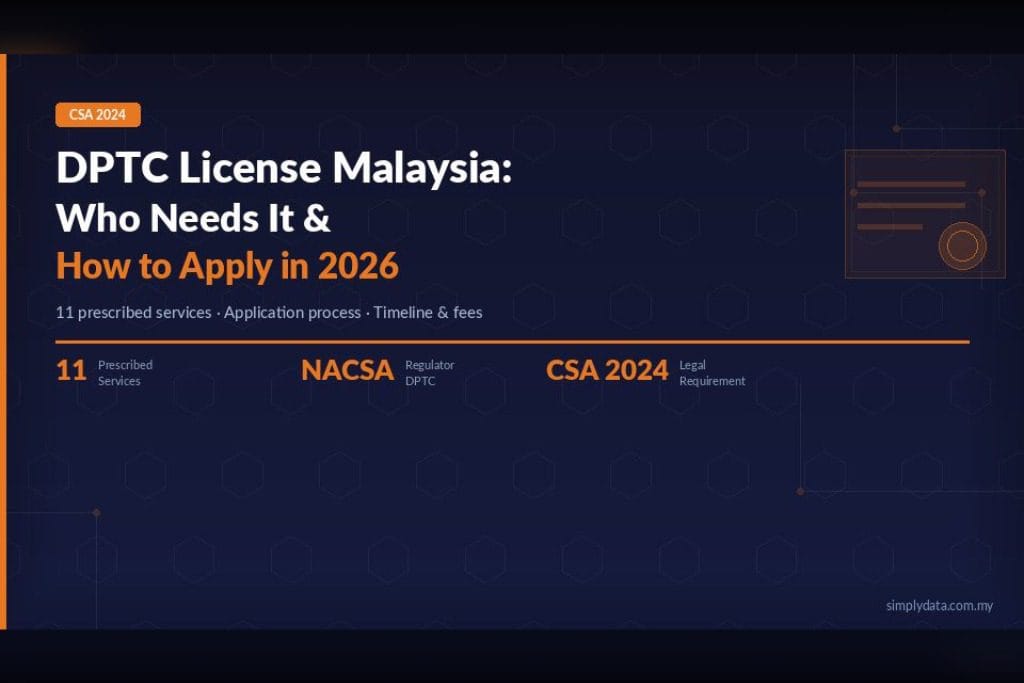
Becoming a Malaysia cybersecurity NACSA licensed service provider is now a legal requirement for any company providing prescribed cybersecurity services under the Cyber Security Act 2024. Whether you operate a managed SOC, offer penetration testing, or provide incident response — if you’re a cybersecurity service provider in Malaysia, NACSA licensing directly affects your business.
What Is the Cybersecurity Service Provider (CSSP) License?
The Cybersecurity Service Provider (CSSP) License is a mandatory licence introduced under Malaysia’s Cyber Security Act 2024 (Act 854), which came into force on 26 August 2024. Regulated by the National Cyber Security Agency (NACSA), the licence applies to any individual or company providing prescribed cybersecurity services in Malaysia.
This is one of the most significant new compliance obligations for cybersecurity firms, managed security service providers (MSSPs), penetration testing companies, SOC operators, and incident response teams operating in Malaysia. Non-compliance carries penalties of up to RM 500,000 or imprisonment.
Why Was the CSSP Licence Introduced?
Before the Cyber Security Act 2024, Malaysia had no formal licensing regime for cybersecurity service providers. Any individual or company could offer cybersecurity services without meeting minimum competency, ethical, or security standards. The CSSP licence addresses this by:
- Setting minimum technical competency requirements for cybersecurity practitioners
- Creating accountability for service providers handling sensitive client data
- Establishing NACSA as the national regulator for the cybersecurity services industry
- Aligning Malaysia with international best practices (Singapore MAS, EU NIS2)
- Protecting critical national information infrastructure (CNII) clients from substandard providers
Who Needs a CSSP Licence?
Under the Cyber Security Act 2024, any entity providing prescribed cybersecurity services in Malaysia must hold a valid CSSP licence. The prescribed services currently regulated include:
- Penetration Testing / VAPT — vulnerability assessments and ethical hacking services
- Security Operations Centre (SOC) Services — 24/7 monitoring, threat detection, incident response
- Managed Security Services (MSS/MSSP) — outsourced security management
- Digital Forensics — cyber crime investigation and evidence collection
- Incident Response Services — emergency response to cyber incidents
- Security Risk Assessment — formal risk and compliance assessments
If your company provides any of these services — even as a secondary offering — you are required to apply for the relevant CSSP licence category.
Types of CSSP Licences
NACSA issues CSSP licences in two main tiers:
- Individual Licence — for independent cybersecurity practitioners and consultants
- Company Licence — for organisations providing cybersecurity services as a business
Each licence is tied to specific service categories. A company providing both VAPT and SOC services must be licensed for both categories separately.
How to Apply for a CSSP Licence
NACSA opened the licence application portal on 1 October 2024. All applications are submitted electronically via licence.nacsa.gov.my.
The application process involves:
- Register on the NACSA licensing portal at licence.nacsa.gov.my
- Select your service category — choose the prescribed cybersecurity service type(s) you provide
- Submit supporting documents — company registration (SSM), staff certifications (CISM, OSCP, CEH, etc.), proof of technical competency, insurance documents
- Pay the licence fee — fee schedule published by NACSA (varies by category and licence type)
- Await NACSA evaluation — NACSA reviews applications and may conduct interviews or site visits
- Receive licence — valid licence is issued with a defined validity period (typically 1–2 years)
Key Compliance Obligations for Licence Holders
Once licensed, CSSP companies must comply with ongoing obligations under the Act:
- Maintain technical standards — licensed staff must hold relevant certifications and undergo CPD
- Report incidents — cybersecurity incidents affecting clients must be reported to NACSA within defined timeframes
- Data handling standards — client data must be handled per PDPA 2010 and NACSA guidelines
- Renew licence — licences must be renewed before expiry; late renewals attract penalties
- Non-disclosure obligations — service providers must protect client confidential information
- Cooperate with NACSA audits — NACSA has powers to inspect and audit licensed entities
Penalties for Non-Compliance
Providing prescribed cybersecurity services without a valid CSSP licence is a criminal offence under the Cyber Security Act 2024. Penalties include:
- Individuals: fine up to RM 500,000 or imprisonment up to 10 years, or both
- Companies: fine up to RM 500,000 per offence
- Continuing offences: additional daily fines for each day the offence continues
What Does This Mean for Malaysian Cybersecurity Buyers?
If you are a Malaysian company buying cybersecurity services, the CSSP licence matters to you too. You should:
- Always verify your cybersecurity vendor holds a valid CSSP licence before engaging them
- Request proof of licence number and validity from any VAPT, SOC, or MSSP vendor
- Include CSSP licence verification in your vendor due diligence checklist
- Update your third-party risk management policy to reflect this regulatory requirement
Procuring services from an unlicensed provider could expose your organisation to regulatory scrutiny, especially if you are a National Critical Information Infrastructure (NCII) entity.
Simply Data CSSP Licence Status
Simply Data Sdn. Bhd. is fully compliant with Malaysia’s Cyber Security Act 2024 licensing requirements. Our SOC, MSSP, and VAPT services are provided under valid CSSP licences issued by NACSA. We are committed to maintaining the highest standards of professional conduct, technical competency, and data protection for all our clients.
Need to verify a cybersecurity vendor’s licence status or want to learn more about your compliance obligations? Contact our team for a free consultation.
Malaysia Cybersecurity NACSA Licensed Service Provider: MyCERT and Incident Reporting
MyCERT (Malaysia Computer Emergency Response Team) plays a complementary role to NACSA in Malaysia’s cybersecurity governance ecosystem. Once you are a NACSA licensed service provider, your team is expected to coordinate with MyCERT during significant cyber incidents — particularly if your clients include CNII operators or regulated financial institutions. MyCERT provides technical incident response support and acts as the national point of contact for cybersecurity incidents affecting Malaysia.
Licensed cybersecurity service providers should maintain a formal working relationship with MyCERT: subscribe to their threat advisories, participate in national cyber exercises where invited, and ensure your incident response playbooks reference MyCERT escalation pathways as required under Malaysia’s national cybersecurity policy framework.
For financial sector organisations, Bank Negara Malaysia (BNM) RMiT guidelines strongly encourage engagement with NACSA-licensed cybersecurity service providers to ensure that critical security functions meet regulatory standards. This alignment between the NACSA licensing framework and BNM RMiT requirements creates a robust compliance foundation for Malaysian businesses operating in regulated industries.
Frequently Asked Questions
Who must hold a NACSA cyber security service provider licence?
Under s.27 of the Cyber Security Act 2024, no one may provide a prescribed cyber security service, or advertise or present themselves as a provider of one, without a licence from NACSA's Chief Executive, subject to applicable exceptions. The licensing regulations currently prescribe managed security operation centre monitoring and penetration testing. The licensing duty falls on providers. Organisations buying these services should still check that their provider holds the relevant licence.
How do I apply for a NACSA CSSP licence?
You apply to NACSA's Chief Executive under ss.28–29 of the Cyber Security Act 2024, currently through NACSA's online licensing portal. Applicants provide company information, details of the prescribed service they intend to offer, and the supporting documents set out in NACSA's current requirements. NACSA may ask for more information before deciding. Check the current NACSA licensing FAQ and checklist for the documents required, as these can change.
How long is a NACSA CSSP licence valid?
A NACSA cyber security service provider licence is valid for one year. The licensee must apply for renewal at least 30 days before it expires, as set out in s.30 of the Cyber Security Act 2024 and NACSA's licensing FAQ. Simply Data holds NACSA CSSP licences 20007-01 for managed SOC monitoring and 20007-02 for penetration testing. Current licence status can be checked on the NACSA licensing portal.
What are the penalties for operating without a NACSA CSSP licence?
Providing a prescribed cyber security service without a licence is an offence under s.27(5) of the Cyber Security Act 2024. On conviction, the penalty is a fine of up to RM500,000, imprisonment of up to ten years, or both. The offence applies to the provider, not the buyer. Organisations should still check licence status, because their own procurement rules or sector regulator may set separate requirements.
How can I verify a NACSA licensed service provider in Malaysia?
Ask the provider for its licence number and check it on NACSA's licensing portal. Confirm that the licence is current and that the licensed service matches what you are buying, such as managed SOC monitoring or penetration testing. For example, Simply Data holds NACSA CSSP licences 20007-01 (managed SOC monitoring) and 20007-02 (penetration testing), both issued under the Cyber Security Act 2024.