
SD Unified Platform — Agentic AI SOC
The SD Unified Platform (SDP) is Malaysia's first self-built Agentic AI SOC. NACSA-licensed (20007-01 SOC + 20007-02 Pentest), CREST-accredited, and engineered on sovereign Malaysian infrastructure. SDP unifies 11 SOC modules — Agentic AI SOC, AI Threat Hunting, SDP-Portal, SD Monitoring, ASM-VA, VAPT Portal, SOAR, Dashboards, Reporting, Cyber Asset Management, and SCC — into one unified platform.
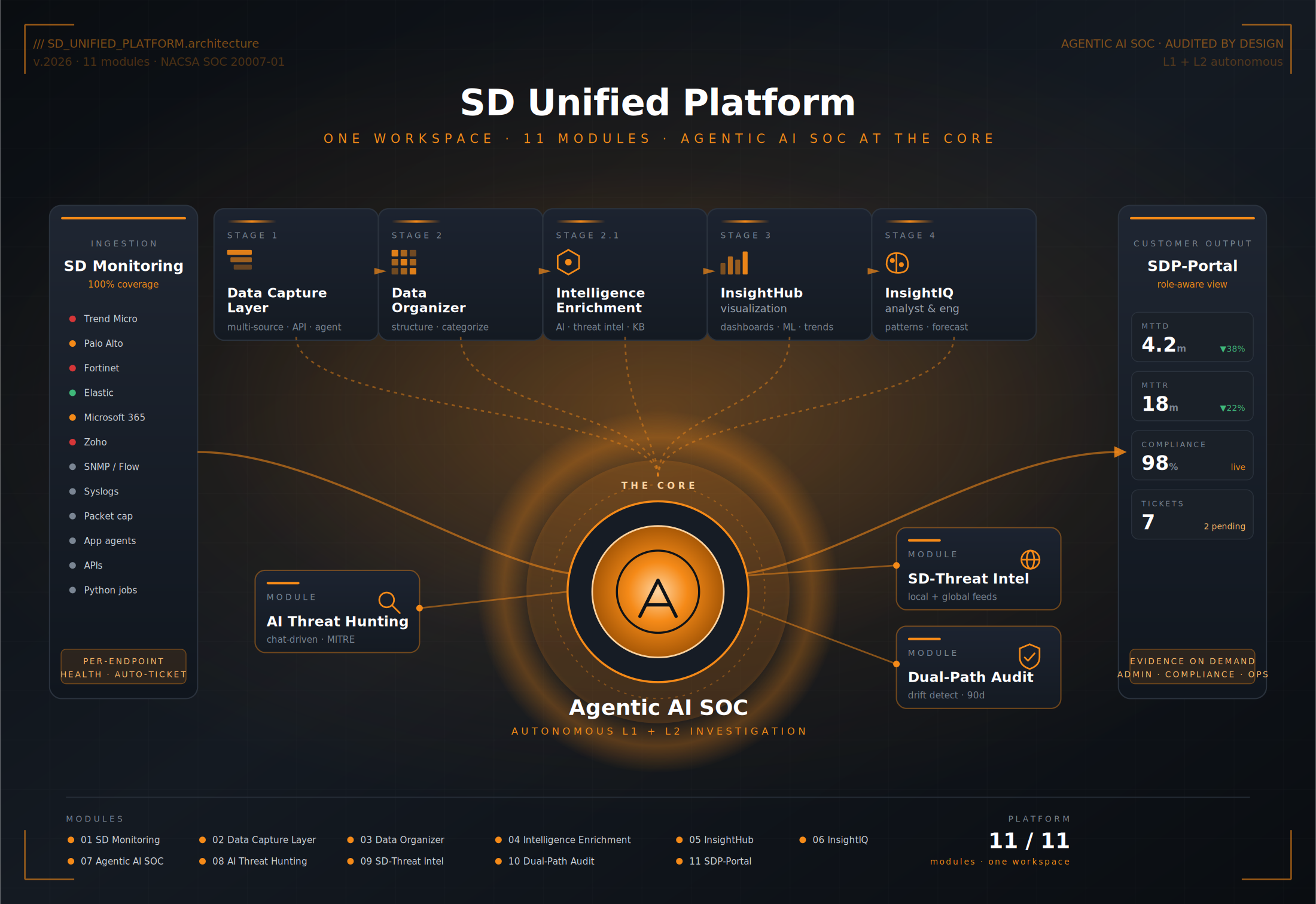

Agentic AI SOC at the Core
SD Unified Platform (SDP) is engineered around an Agentic AI SOC engine — autonomous AI agents that investigate every alert, draft full case packets, and either close or escalate with documented evidence. This is not "AI bolted onto a SIEM." SDP runs a three-tier model: L1 closes false positives and low-severity noise autonomously, L2 drafts the customer-facing investigation packet for senior analyst review, and L3 hunters drive ad-hoc investigations through the AI Threat Hunting chat interface.
Every AI decision is captured to two disjoint audit pipelines with per-call token rollup, prompt-hash drift detection, opt-in PII redaction (NRIC / passport / IBAN / email), and 90-day retention by default. This audit depth is rare even among global tier-1 MDR vendors — and it is exactly what BNM, NACSA, and PDPA auditors will ask for. Customer telemetry never leaves Malaysian-sovereign infrastructure. AI model calls are transient, routed through a single audited choke point. Operated under NACSA SOC Licence 20007-01.
Explore SDP Modules — Inside
SD Unified Platform
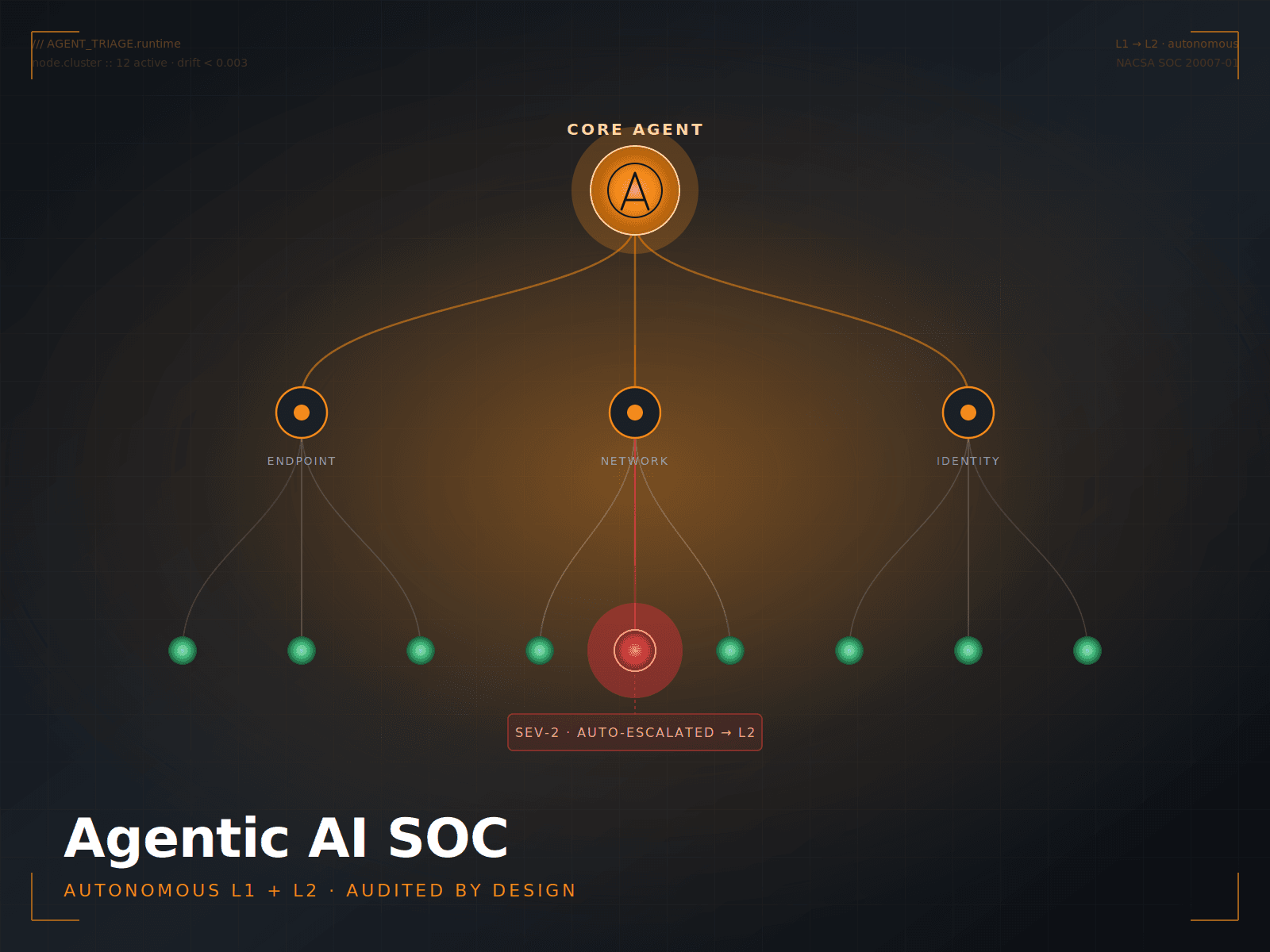
Agentic AI SOC
AI agents triage L1 alerts and draft L2 investigations autonomously. Every AI decision is captured to a dual-path audit log with prompt-hash drift detection. Operated under NACSA SOC Licence 20007-01.
View More
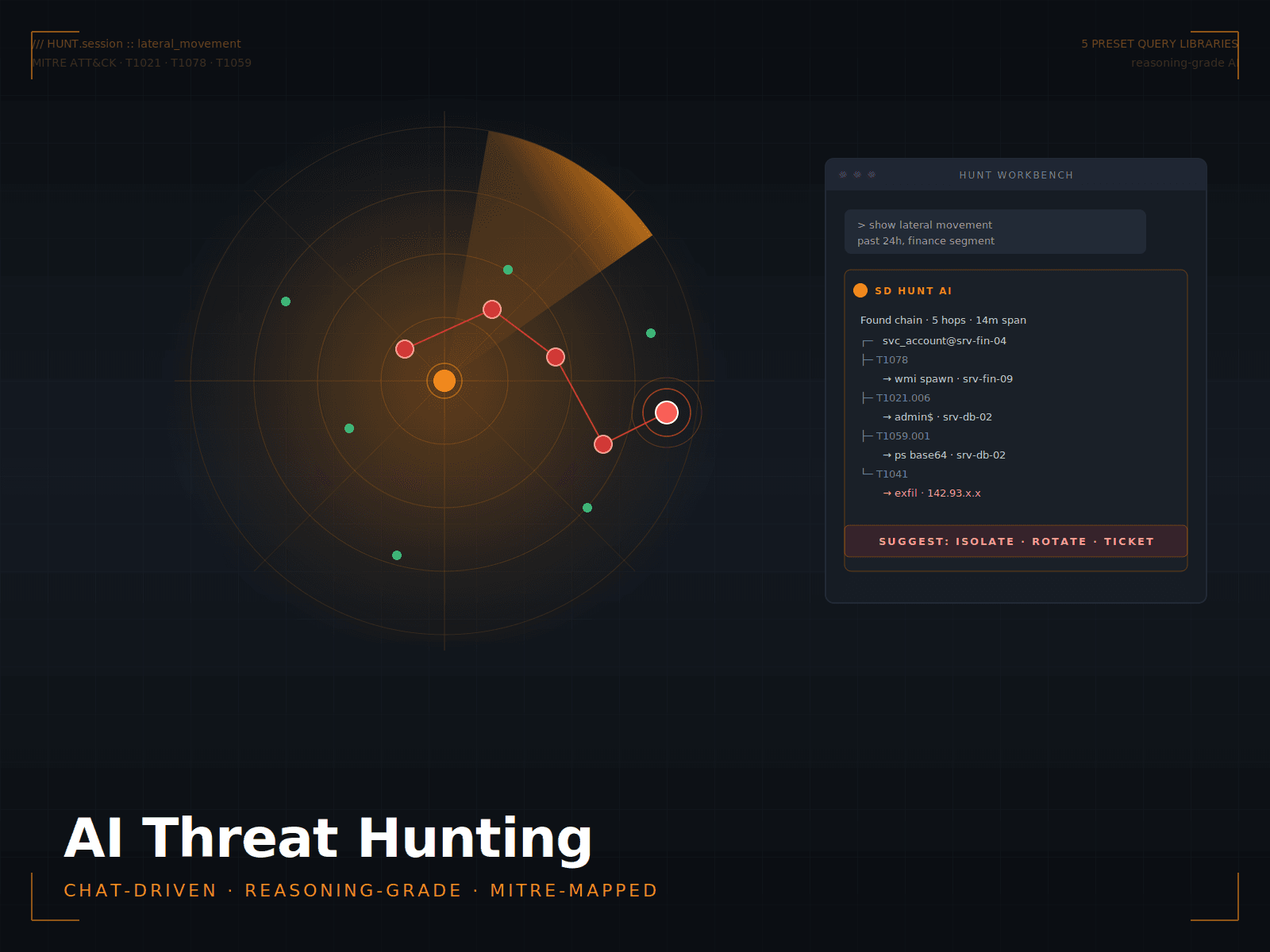
AI Threat Hunting
Chat-driven senior analyst workbench with five preset query libraries (Endpoint, Network, Identity, Threat Intel, MITRE ATT&CK). Reasoning-grade AI walks lateral-movement chains.
View More
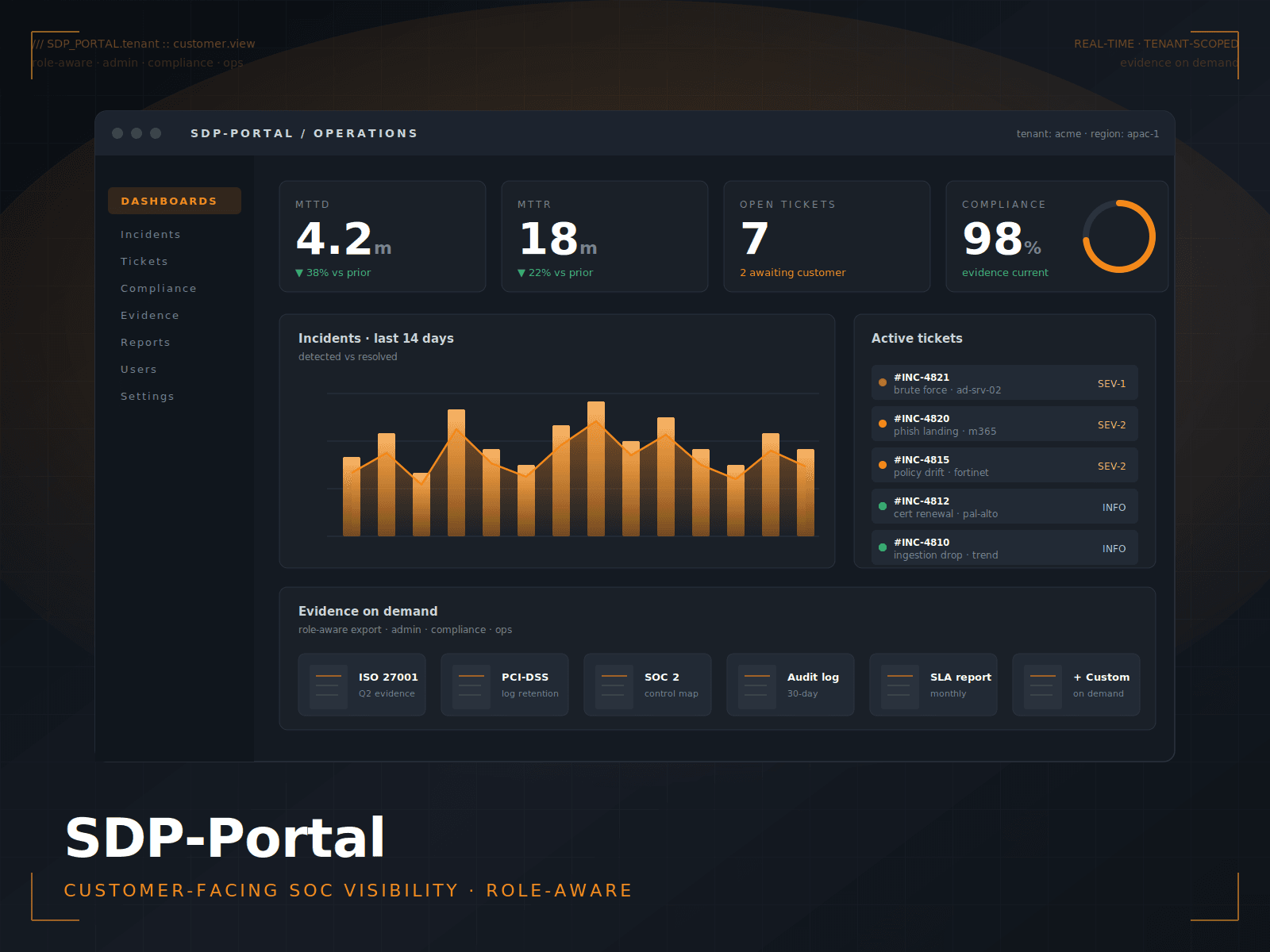
SDP-Portal
The customer-facing surface of SD Unified Platform. MTTD and MTTR dashboards, compliance evidence on demand, ticket lifecycle visibility, role-aware access for admins, compliance, and ops.
View More
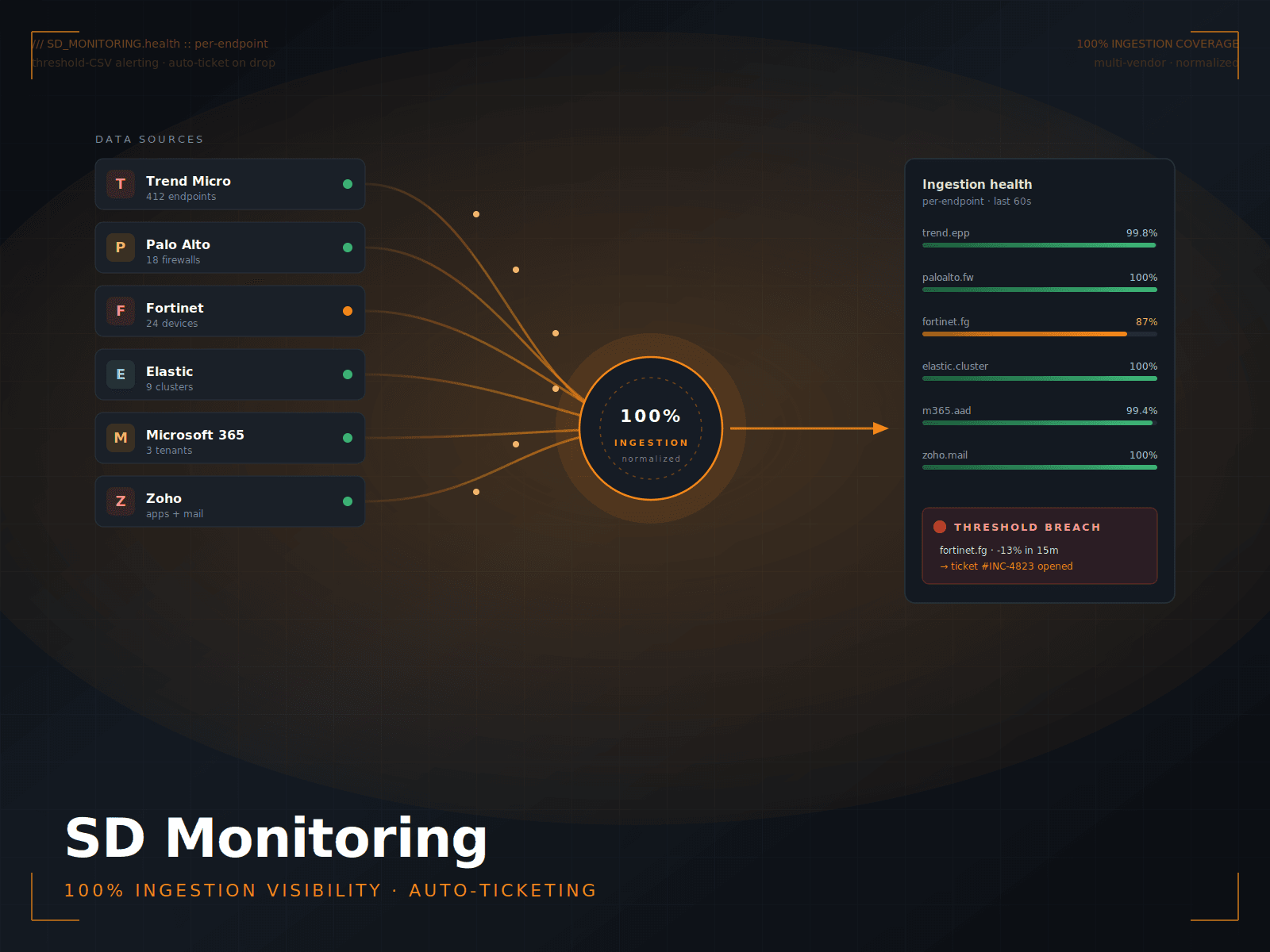
SD Monitoring
Per-endpoint ingestion health across Trend Micro, Palo Alto, Fortinet, Elastic, Microsoft 365, and Zoho. Threshold-CSV alerting auto-opens tickets on drop. 100% data ingestion.
View More
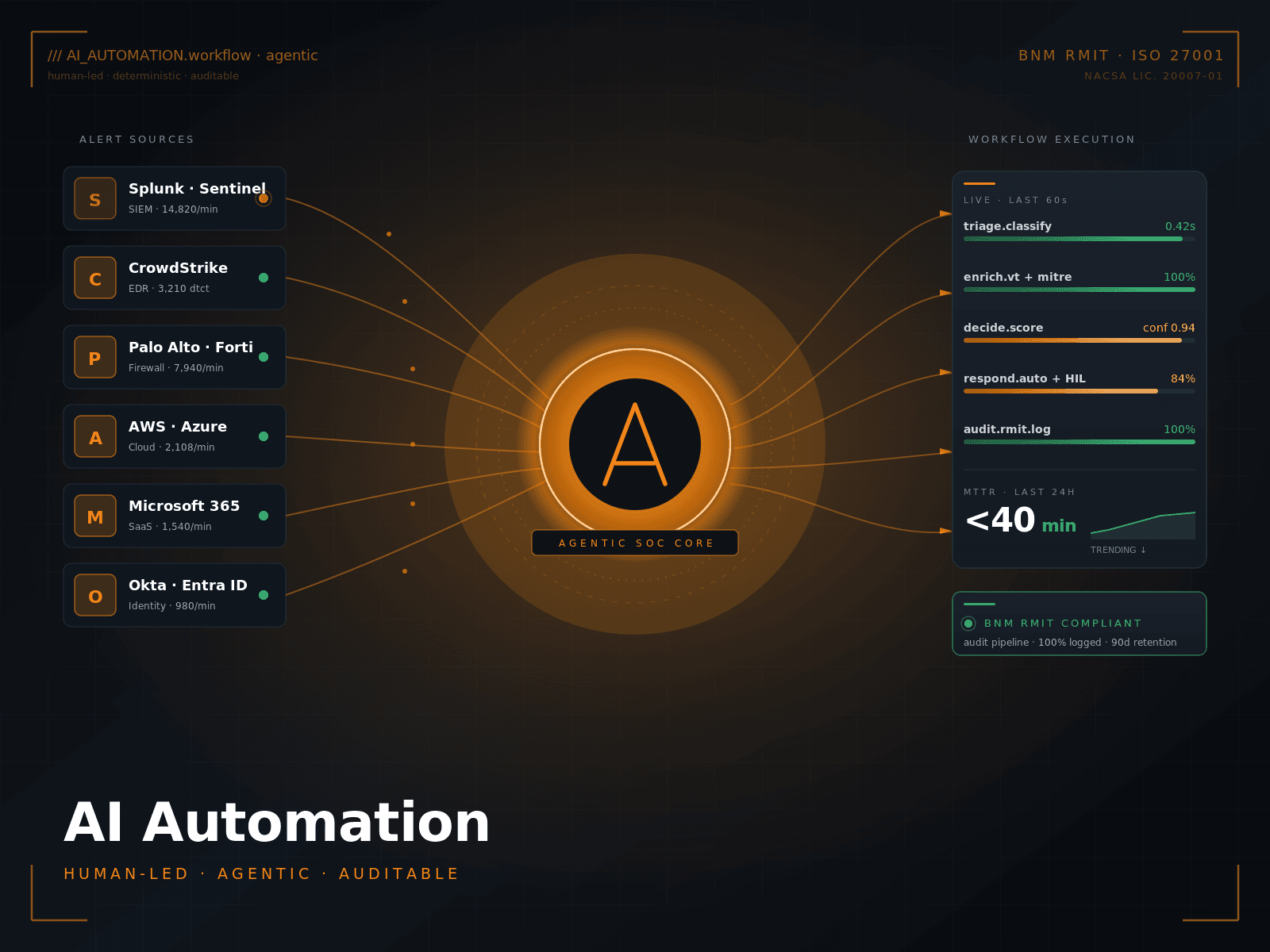
AI Automation
Intelligent, human-led security automation — SOC alert triage, compliance reporting, and agentic workflows.
View More
How SDP Turns Raw Telemetry Into Analyst Action
Data Capture Layer
SD Unified Platform collects telemetry from every security tool on your network — endpoints, firewalls, cloud platforms, identity systems, and applications. SNMP traps, syslog streams, API feeds, flow data, and application metrics all arrive in a single pipeline. No per-GB sampling, no dropped events. If a security tool generates it, SDP ingests it.
Stage 1: Data Capture Layer
Data Organizer
Raw telemetry from 20+ source types arrives in inconsistent formats. The Data Organizer normalizes every event to a consistent schema and tags it by asset, user, and source — so every downstream AI and analyst module works from the same clean, structured data. This is what makes vendor-agnostic detection possible without losing context across tools.
Stage 2: Data Organizer
Intelligence Enrichment Engine
Normalized events are enriched before any analyst sees them — asset criticality, user risk scores, and both local and global threat intelligence are layered onto every event. AI models score each event for anomaly likelihood. When an alert reaches your SOC, it already carries the context needed to decide quickly. False positive rates drop; confidence in true positives rises.
Stage 2.1: Intelligence Enrichment Engine
InsightHub
Enriched, scored data surfaces in InsightHub — the single pane of glass for SOC analysts, compliance officers, and customer admins. Real-time MTTD and MTTR dashboards, per-tool ingestion health, compliance evidence exports for BNM RMiT, PCI-DSS v4.0.1, and ISO 27001, and full alert timelines. Everything your team and your regulator need, in one place.
Stage 3: InsightHub
InsightIQ — Analyst Workbench
InsightIQ is where investigations happen. Analysts search enriched historical data, trace lateral-movement chains, run AI-assisted threat hunts using five preset query libraries, and build detection logic — without writing raw queries from scratch. Senior analysts work faster; junior analysts escalate more accurately.
Stage 4: InsightIQ (Analyst & Engineering)
Why SD Unified Platform
Most Malaysian MSSPs resell Splunk or Microsoft Sentinel. SDP is different — Simply Data built every module from first principles, fine-tuned for Malaysian regulated industries.
01.
SD Monitoring — 100% Data Ingestion Visibility
Per-endpoint ingestion health across Trend Micro, Palo Alto, Fortinet, Elastic, Microsoft 365, and Zoho. Threshold-CSV alerting auto-opens tickets when ingestion drops below baseline. 100% data ingestion — no per-GB charges, no sampling, no blind spots.
02.
SD Unified Platform — One Workspace, 11 Modules
11 SOC operational modules in one role-aware workspace — Security Command Centre (SCC), AI Threat Hunting, SOAR (Security Orchestration, Automation & Response), ASM-VA (Attack Surface Management & Vulnerability Assessment), VAPT Portal, Cyber Asset Management, Dashboards, SD Monitoring, Reporting, and SDP-Portal. Single RBAC (role-based access control), single audit trail, single compliance evidence pipeline.
03.
Agentic AI SOC — Autonomous L1 + L2 Investigation
AI agents triage alerts at L1, investigate at L2, and escalate to senior threat hunters at L3. Every AI decision is logged to two disjoint audit pipelines with prompt-hash drift detection and per-call token accounting. The AI audit depth BNM, NACSA, and PDPA auditors require.
04.
SDP-Portal — Customer-Facing SOC Visibility
The customer-facing surface of SD Unified Platform. Real-time MTTD and MTTR dashboards, compliance evidence on demand (PCI-DSS v4.0.1, BNM RMiT, ISO 27001:2022, NIST CSF 2.0, PDPA, CSA 854), ticket lifecycle visibility, and role-aware access for customer admins, compliance officers, and operational staff.
Benefits:
- Simpler Setup: One agent handles both security and performance monitoring.
- Cost-Effective: Only one agent is needed, reducing costs.
- Real-Time Data: •Provides both performance and security data in real-time for a complete view.
05.
Integrated SD-Threat Intelligence for Automated Remediation
Sovereign Malaysian threat intelligence integrated with SDP L1 automation. Real-time IP and URL reputation lookup on 100% of ingested logs. Automatic ticket creation with attached evidence when malicious indicators match. Zero customer telemetry leaves Malaysian infrastructure.
Why We Built the SD Unified Platform
Malaysian SOC teams are burning out. Analysts triaging 800+ alerts per shift on Splunk and Sentinel licences quoted in USD — while BNM RMiT, NACSA Act 854, and PDPA all tighten the rule that customer telemetry must stay on Malaysian soil. SD Unified Platform was built to answer all three pressures at once: autonomous L1 + L2 investigation that cuts analyst load, ringgit-denominated economics with no per-GB sampling, and sovereign Malaysian infrastructure that satisfies the regulator on day one. Unlike every other SOC platform in this market, every module was designed, built, and hosted entirely by the Simply Data engineering team in Malaysia.
Book Your SDP Demo Now
See the SD Unified Platform in action. Available now to Malaysian enterprises and regulated industries. SOC customers gain SDP-Portal access progressively from 23 June 2026 onward.
- B-03A-03, 3RD Floor, Block B Setiawalk, Persiaran Wawasan, Pusat Bandar Puchong, 47100 Puchong, Selangor
- +603 5886 2714
- contactus@simplydata.com.my
Frequently Asked Questions
SD Unified Platform (SDP) is Simply Data fully self-built, NACSA-licensed, CREST-accredited Agentic AI Security Operations Centre platform. SDP unifies 11 SOC modules — including Security Command Centre, AI Threat Hunting, SDP-Portal, and SD Monitoring — on sovereign Malaysian infrastructure.
SDP is now available. Existing SOC customers gain SDP-Portal access progressively from 23 June 2026 onward. Demos are available on request.
Yes. Simply Data operates SDP under NACSA SOC Licence 20007-01 and Pentest Licence 20007-02.
Yes. Simply Data penetration testing team operates under CREST accreditation with internationally peer-reviewed methodology.
SDP delivers evidence pipelines for PCI-DSS v4.0.1, BNM RMiT, ISO 27001:2022, NIST CSF 2.0, PDPA (Malaysia), and Cyber Security Act 2024 (CSA 854).
A SIEM is a log-search engine. SDP is a full Agentic AI SOC — it ingests telemetry, runs L1 and L2 triage autonomously, augments L3 hunting with reasoning-grade AI, and surfaces customer-facing dashboards and compliance evidence. SDP integrates with existing SIEMs such as Elastic rather than replacing them.
No customer data is stored outside Malaysia. SDP runs on Malaysian-sovereign infrastructure. AI model calls are transient and routed through a single audited choke point with opt-in PII redaction.
SDP integrates natively with Trend Micro, Palo Alto, Fortinet, Elastic, Microsoft 365, and Zoho, plus any source that exposes REST, syslog, or webhook surfaces via API.
SDP-Portal is the customer-facing self-service surface of SD Unified Platform. Customers see per-tenant MTTD/MTTR dashboards, ticket lifecycle, real-time monitoring health, and download compliance evidence on demand.
SD Monitoring is the data ingestion status module of SDP. It tracks per-endpoint ingestion health, vendor-agnostic source coverage, threshold-CSV alerting, hash blocking, isolation actions, and compliance auto-evidence collection.
Yes for L1 and L2. SDP agentic AI closes Tier-1 alerts autonomously and drafts Tier-2 investigation packets for senior analyst review. Tier-3 threat hunting is human-led with AI augmentation.
SDP captures every AI call across two disjoint audit pipelines with per-call token rollup, prompt-hash drift detection, and opt-in PII redaction. Retention is 90 days by default and configurable upward for regulated customers. This per-call audit depth is rare even among global tier-1 MDR vendors.
Yes. Every module of SD Unified Platform — from Agentic AI SOC to SDP-Portal — was designed, built, and is hosted entirely by the Simply Data engineering team in Malaysia. No customer telemetry is processed or stored outside Malaysia. SDP is Malaysia's first fully in-house-built Agentic AI SOC platform, not a rebrand of a foreign product.
Onboarding for new SOC customers typically completes within 4 weeks. Existing Simply Data SOC customers gain SDP-Portal access progressively from 23 June 2026. Agent deployment for endpoint telemetry ingestion takes 1–2 days per environment.