Cyber Incident Reporting Requirements in Malaysia: PDPA, NCII and BNM Clocks
You must assess cyber incident reporting requirements Malaysia separately: NCII entities report under the Cyber Security Act 2024, while PDPA and BNM duties depend on the organisation and incident. In 2026, identify each applicable regime before applying its notification trigger and deadline, using the NCII regulations, PDPA guideline and relevant BNM policies.
Which duties do cyber incident reporting requirements Malaysia cover?
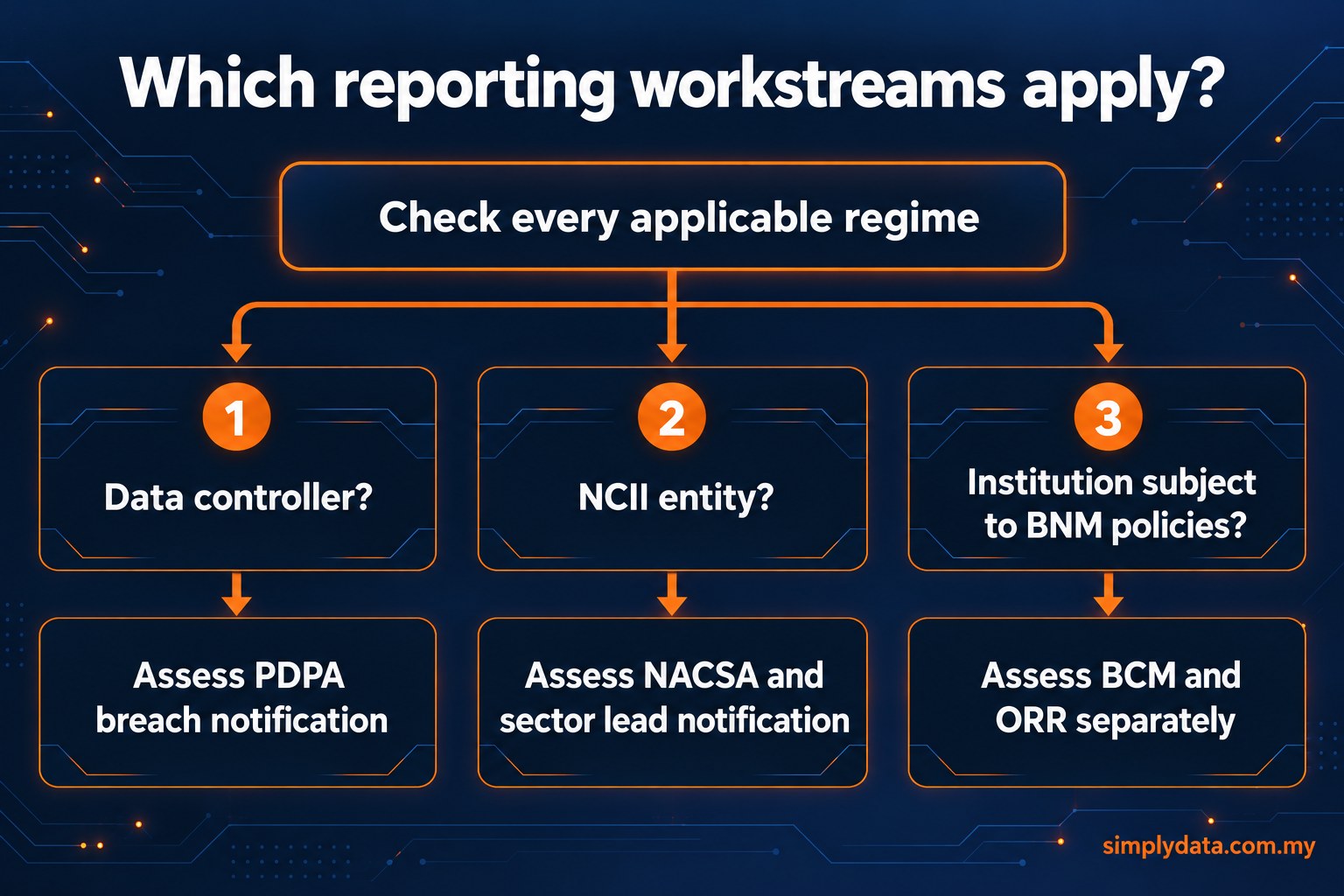
Start with the organisation’s regulatory status and the incident’s impact. The PDPA notification guideline addresses data controllers; the NCII notification regulations address NCII entities. Institutions must separately check applicability under the BNM BCM policy and ORR policy. Assess every applicable duty against the same incident record.
The Cyber Security Act 2024 is Act 854. NACSA identifies 11 NCII sectors. Confirm whether your organisation is an NCII entity rather than treating a sector description as the reporting decision. The Simply Data guide to the Cyber Security Act 2024 provides supporting context for that assessment.
Create an applicability register before an incident. Record the legal entity, the relevant policy or regulation, the assessment owner and the evidence supporting the decision. Revisit that register when operations or regulatory status change. During an incident, use it to open reporting tasks with named owners and alternates.
| Reporting workstream | Applicability check | Suggested internal owner |
|---|---|---|
| PDPA | Data controller and personal data breach assessment | Privacy or DPO function |
| NCII | NCII entity and cyber security incident assessment | NCII compliance owner |
| BNM BCM | Institution within the BCM policy’s scope | Business continuity and compliance |
| BNM ORR | Institution and event within the ORR policy’s scope | Operational risk and compliance |
What does the PDPA require after a personal data breach?
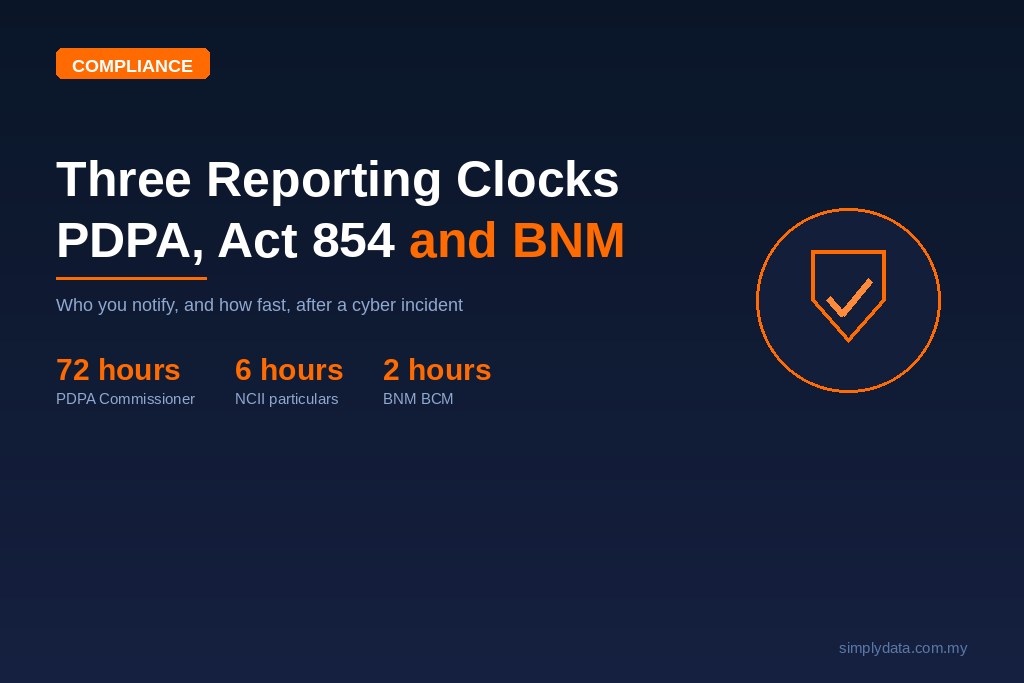
Under the PDPA, a data controller must notify the Personal Data Protection Commissioner of a personal data breach that causes or is likely to cause significant harm as soon as practicable and no later than 72 hours from the occurrence of the breach; the Commissioner’s Data Breach Notification Guideline explains that the clock starts when the controller is informed of, detects or confirms the breach (Commissioner’s Data Breach Notification Guideline).
Where the breach results in or is likely to result in significant harm to them, affected data subjects must be notified without unnecessary delay and no later than seven days after the notification to the Commissioner (same guideline).
Keep the Commissioner notification and affected-person communication as separate tasks. Record the harm assessment, its supporting evidence and the Commissioner submission timestamp. Prepare clear communications explaining the established impact and practical protective steps. Have the investigation team check technical statements before approval.
Failure to notify the Commissioner carries a fine of up to RM250,000, imprisonment of up to two years, or both under Act A1727. Preserve the reasoning behind the notification decision, including the evidence available to the decision-maker.
Give the privacy team access to discovery evidence. Keep the original alert, any external notification and the internal assessment as distinct chronology entries. The PDPA data breach notification guide for Malaysian organisations can support preparation of this workstream.
Cyber Security Act 2024 Malaysia: what do businesses need to do?
An NCII entity must notify NACSA and its NCII sector lead immediately once a cyber security incident becomes known, provide the prescribed particulars within six hours, and submit supplementary information within 14 days of the initial notification, under the Cyber Security (Notification of Cyber Security Incident) Regulations 2024.
Prepare the notification routes before an incident. Identify the responsible officer, an alternate, the communication channels and the information sources available to them. Keep the NACSA and sector lead contact arrangements accessible to the response team, including when normal systems are unavailable.
Build the reporting pack progressively. Separate established findings from working hypotheses, reference the evidence behind each statement and assign someone to investigate unanswered questions. Preserve earlier versions so reviewers can establish what the organisation knew when each submission was approved.
Keep a dedicated NCII reporting record. Track recipients, submissions, acknowledgements and outstanding information. Reconcile descriptions with privacy and operational risk reporting so the same technical finding is described consistently. Record the reason whenever later evidence changes an earlier account.
During an exercise, test whether the reporting owner can retrieve the prescribed information and use the escalation routes. Include an unavailable approver in the scenario. Check that the alternate understands their authority and can access the evidence needed to proceed.
What do BNM-regulated institutions report, and when?
Bank Negara Malaysia reporting depends on the policy document. Institutions subject to the Business Continuity Management policy notify BNM within two hours upon confirmation of a cyber incident disruption. Under the Operational Risk Reporting policy, cyber incidents and events, including near misses, are reportable within 14 calendar days of event confirmation, with any earlier applicable deadline taking precedence.
The BCM cyber incident notification requirement appears at S 10.5. Keep the applicable policy provision with the reporting task so the institution can trace its decision to the source. Record the confirmation evidence and the person responsible for assessing it.
Assign business continuity, operational risk and technical investigation contacts. Ask each reporting owner to document the applicable policy, the relevant confirmation evidence and submission status. Keep reporting routes and escalation authority accessible from the environment the team would use during an outage.
How should a playbook track each applicable reporting duty separately?
Use a shared incident identifier with separate regulatory tasks. Each task should state applicability, trigger evidence, recipient, owner, deadline basis and approval status. Link it to the technical investigation record. This lets reporting owners use common evidence while documenting their own assessments and decisions.
Preserve original timestamps and their time zones. Record the source, the person entering the information and any uncertainty. If later evidence changes the chronology, append the correction and explanation while retaining the earlier entry. Make the distinction between an event timestamp and an analyst’s interpretation visible.
Agree who can authorise submissions and who takes over during absence. Give each reporting owner a named technical contact. Prepare an escalation route for disagreements about scope, impact or wording. Document the decision reached and the evidence considered, with unresolved questions assigned to an investigation owner.
Exercise the hand-offs using a scenario involving unavailable systems, uncertain personal data exposure and an external alert. Ask participants to identify applicable duties and explain their trigger assessments. Check whether they can retrieve evidence and approval records using the access available during the exercise.
Use the incident response plan guide for Malaysian organisations to connect reporting tasks with containment, investigation, recovery and communications. After the exercise, assign improvement owners and verify that participants can use the revised contacts, evidence access and approval arrangements.
What evidence should your SOC capture in the first hours?
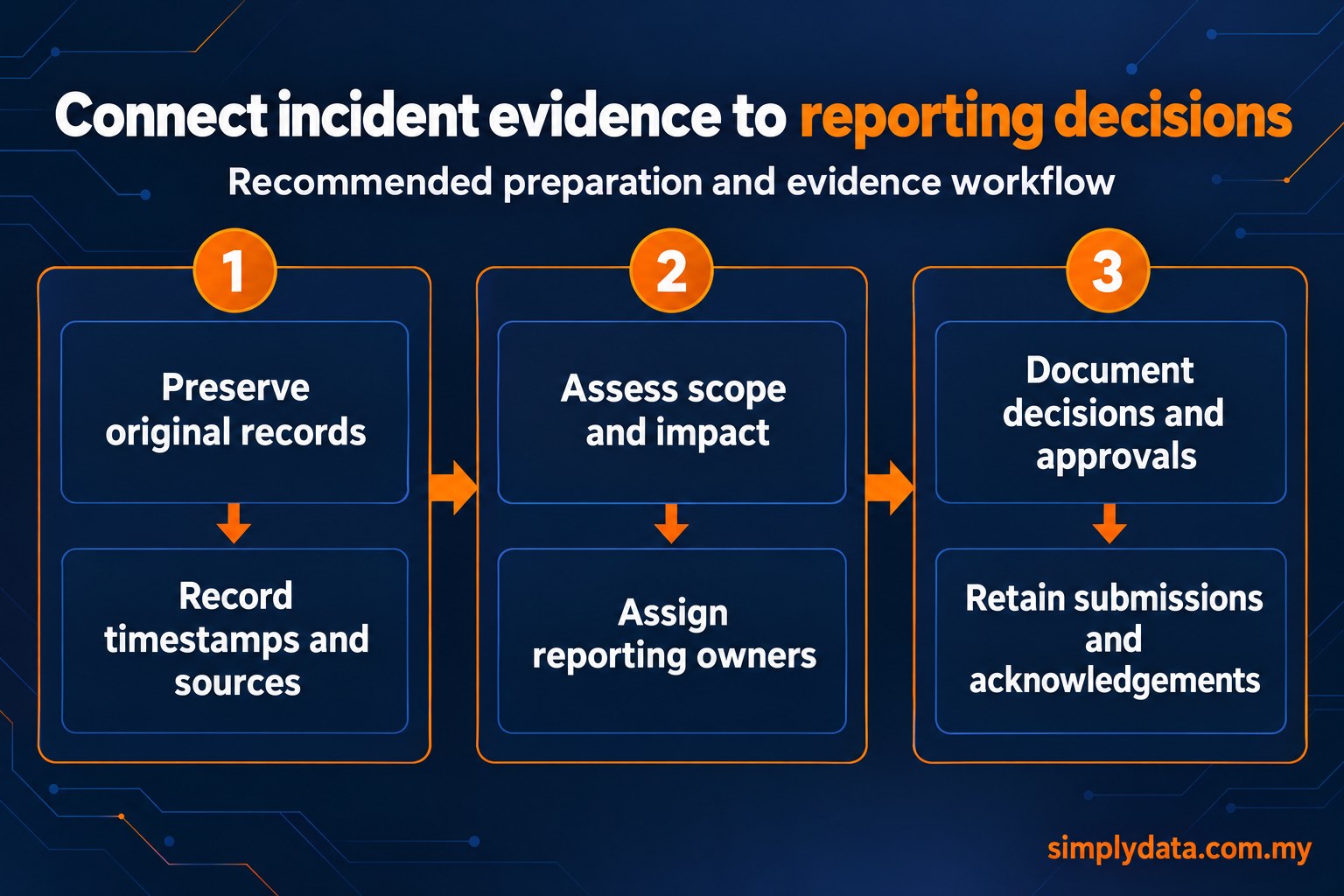
Capture evidence explaining discovery, scope and impact. Build a chronology showing what generated the alert, who received it, what investigators observed and when decisions were made. Preserve original records alongside analyst notes so reporting owners can trace conclusions to their sources.
Prepare an evidence pack that answers practical questions: which systems are affected, what disruption has been observed and what indicates personal data exposure? Label confirmed findings and open questions clearly. Link each material statement to its supporting record and identify who is investigating remaining uncertainty.
Useful material can include endpoint telemetry, network events, application logs, cloud audit records and external communications. Record how evidence was collected and who handled it. Control access and preserve the relationship between original material and exported working copies.
Coordinate collection with containment. Before changing a system, assess what evidence the action could remove and document the operational reason for acting. Give the response lead a clear route for resolving conflicts between investigative needs and service protection.
Simply Data provides 24×7 SOC monitoring under NACSA managed SOC monitoring licence 20007-01. See the Simply Data service overview. Teams preparing investigation arrangements can also explore cyber incident response services, with engagement scope, internal responsibilities and evidence access agreed during preparation.
Frequently asked questions
How many hours do I have to report a data breach in Malaysia?
Under PDPA, data controllers notify the Commissioner as soon as practicable, within 72 hours from occurrence, for breaches causing or likely to cause significant harm. The guideline explains that the clock starts when the controller is informed of, detects or confirms the breach. See the official guideline.
Does the 72-hour PDPA deadline apply to NCII entities as well?
NCII entities must assess data controller duties separately. Under PDPA, controllers notify the Commissioner as soon as practicable, within 72 hours from occurrence, for breaches causing or likely to cause significant harm; the guideline explains the informed, detected or confirmed trigger. NCII status requires a separate reporting assessment. See the PDPA guideline.
What is the 6-hour rule under the Cyber Security Act 2024?
An NCII entity must notify NACSA and its NCII sector lead immediately once a cyber security incident becomes known, provide the prescribed particulars within six hours, and submit supplementary information within 14 days of the initial notification, under the Cyber Security (Notification of Cyber Security Incident) Regulations 2024.
When must a bank notify Bank Negara of a cyber incident?
Bank Negara Malaysia reporting depends on the policy document. Institutions subject to the Business Continuity Management policy notify BNM within two hours upon confirmation of a cyber incident disruption. Under the Operational Risk Reporting policy, cyber incidents and events, including near misses, are reportable within 14 calendar days of event confirmation, with any earlier applicable deadline taking precedence.
Do I have to tell customers about a data breach in Malaysia?
Where the breach results in or is likely to result in significant harm to them, affected data subjects must be notified without unnecessary delay and no later than seven days after the notification to the Commissioner (same guideline).
Who can help us prepare for incident reporting under Malaysian law?
Simply Data provides cybersecurity compliance services, DPO and PDPA compliance support, tabletop exercises and incident response services. Explore Simply Data cybersecurity compliance services or contact Simply Data to discuss reporting ownership, applicability mapping and evidence preparation.
How can Simply Data help prepare your reporting playbook?
Simply Data Sdn. Bhd. is a Malaysian cybersecurity company. Preparation can bring together cybersecurity compliance services, DPO and PDPA compliance support, tabletop exercises and incident response services. Start with your applicability register and identify the reporting decisions, evidence access and internal hand-offs your team needs to test.
Prepare your reporting playbook with Simply Data cybersecurity compliance services and contact Simply Data to discuss applicability mapping, reporting ownership, evidence preparation and tabletop exercises for your organisation.