NACSA Threat Level Malaysia: 4 NCII Evidence Checks
NCII entities should obtain current preparedness instructions from their sector lead and organise dated evidence for each applicable control. This 2026 guide to the NACSA threat level Malaysia provides four practical evidence checks covering monitoring, patching, multi-factor authentication and service continuity, with suggested owners, records and supplier checks. Simply Data is a NACSA-licensed managed SOC provider.
NACSA threat level Malaysia: what should NCII entities do when it changes?
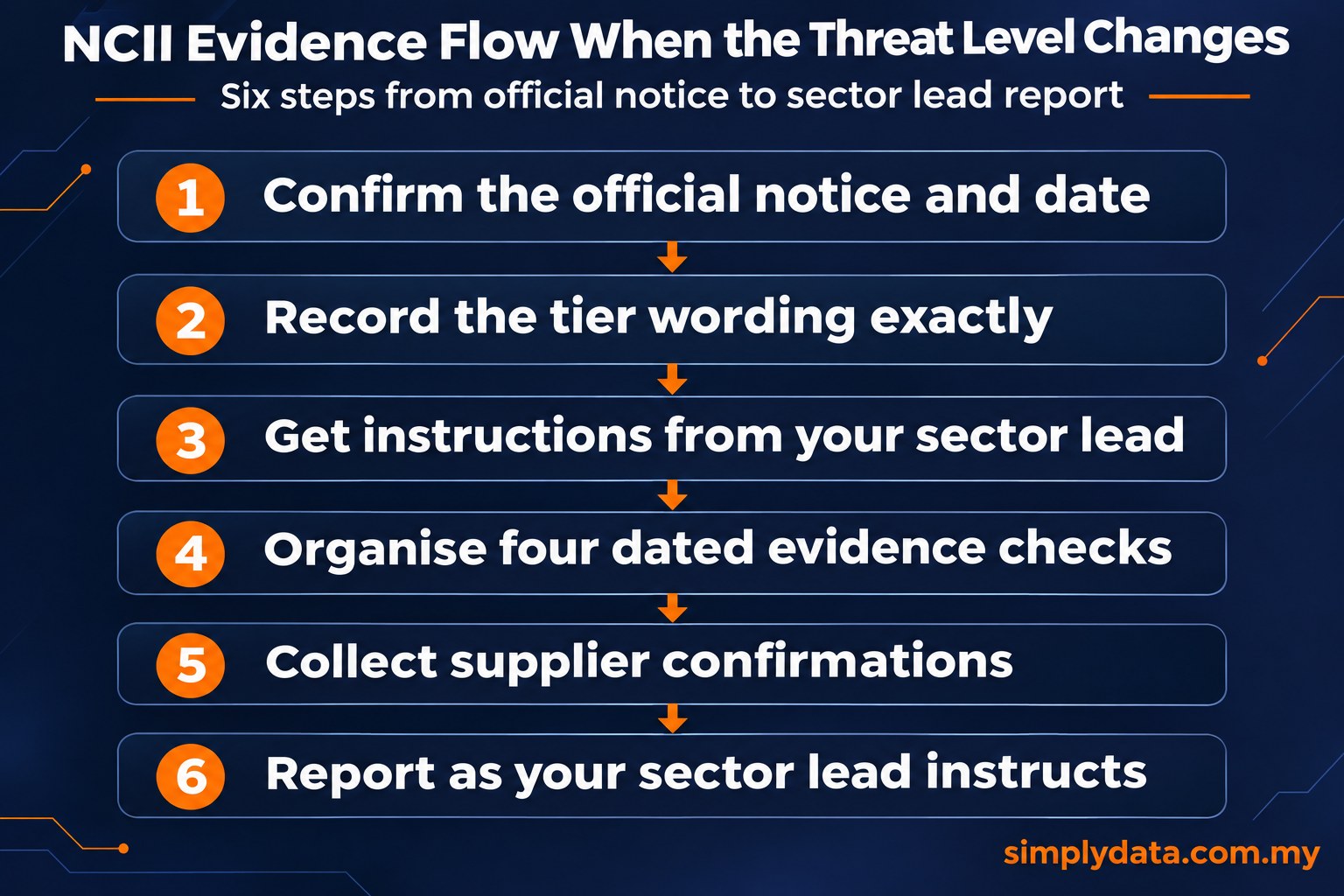
When the level changes, an NCII entity should do three things in order: confirm the official notice, obtain the preparedness instructions that apply to its sector, and organise dated evidence for each control those instructions cover. Records prepared in advance only need to be matched to the instruction, not created under pressure.
As of 13 November 2026, press reports dated 4 November 2026 say NACSA raised the national cyber security threat level. This guide does not restate the level, the tier wording or the official instructions. Copy those from the applicable official notice, and treat the four checks below as practical preparation, not as measures mandated by NACSA.
The legal backdrop is the Cyber Security Act 2024 (Act 854), in force since 26 August 2024. It covers 11 NCII sectors, including banking and finance, energy, transportation and healthcare services, as listed on the NACSA NCII page. Our guide to the Cyber Security Act 2024, NACSA licensing and penalties explains the wider Cyber Security Act 2024 NCII obligations.
A NACSA threat level Malaysia change is a prompt to test whether your records can answer one plain question from a sector lead: what is in place, who owns it and what proves it? If the answer takes days to assemble, the evidence register needs work.
Where should NCII entities confirm the current threat level and preparedness instructions?
Confirm the current level with three sources: NACSA, the National Cyber Coordination and Command Centre (NC4) and your NCII sector lead. NACSA lists the 11 NCII sectors on its official NCII page. Your sector lead is the route for the preparedness instructions that apply to your sector.
Record the tier wording exactly as it appears in the official notice, together with the notice date, the issuing body and the source. Do not rely on a headline or a forwarded message, because wording can differ between reports. One line in your evidence register is enough: level, wording, date, source and the person who checked it.
Treat each NACSA threat level Malaysia notice as a dated record. Re-check the national cyber security threat level Malaysia status on the day you report, note the time of the check, and keep a copy of the notice you relied on. If two sources use different words for the same tier, ask your sector lead which wording to use.
What are the four evidence checks for monitoring, patching, MFA and service continuity?
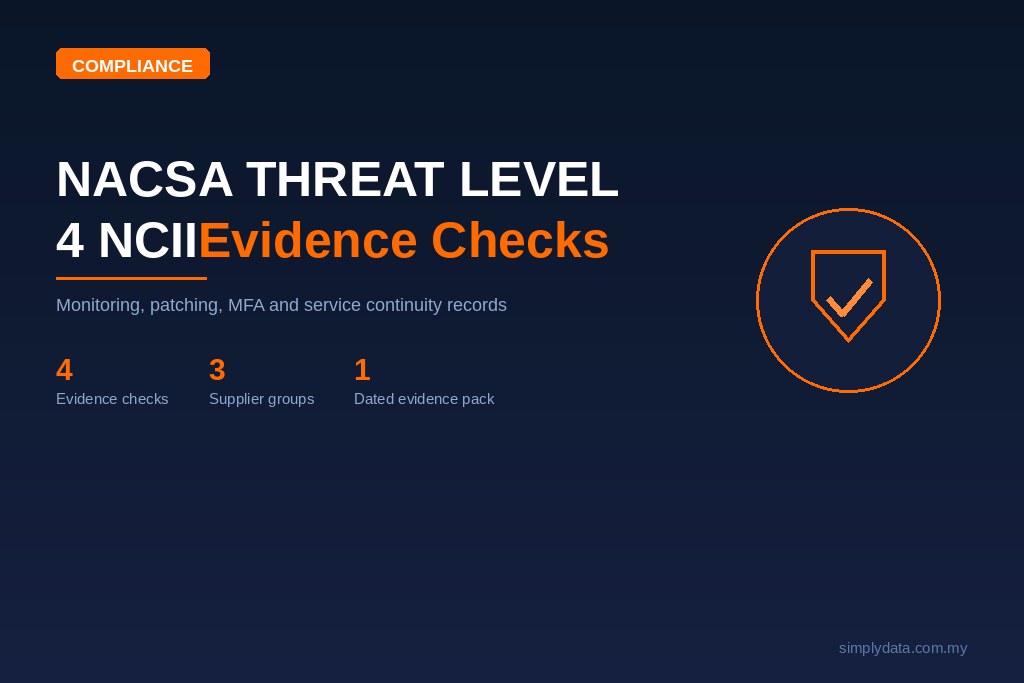
The four evidence checks are monitoring, patching, multi-factor authentication and service continuity. Each needs a named owner, a dated record and a supplier check. Together they form a practical NCII entity cybersecurity checklist that you can map to the instructions your sector lead issues. Use the table as a starting register for NCII preparedness evidence.
| Evidence check | Suggested owner | Records to organise | Supplier check |
|---|---|---|---|
| Monitoring | SOC manager or security operations lead | Monitoring hours and shift roster, log source inventory, alert and escalation records, on-call contact list | SOC provider confirms coverage hours, escalation contacts and licence number |
| Patching | IT operations or infrastructure lead | Asset inventory, patch SLA, latest vulnerability scan, patch status report, approved exceptions with dates | MSP confirms patch status for the systems it manages and its exception process |
| Multi-factor authentication | Identity and access management lead | MFA coverage report for privileged, remote and third-party accounts, exception list, last review date | Suppliers confirm MFA on the accounts they use to reach your systems |
| Service continuity | Business continuity manager | Current continuity and recovery plans, last test or exercise record, backup restore test, emergency contact tree | Providers and installers confirm continuity contacts and support arrangements |
Date every record and name the system it covers. A screenshot with no date, system name or owner is weak evidence. Export reports from the source tool where possible, and store them in one folder per check so that the next NACSA threat level Malaysia change does not start a new search.
For monitoring, check scope first. List which critical systems send logs to the SOC and which do not, then record the hours covered and who is on call. For patching, compare the patch status report with your own patch SLA and list each exception with its approver and review date.
For MFA, report coverage by account type instead of a single percentage, so privileged, remote and third-party access are each visible. For service continuity, check that the plan names current people and that the last test has a written result. Where coverage is incomplete, record the gap, the owner and the target date.
What reporting instructions should an NCII entity confirm with its sector lead?
Confirm five items with your sector lead before sending anything: the recipient, the frequency, the reporting period, the format and the deadline. NCII sector lead reporting arrangements are set by the sector lead, so obtain them in writing and file them with your evidence register.
- Recipient: the person or mailbox that receives the report, and who is copied.
- Frequency: how often a report is due while the level applies.
- Reporting period: the dates each report must cover.
- Format: the template, fields and file type required.
- Deadline: the day and time each report is due, and the contact for questions.
Keep preparedness reporting separate from incident notification, because the two have different triggers. Preparedness reporting follows the instruction from your sector lead. Incident notification follows the regulations and starts when an incident becomes known.
An NCII entity must notify NACSA and its NCII sector lead immediately once a cyber security incident becomes known, provide the prescribed particulars within six hours, and submit supplementary information within 14 days of the initial notification, under the Cyber Security (Notification of Cyber Security Incident) Regulations 2024.
Make sure the people who prepare status reports linked to the NACSA threat level Malaysia know who holds the incident notification duty and how to reach that person out of hours. Write both contact routes on the same page of the evidence register.
What preparedness evidence should NCII entities request from SOC providers, MSPs and installers?
Request written, dated confirmation from each supplier that touches a critical system. These are contractual and operational expectations that you set, not statutory duties on the supplier. Write them into the contract, the statement of work or a service letter so that the request is routine.
- SOC provider: coverage hours, log sources monitored, escalation contacts, the latest service report and the NACSA licence number.
- MSP: patch status and patch SLA for managed systems, administrator account list with MFA status, change and exception records.
- Installers and maintainers: remote access method, accounts held, MFA status and support contacts.
- All suppliers: a named contact while a heightened level applies, and their own continuity arrangements for the service they provide to you.
One licensing point is worth checking. Managed security operation centre monitoring and penetration testing are licensable services under the Cyber Security (Licensing of Cyber Security Service Provider) Regulations 2024, administered by NACSA. Keep the licence number with the SOC provider evidence for NCII entities in your register. Our article on choosing a NACSA-licensed cybersecurity service provider in Malaysia explains what to look for.
If monitoring is outsourced, ask what a managed detection and response (MDR) service can supply on request: monitoring scope, escalation records and regular reporting. Where the provider uses AI in alert triage, ask whether each AI decision is logged and retrievable.
Collect these confirmations before the next NACSA threat level Malaysia change, so that supplier evidence is already dated and on file. Refresh them when a contract renews, when a supplier changes its access method, or when your sector lead issues new instructions.
How do these checks fit with the annual risk assessment, two-yearly audit and BNM RMiT records?
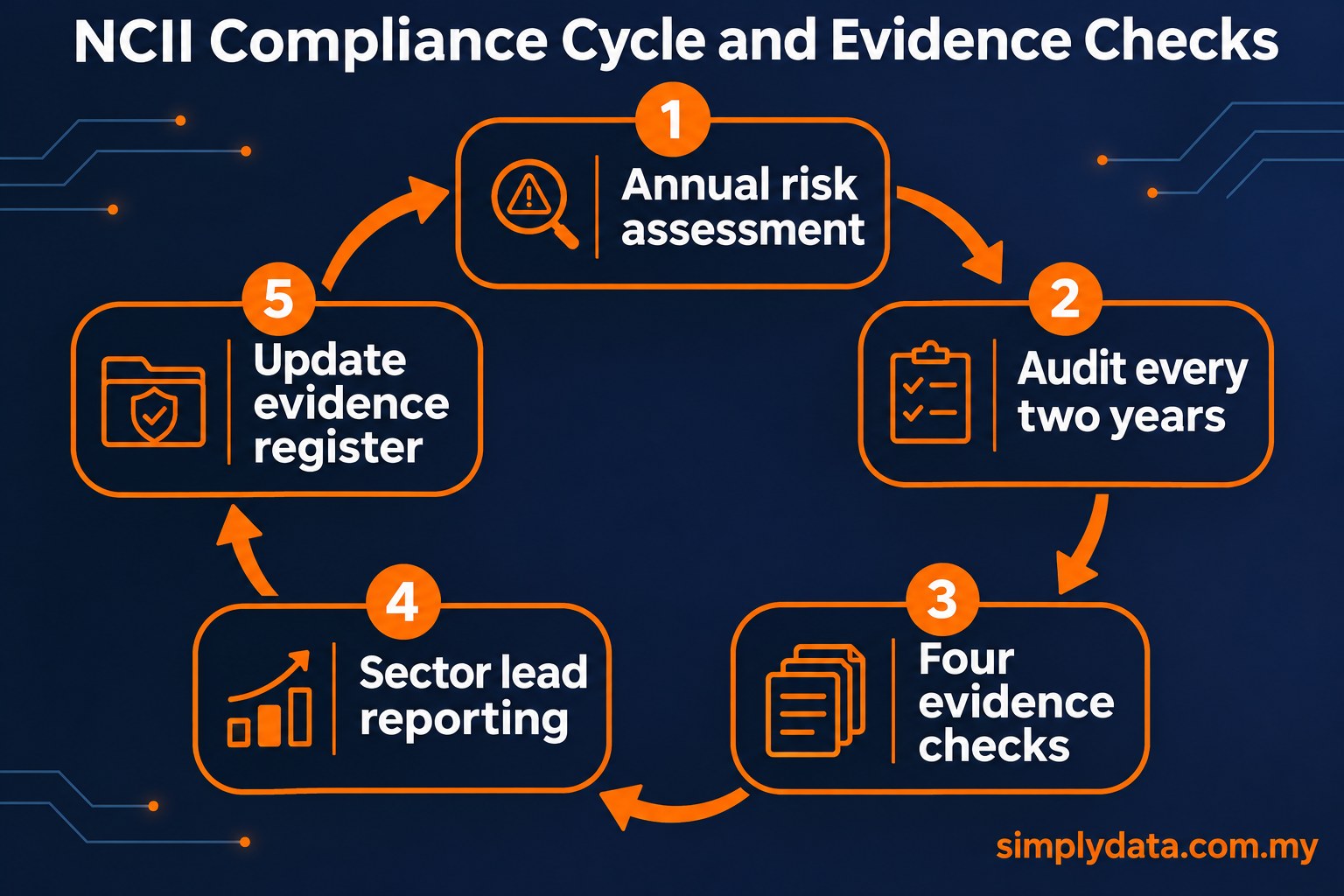
The four checks sit on top of the regular compliance cycle and do not replace it. An NCII entity must carry out a cyber security risk assessment at least once a year and a cyber security audit at least once every two years, or more often if directed by the Chief Executive of NACSA, under the Cyber Security (Period for Cyber Security Risk Assessment and Audit) Regulations 2024.
Reuse that work. The risk assessment already identifies critical systems and their owners, and audit findings show which gaps are open. Link each evidence check to the related risk register entry or audit finding, so one record serves more than one purpose.
Financial institutions hold further records under the Bank Negara Malaysia Risk Management in Technology policy document issued on 25 September 2026, which adds the NACSA-endorsed NCII Code of Practice as Appendix 12. S 11.9 and Appendix 5 Part C call for continuous, proactive cyber security monitoring through a SOC covering critical systems, with Appendix 5 Part C describing 24×7 operation, as set out in the RMiT policy document.
The same RMiT policy document requires relevant network device logs to be retained for at least three years (S 10.42), a quarterly vulnerability assessment of network components supporting critical systems (Appendix 5 Part D) and a red-team simulation at least every three years (S 11.6). Our BNM RMiT compliance guide for Malaysia covers these records in more depth.
For a regulated institution, the monitoring check maps to SOC records and the patching check maps to quarterly vulnerability assessment results. One evidence register can serve the sector lead instruction, the NACSA cycle and RMiT, provided each record is dated and owned. A NACSA threat level Malaysia change then becomes a retrieval exercise.
Frequently asked questions
What evidence can NCII entities prepare for monitoring, patching, MFA and service continuity?
NCII entities can prepare dated records for four checks: monitoring hours and log source coverage, patch status against the patch SLA, MFA coverage for privileged, remote and third-party accounts, and current continuity plans with test records. Give each record a named owner and map it to the instructions from your NCII sector lead.
What preparedness evidence should NCII entities request from SOC providers and MSPs?
NCII entities should request written, dated confirmation of monitoring coverage hours, escalation contacts, patch status for managed systems, MFA on supplier accounts and continuity contacts. These are contractual or operational expectations, not statutory duties on the supplier. For managed SOC monitoring, also record the NACSA licence number of the provider.
Where should NCII entities confirm the current threat level?
NCII entities should confirm the current threat level with NACSA, NC4 and their NCII sector lead. Copy the level from the applicable official notice with its date and source, and re-check it on the day you report. Do not rely on headlines or forwarded messages.
What reporting instructions should an NCII entity confirm with its sector lead?
An NCII entity should confirm five items with its NCII sector lead: the recipient, the frequency, the reporting period, the format and the deadline. Obtain them in writing and file them with the evidence register. Preparedness reporting is separate from statutory incident notification to NACSA.
How should an entity record the threat-tier wording?
An entity should record the threat-tier wording exactly as it appears in the applicable official notice, with the notice date, issuing body, source and the name of the person who checked it. If reports use different words for the tier, confirm the wording with your NCII sector lead.
How often must NCII entities carry out a cyber security risk assessment and audit?
An NCII entity must carry out a cyber security risk assessment at least once a year and a cyber security audit at least once every two years, or more often if directed by the Chief Executive of NACSA, under the Cyber Security (Period for Cyber Security Risk Assessment and Audit) Regulations 2024.
How can Simply Data help you organise preparedness evidence?
Simply Data Sdn. Bhd. is a Malaysian cybersecurity company that operates a 24×7 Security Operations Centre and provides managed SOC, MDR, VAPT, compromise assessment, incident response and tabletop exercises. These services produce the kinds of records the four checks call for: monitoring scope, escalation logs, vulnerability findings and exercise reports.
Simply Data holds NACSA managed SOC monitoring licence 20007-01 and NACSA penetration testing licence 20007-02, is certified to ISO/IEC 27001:2022, is CREST-accredited, and has a completed SOC 2 Type II report available under NDA on request.
In the Simply Data SOC, the SD Unified Platform AI analyst handles around 70% of alerts automatically, such as false positives and low-severity noise. The remaining around 30% go to Simply Data SOC analysts for review and investigation. Every AI decision in the SOC workflow is logged and retrievable for audit, which supports the monitoring check.
The effort involved depends on a few drivers: the number of critical systems and log sources, how many suppliers hold access, how current the asset inventory is, and how many separate regimes your organisation reports under. A clear scope at the start keeps the evidence register manageable.
To map your monitoring hours, patch SLA and MFA coverage against the four evidence checks and the instructions from your sector lead, explore the Simply Data Security Operations Centre services or contact Simply Data. The mapping gives you a dated gap list to review before the next NACSA threat level Malaysia notice; acceptance of evidence rests with your sector lead and NACSA.