
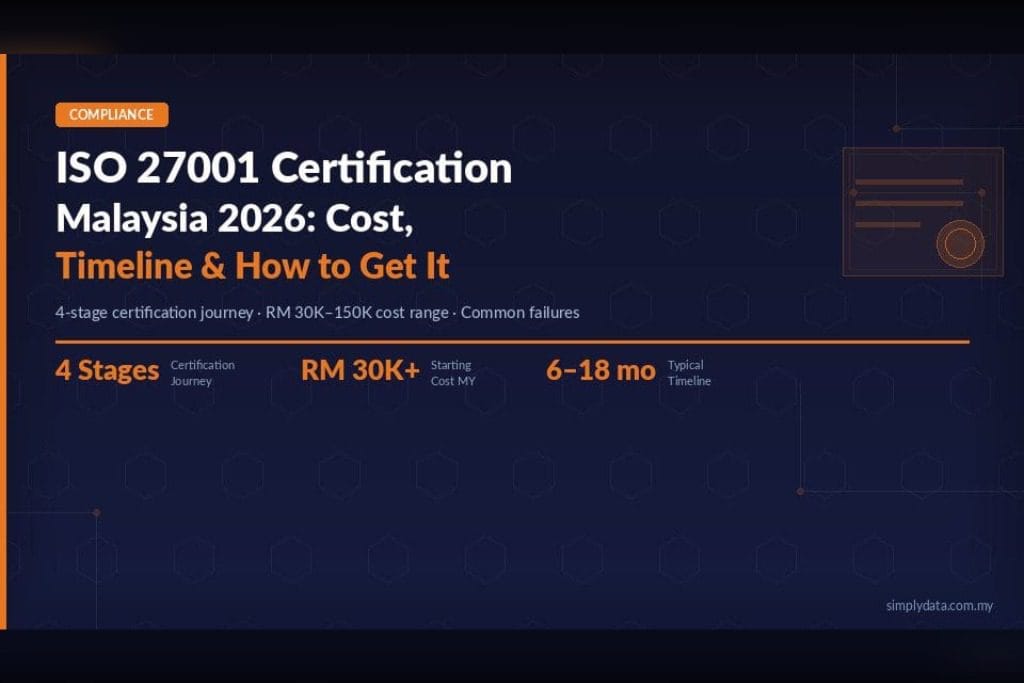
ISO 27001 Certification Malaysia 2026: Cost, Timeline & How to Get Certified
What Is ISO 27001?
ISO/IEC 27001:2022 is an international standard for information security management systems (ISMS). It provides a framework for establishing, implementing, maintaining, and continuously improving an organisation’s information security controls. ISO 27001 certification demonstrates to customers, partners, and regulators that your organisation has a mature, documented approach to protecting information assets.
Key Takeaways
- ISO 27001 is the international standard for Information Security Management Systems (ISMS) and is recognised by NACSA, BNM, and Malaysia’s Cyber Security Act 2024
- Certification typically takes 9–12 months and costs between RM 80,000 and RM 250,000 for Malaysian SMEs depending on scope
- The 2022 revision (ISO 27001:2022) replaced the 2013 edition and introduced 11 new controls across 4 themes
- ISO 27001 certification directly supports PDPA Security Principle compliance and BNM RMiT obligations
- Simply Data provides end-to-end ISO 27001 implementation and audit readiness support for Malaysian organisations
Why ISO 27001 Certification Matters for Malaysian Organisations
In Malaysia, ISO 27001 is widely recognised and often required by:
- Regulatory Bodies: Bank Negara Malaysia (BNM), SC Malaysia, and PDPC often reference ISO 27001 as a benchmark for adequate security controls.
- Procurement Departments: Government and corporate procurement processes increasingly require suppliers to be ISO 27001 certified.
- Customer Contracts: Large customers (multinational corporations, government agencies) often require their vendors to maintain ISO 27001 certification.
- Insurance and Risk Management: Cyber insurance providers offer better rates to certified organisations.
The ISO 27001 Certification Journey: 4 Stages
Stage 1: Initiation and Scoping (Months 1–2)
Define the scope of your ISMS — which departments, systems, and data will be included? For a typical Malaysian SME, the scope includes:
- All IT systems and network infrastructure
- Cloud services and SaaS applications
- All personnel with access to information assets
- All information categories (customer data, financial records, intellectual property)
Stage 2: Planning and Implementation (Months 3–8)
Conduct a gap analysis — compare your current security controls to ISO 27001 requirements. Address gaps by:
- Documenting information security policies
- Implementing required technical controls (access control, encryption, monitoring)
- Establishing governance structures (ISMS steering committee, roles and responsibilities)
- Developing an inventory of information assets
- Conducting a risk assessment to identify threats and vulnerabilities
- Selecting appropriate controls for identified risks
- Training all personnel on security policies and procedures
Stage 3: Internal Audit and Readiness (Months 9–10)
Conduct an internal audit to verify that controls are implemented and effective. Address any non-conformities identified in the audit. A third-party consultant typically facilitates this stage to provide an independent perspective.
Stage 4: Certification Audit (Month 11–12)
The certification body (accredited auditor) conducts a two-stage certification audit:
- Stage 1 (Planning): Review your documentation and readiness before the full audit.
- Stage 2 (Compliance Verification): Interview key personnel, review evidence of control implementation, and test controls to verify they are effective.
If all requirements are met, you are awarded ISO 27001 certification valid for 3 years. Annual surveillance audits (1–2 days) ensure ongoing compliance during the 3-year period.
ISO 27001 Requirements: The 14 Control Categories
ISO 27001:2022 defines 114 security controls across 14 categories:
| Category | Key Controls |
|---|---|
| A.5 Organisational Controls | Information security policies, governance, roles |
| A.6 People Controls | User management, security awareness training, supplier management |
| A.7 Physical Controls | Physical security of facilities, secure areas, equipment protection |
| A.8 Technological Controls | Cryptography, access control, logging, malware protection, network security |
Cost of ISO 27001 Certification in Malaysia (2026)
Realistic cost expectations for Malaysian organisations:
- Consulting and Gap Analysis: RM 15,000–30,000 (initial assessment)
- Implementation Support: RM 50,000–150,000 (implementation of controls, documentation, training)
- Certification Audit: RM 20,000–50,000 (audit fees, typically varies by organisation size)
- Annual Surveillance Audits: RM 10,000–20,000 per year
- Total First-Year Cost: RM 95,000–250,000
- Cost for Small SMEs (<50 staff): RM 80,000–130,000
- Cost for Mid-size (50–500 staff): RM 150,000–300,000
- Cost for Large (>500 staff): RM 300,000–600,000+
While the cost is significant, the ROI is typically positive within 2–3 years due to avoided breaches, regulatory compliance, and customer confidence.
Common ISO 27001 Audit Failures and How to Avoid Them
Based on audit experience, organisations commonly fail on:
- Incomplete Documentation: Policies and procedures must be comprehensive and approved by management. Update documentation regularly.
- Lack of Evidence: Auditors need evidence that controls are actually implemented and working. Maintain records of control testing, audit logs, training attendance, etc.
- Inadequate Risk Assessment: Your risk assessment must be thorough and documented. Identify risks, assess likelihood and impact, and select controls to mitigate.
- Poor Access Control: One of the most common failures. Implement strict user access controls, periodic access reviews, and prompt removal of excessive privileges.
- Insufficient Logging and Monitoring: All security-relevant events must be logged and reviewed. Auditors will ask for evidence of log review and incident response.
- Weak Change Management: Changes to IT systems must be controlled and documented. All changes must be tested and approved before deployment.
ISO 27001:2022 vs ISO 27001:2013 — What Changed?
The most recent version of the standard, ISO 27001:2022, replaced the 2013 edition and introduced significant changes that Malaysian organisations must understand if they are pursuing or renewing certification:
- New Control Structure: Annex A was reorganised from 14 control categories and 114 controls to 4 themes (Organisational, People, Physical, and Technological) with 93 controls total.
- 11 New Controls: The 2022 revision introduced 11 brand-new controls including Threat Intelligence, Cloud Services Security, ICT Readiness for Business Continuity, Physical Security Monitoring, Data Masking, Data Leakage Prevention, Web Filtering, Secure Coding, and Configuration Management.
- Transition Deadline: Organisations certified to ISO 27001:2013 had until October 2025 to transition to the 2022 standard. Any new certifications issued from 2024 onwards are to the 2022 standard only. Malaysian organisations that certified under the 2013 standard during this window must have completed their transition by their last surveillance audit date before October 2025.
- Alignment with Other Frameworks: ISO 27001:2022 is better aligned with ISO 27002:2022 (code of practice), ISO 27701 (privacy), and NIST Cybersecurity Framework, making dual-framework implementations more efficient.
If you certified under ISO 27001:2013 and have not yet completed your transition audit, contact Simply Data immediately — expired 2013 certifications may not be accepted by clients, regulators, or government tender processes.
Maintaining ISO 27001 Certification: Surveillance Audits and Recertification
ISO 27001 certification is not a one-time achievement. It requires ongoing commitment through a structured three-year audit cycle:
Year 1: Initial Certification Audit
The certification body conducts a Stage 1 (documentation review) and Stage 2 (on-site assessment) audit. Upon successful completion, you receive your ISO 27001 certificate, which is valid for three years subject to continued compliance.
Year 2 and Year 3: Surveillance Audits
Annual surveillance audits verify that your ISMS remains effective and continues to meet the standard’s requirements. These audits are typically shorter than the initial certification audit but still require evidence of continuous improvement, management review outcomes, internal audit results, and corrective action closure. Failure to maintain surveillance audit compliance can result in suspension or withdrawal of your certificate.
Year 3: Recertification Audit
At the end of the three-year cycle, a full recertification audit is conducted. This is similar in scope to the initial certification audit and renews your certificate for a further three years. Organisations that invest in continuous ISMS improvement and maintain their non-conformance registers throughout the cycle typically find recertification audits significantly smoother than the initial audit.
ISO 27001 Implementation Checklist for Malaysian Organisations
Use this checklist to assess your readiness for ISO 27001 certification:
- ☐ Management Commitment: Senior leadership has formally endorsed the ISMS project with a signed policy and allocated budget
- ☐ Scope Definition: ISMS scope documented, including organisational units, locations, and information assets in scope
- ☐ Risk Assessment Methodology: Documented risk assessment process with defined risk criteria, risk acceptance levels, and risk owners
- ☐ Asset Inventory: Complete inventory of information assets with classifications (public, internal, confidential, restricted)
- ☐ Risk Treatment Plan: All identified risks mapped to Annex A controls with documented treatment decisions
- ☐ Statement of Applicability (SoA): All 93 Annex A controls documented with applicability justification and implementation status
- ☐ ISMS Policies: Information security policy, acceptable use policy, access control policy, and incident response policy drafted and approved
- ☐ Staff Awareness Training: All in-scope staff have completed ISO 27001 awareness training and signed security policy acknowledgement
- ☐ Internal Audit Programme: At least one complete internal audit cycle completed prior to certification audit
- ☐ Management Review: Formal management review meeting conducted with documented outputs and action items
- ☐ Corrective Action Register: All non-conformances from internal audit logged with root cause analysis and closure evidence
- ☐ Supplier Security Assessments: Key suppliers and third-party processors assessed against security requirements
Organisations that score 10 or more on this checklist are typically ready to engage a certification body for their Stage 1 audit. If you score below 8, a structured gap assessment and implementation programme is recommended first.
ISO 27001 for Malaysian SMEs: Is It Worth It?
A common concern among Malaysian small and medium enterprises is whether ISO 27001 certification is worth the investment — given the cost, time, and internal resource commitment required. The answer depends on your business context, but for many Malaysian SMEs the business case is compelling:
- Client and Tender Requirements: Government contracts, GLCs, and large enterprises increasingly mandate ISO 27001 as a minimum security requirement for vendors and service providers. Without certification, your business may be disqualified from significant procurement opportunities.
- NACSA Licensing: Under the Cyber Security Act 2024, certain cybersecurity service providers require NACSA licensing, and ISO 27001 certification is a recognised qualification criterion that simplifies the licensing process.
- Cyber Insurance: Many cyber insurers in Malaysia offer preferential premiums to ISO 27001 certified organisations, as certification demonstrates a mature risk management posture.
- Right-Scoping for SMEs: ISO 27001 does not require certification of your entire organisation. SMEs can scope their ISMS to a specific business unit, product, or service — significantly reducing the cost and complexity of certification while still delivering the business benefit.
Simply Data helps Malaysian SMEs design right-scoped ISO 27001 implementation programmes that balance business benefit against implementation cost — achieving certification in as little as six months for well-scoped engagements.
Simply Data ISO 27001 Support
Achieving ISO 27001 certification is a significant undertaking, but you don’t have to do it alone. Our team has supported dozens of Malaysian organisations through certification. Contact us to discuss your ISO 27001 certification roadmap and the support Simply Data can provide.
ISO 27001 and Malaysian Regulatory Alignment
ISO 27001 certification in Malaysia supports compliance with multiple local regulatory frameworks. NACSA (National Cyber Security Agency Malaysia) recognises ISO 27001 as a benchmark cybersecurity standard for CNII entities and licensed cybersecurity service providers under the Cyber Security Act 2024. Holding ISO 27001 certification can expedite NACSA licensing applications.
MyCERT (Malaysia Computer Emergency Response Team) recommends ISO 27001’s incident management controls (Annex A.5.24–5.28) as best practice for Malaysian organisations’ incident response capabilities. Aligning your ISMS with MyCERT reporting requirements also fulfills ISO 27001’s interested-party obligations under Clause 4.2.
What is the difference between ISO 27001 and ISO 27002?
ISO 27001 is the certifiable standard that specifies the requirements for establishing, implementing, maintaining, and continually improving an Information Security Management System (ISMS). ISO 27002 is a companion code of practice that provides guidance on implementing the Annex A controls referenced in ISO 27001. Organisations get certified to ISO 27001 — not ISO 27002. ISO 27002 is used as an implementation guide by practitioners. The 2022 revision updated both standards simultaneously to ensure alignment.
Does ISO 27001 certification help with PDPA compliance in Malaysia?
Yes — significantly. The PDPA’s Security Principle requires data processors to take practical steps to protect personal data from loss, misuse, modification, unauthorised or accidental access, disclosure, or other adverse effects. ISO 27001 certification provides a documented, audited framework that directly satisfies the Security Principle’s requirements. While ISO 27001 does not guarantee PDPA compliance (which also requires legal and operational measures such as consent management and privacy notices), it is widely accepted by the PDPC and by clients as evidence that an organisation takes data security seriously. For organisations also subject to BNM RMiT, ISO 27001 provides a strong foundation that significantly reduces the effort required to satisfy RMiT’s technical security requirements.