Skip to content
  • Case Studies
  • Cybersecurity Readiness Assessment
simply data logo
  • About
    • About Us
    • Innovation
      • SD Platform Overview
    • Certifications & Awards
  • Our Services
    • CyberSecurity Services
      • DFIR (Digital Forensics and Incident Response)
      • Compromise Assessment
      • Security Operations Center (SOC) Managed Service
        • SD-Cyber Deception
        • Threat Intelligence
        • Managed Detection and Response (MDR)
        • Cloud Security Posture Management (CSPM)
        • Web Defacement Monitoring
        • In-house Automation Script Development
        • Advanced Malware Analysis & Threat Intelligence
        • Office 365 Monitoring
        • SaaS Monitoring
      • Extended Threat Intelligence
        • Dark Web Monitoring
        • Attack Surface Management
        • Cyber Risk Management
        • Supply Chain Intelligence
      • Security Posture Assessment (SPA)
      • VAPT & Penetration Testing
      • Network & Security Configuration Audit & Hardening
      • Phishing Email Simulation
    • Managed Network & Security Services
    • Application Performance Monitoring (APM)
      • APM as a Service (APMaaS)
      • Cloud Monitoring
      • Database Performance Monitoring
      • Web Application Monitoring
      • Synthetic Testing Monitoring
      • Real User Monitoring (RUM)
      • Application Stress Test / Load Test Services
    • Consultancy Services
      • NCSB Risk Assessment
      • Security BluePrint™ Consultancy Services
    • Agentic AI & Automation
      • SD Unified Platform (SDP)
      • Agentic AI SOC
      • AI Automation
      • SD Monitoring — 100% Data Ingestion Visibility | SD Unified Platform
      • SDP-Portal — Customer-Facing SOC Visibility | SD Unified Platform
      • AI Threat Hunting — Chat-Driven Investigation by SD Unified Platform
    CyberSecurity Services
    • VAPT & Penetration Testing
    • Cyber - 911 - DFIR Services
    • Compromise Assessment
    • Security Operations Center (SOC)
    • Extended Threat Intelligence
    • Security Posture Assessment (SPA) Services
    • Network & Security Configuration Audit & Hardening
    • Phishing Email Simulation
    • AI Automation
    Managed Network & Security Services
    • Managed Network & Security Services
    Consultancy Services
    • NCSB Risk Assessment
    • Security BluePrint™ Consultancy Services
    Agentic AI & Automation
    • SD Unified Platform
    • Agentic AI SOC
    • AI Automation
    • SD Monitoring
    • SDP-Portal
    • AI Threat Hunting
    Application Performance Monitoring
    • APM as a Service (APMaaS)
    • Cloud Monitoring
    • Database Performance Monitoring
    • Web Application Monitoring
    • Synthetic Testing Monitoring
    • Real User Monitoring (RUM)
    • Stress Test / Load Test – Performance Assessment

    Not Sure What Security Threats Your Organization is Facing?

    We can help. Contact us now for a free consultation and protect your business from potential risks.

    Contact Us
  • Technology Vendor Partners
  • Blog & News
  • Contact
    • Contact Us
    • Become a Simply Data Partner

Under Attack?

Submit your message through our contact form or call us at +603 5886 2714.

    Industry Insights & Trends

    Proactive SOC vs Agentic SOC: Why Malaysian Businesses Should Ask a Different Question
    June 7, 2026
    Proactive SOC vs Agentic SOC

    Home – Proactive SOC vs Agentic SOC: Why Malaysian Businesses Should Ask a Different Question

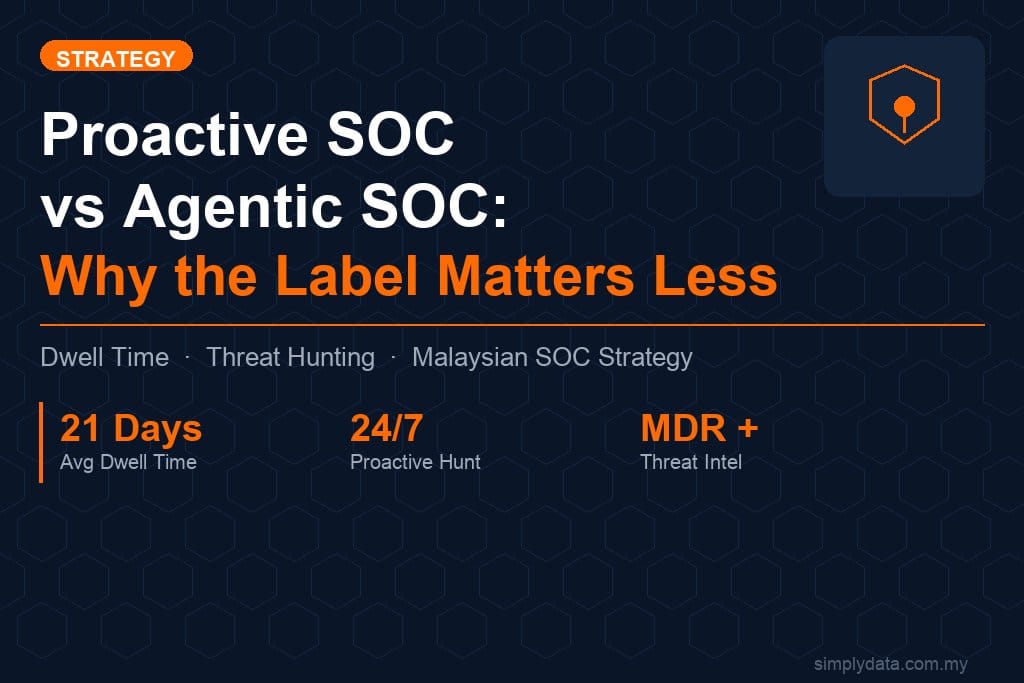
    A proactive SOC eliminates attacker dwell time before an alert is ever generated — by hunting for threats continuously, running compromise assessments, and closing exposure windows before they are exploited. An agentic SOC automates response after detection. Both matter, but Malaysian businesses facing 21-day average dwell times in the banking sector need to ask the earlier question first: how do we stop the attacker from staying hidden long enough to cause damage?

    What the 21-Day Dwell Time Statistic Actually Tells You

    Industry data reported in regional media has put average attacker dwell time in the Malaysian banking sector at 21 days. That number gets cited as a benchmark for SOC performance. But read it carefully: 21 days is how long attackers remain inside a network *after they have already breached it* — and before they are discovered.

    It is not a measure of how quickly a SOC responds once alerted. It is a measure of how long detection is failing.

    The implication is uncomfortable. If your SOC is measuring itself by mean-time-to-respond, it is answering the wrong question. The attacker is already inside. Lateral movement, credential harvesting, and ransomware staging happen in the gap between entry and first alert — the gap that the 21-day figure actually measures.

    The Detection Trap: Why Faster Alerts Still Leave a Window Open

    Agentic SOC platforms are genuinely impressive. AI-driven alert triage, automated playbook execution, and machine-speed incident correlation compress response time significantly once a threat is detected. That compression matters.

    But it does not close the pre-alert window.

    Think of it this way: a faster fire alarm does not make your building fireproof. It tells you the fire has started. A proactive security posture — the equivalent of fireproofing — looks for the conditions that cause fires before they ignite.

    IBM X-Force data shows that global median dwell time for ransomware incidents has dropped below five days in the worst cases. That means attackers in active campaigns are completing their objectives — exfiltration, encryption, persistence — faster than any detection-and-response cycle can contain them. Faster alerting helps. Earlier intervention prevents.

    The question is not whether your SOC is fast. It is whether your SOC is looking for threats that have not yet become alerts.

    What a Proactive SOC Does Differently

    A proactive Security Operations Center does not wait for signatures to fire. It operates on the assumption that an attacker may already be present — and hunts for the evidence before damage is done.

    In practice this means three things.

    Continuous threat hunting. Analysts and automated systems run hypothesis-driven searches for attacker behaviour that falls below the detection threshold. Unusual authentication patterns at off-hours. Unexpected internal port scans. Dormant command-and-control beacons calling home. None of these trigger a rule. A hunter finds them anyway.

    Compromise assessments at onboarding and on a recurring cycle. Before a SOC engagement begins — and periodically thereafter — a Security Posture Assessment establishes whether an attacker is already present. Many organisations discover legacy access that predates their current SOC contract. You cannot defend what you have not assessed.

    Managed Detection and Response (MDR) that feeds on hunt findings. Threat hunt outputs improve detection rules in real time. An MDR function that receives active hunt intelligence is measurably more effective than one operating on static rule sets alone. The loop between hunting and detection is what compresses dwell time — not automation speed in isolation.

    The Right Questions to Ask Your SOC Provider

    Before signing a SOC contract, Malaysian businesses should ask any prospective provider the following:

    1. How do you detect threats that have not triggered a signature or rule? If the answer describes alert correlation but not active hunting, the capability gap is real.

    2. Do you conduct a compromise assessment before onboarding? A provider that skips this step is defending a perimeter without knowing what is already inside it.

    3. What is your median time-to-contain, not just time-to-detect? Detection without containment is not a measure of protection.

    4. Can you show evidence of threat hunts your team ran proactively this quarter? Hunt cadence and findings should be reportable. If a provider cannot show this, hunting may be theoretical.

    5. How do findings from penetration testing feed into your hunt hypotheses? Proactive providers use red-team findings to generate active searches — not just to close individual vulnerabilities.

    These questions are not designed to be difficult. They are designed to distinguish between providers who prevent incidents and providers who respond to them.

    Proactive Posture Is a Business Decision, Not a Technology One

    The choice between a proactive and a reactive SOC model is ultimately a decision about risk tolerance — not about which platform has the most advanced AI label.

    For Malaysian organisations operating under Bank Negara Malaysia’s Risk Management in Technology (RMiT) framework, 24/7 SOC monitoring with defined mean-time-to-detect thresholds is a regulatory baseline, not a differentiator. For Critical National Information Infrastructure (CNII) operators, NACSA’s Cybersecurity Strategy requires continuous monitoring as a condition of sector resilience.

    These requirements define the floor. A proactive SOC posture — with active threat hunting and recurring compromise visibility — is what organisations build above that floor when they are serious about dwell time, not just compliance.

    The 21-day average is not a fixed law of nature. It is the outcome of a detection-first model operating at scale. Organisations that invest in proactive posture consistently outperform it.

    If your organisation is evaluating SOC providers ahead of the NACSA Cybersecurity Summit in July, the first conversation should be about posture, not product features. Simply Data offers a no-commitment Security Posture Assessment to establish your current exposure baseline — before any SOC engagement begins. Speak to the Simply Data team to find out where your attacker timeline starts.


    Frequently Asked Questions

    What is the difference between a proactive SOC and an agentic SOC?

    A proactive SOC hunts for threats and conducts compromise assessments continuously — reducing attacker dwell time before an alert is ever generated. An agentic SOC uses AI automation to accelerate response after a threat has already been detected. Proactive and agentic are not the same capability, and Malaysian businesses evaluating SOC providers should ask which problem each approach actually solves.

    What does 21-day dwell time mean for Malaysian businesses?

    A 21-day average dwell time means attackers remain inside a network undetected for three weeks before discovery. For Malaysian banking and critical infrastructure sectors, this window is long enough for data exfiltration, lateral movement, and ransomware staging. A proactive SOC model targets this window directly by looking for attacker behaviour before a formal alert is triggered.

    How does threat hunting reduce dwell time?

    Threat hunting is a continuous, hypothesis-driven search for attacker activity that has not yet triggered automated detection rules. Hunters look for anomalous behaviour — unusual authentication patterns, unexpected lateral movement, dormant command-and-control beacons — and close exposure before it escalates. It compresses dwell time from weeks to hours.

    What should Malaysian companies ask a SOC provider before signing a contract?

    Ask: (1) How do you detect threats that have not triggered a signature or rule? (2) Do you conduct compromise assessments as part of onboarding? (3) What is your median time-to-contain, not just time-to-detect? (4) Can you show evidence of threat hunts you ran proactively this quarter? These questions separate proactive providers from detection-and-response-only models.
    • Bank Negara RMiT
    • Cyber SOC
    • Cybersecurity Malaysia
    • Dwell Time
    • Managed SOC
    • MDR
    • nacsa
    • Proactive Cybersecurity
    • SOC Malaysia
    • Threat Hunting

    Post navigation

    Previous

    Search

    Categories

    • Announcements (9)
    • Cybersecurity Tips (41)
    • Industry Insights & Trends (13)
    • Regulatory & Compliance (4)
    • Service Spotlight (8)

    Recent posts

    • Proactive SOC vs Agentic SOC
      Proactive SOC vs Agentic SOC: Why Malaysian Businesses Should Ask a Different Question
    • FortiClient EMS zero-day CVE-2026-35616 patch advisory Malaysia
      FortiClient EMS Zero-Day CVE-2026-35616: Patch Now
    • cloud security malaysia 1 1024x683
      Cloud Security Malaysia: Best Practices for Protecting Your Cloud Environment in 2026

    Tags

    2026 Trends AI Threats Anthropic apm Bank Negara RMiT Certification Company News Compliance Cost-Benefit Analysis CVE cyber-security-act cybersecurity-malaysia Cybersecurity Malaysia Cyber SOC Cyber Threats Dark Web DFIR Digital Forensics Dwell Time Incident Response iso27001 Malaysia Malaysia Cybersecurity Malaysia Cybersecurity 2025 Managed Services MDR nacsa Network Security Patch Management PDPA penetration-testing Proactive Cybersecurity Ransomware ROI SIEM SME Budget SME Security soc SOC Malaysia threat-intelligence Threat Hunting Threat Report vapt Vulnerability Web Application Security

    Related posts

    what does a compromise assessment report contain 1 1024x683
    Service Spotlight

    What Does a Compromise Assessment Report Contain? A Complete Guide for Malaysian Organisations

    May 28, 2026

    Home – What Does a Compromise Assessment Report Contain? A Complete Guide for Malaysian Organisations What Is a Compromise Assessment Report? A compromise assessment report is the formal deliverable produced at the end of a Compromise Assessment engagement. It documents every suspicious activity detected across your environment during a defined observation window, the analyst’s investigation […]

    featured malaysia cybersecurity landscape 2026 1024x683
    Industry Insights & Trends

    Malaysia’s 2026 Cybersecurity Landscape: AI Threats, Emerging Attack Vectors & What Every SME Must Do Now

    February 26, 2026

    Home – Malaysia’s 2026 Cybersecurity Landscape: AI Threats, Emerging Attack Vectors & What Every SME Must Do Now Malaysia cybersecurity 2026 is defined by the rapid evolution of AI-driven threats, deepfake social engineering, and increasingly sophisticated ransomware targeting SMEs. Understanding the landscape is the first step to building resilient defences. Malaysia’s 2026 Cybersecurity Landscape: What […]

    ISCB Certified Penetration Testing Malaysia – Simply Data PTSP Certification
    Announcements

    Simply Data Achieves ISCB Certified Penetration Test Service Provider (PTSP) Status

    January 26, 2026

    Home – ISCB Certified Penetration Testing Malaysia ISCB certified penetration testing Malaysia organisations can now access through Simply Data Sdn Bhd, following our achievement of Penetration Test Service Provider status from the Information Security Certification Body. Simply Data Sdn Bhd is proud to announce that we are now an officially ISCB Certified Penetration Test Service […]

    simply data logo

    Started in 2022, Simply Data is a CREST certified and NACSA Licensed (No. 20007-01 & 20007-02) Cyber Security company in Malaysia that provides cyber security services including Network & Security IT Managed Service, Security Operation Centre (SOC), Cyber Threat Intelligence, Vulnerability Assessment & Penetration Testing (VAPT) service, Application Performance Monitoring (APM) services, and more.

    • B-03A-03, 3RD Floor, Block B Setiawalk, Persiaran Wawasan, Pusat Bandar Puchong, 47100 Puchong, Selangor
    • +603 5886 2714
    • contactus@simplydata.com.my
    Quick Links
    • Home
    • About Us
    • Innovation
    • Technology Vendor Partners
    • Blog / News
    • Career Opportunities
      Hiring
    • Become a Simply Data Partner
    • Cybersecurity Readiness Assessment
    • Malaysia CyberSecurity Act 854
    CyberSecurity Services
    • Cyber - 911 - DFIR Services
    • Compromise Assessment
    • Security Operations Center (SOC)
    • Extended Threat Intelligence
    • Security Posture Assessment (SPA) Services
    • Network & Security Configuration Audit & Hardening
    • Phishing Email Simulation
    Managed Network & Security Services
    • Managed Network & Security Services
    Observability Application Performance Monitoring
    • Observability APM as a Service
    • Cloud Monitoring
    • Database Performance Monitoring
    • Web Application Monitoring
    • Synthetic Testing Monitoring
    • Real User Monitoring
    • Stress Test / Load Test – Performance Assessment
    Consultancy Services
    • NCSB Risk Assessment
    • Security BluePrint™ Consultancy Services

    © 2025 Simply Data Sdn Bhd. All rights reserved.

    • Terms & Conditions
    • Data Protection & User Privacy
    • Privacy Policy
    • Cookie Policy