
Endpoint Security Malaysia: Why Antivirus Alone Is No Longer Enough in 2026
The Evolution of Endpoint Security: From Antivirus to EDR/XDR
For decades, organisations relied on antivirus software as their primary endpoint protection. Antivirus works through signature-based detection — it identifies known malware by matching file signatures against a database. However, this approach has fundamental limitations that modern threat actors have learned to exploit:
- Zero-day exploits: New malware variants without signatures go undetected.
- Fileless attacks: Malware executed in memory leaves no file to scan.
- Encrypted malware: Malicious code wrapped in encryption evades signature detection.
- Living-off-the-land attacks: Attackers use legitimate Windows tools (PowerShell, WMI) to conduct attacks without deploying malware.
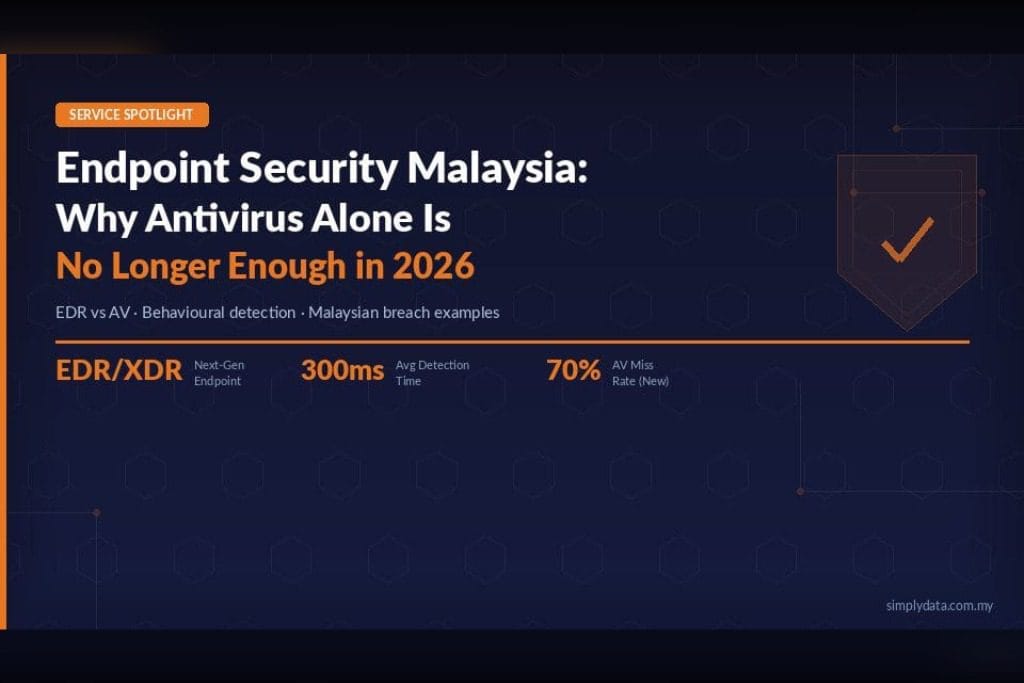
In 2026, antivirus alone is no longer sufficient. Organisations must deploy Endpoint Detection and Response (EDR) or Extended Detection and Response (XDR) to detect behavioural indicators of attack — not just known malware.
What Is Endpoint Detection and Response (EDR)?
EDR is a continuously evolving approach to endpoint protection that goes beyond traditional antivirus. EDR solutions monitor endpoint behaviour in real-time, looking for suspicious activities indicative of a cyberattack:
- Process Execution Monitoring: Track what programs are running, what they’re accessing, and what network connections they make.
- Behavioural Analysis: Detect suspicious behaviour patterns (e.g., a spreadsheet executing PowerShell, a user accessing sensitive files outside their normal role).
- Privilege Escalation Detection: Identify attempts to gain administrative rights.
- Lateral Movement Detection: Recognise when an attacker moves from one system to another using stolen credentials.
- File System Activity Monitoring: Track creation, modification, and deletion of files, especially in sensitive directories.
EDR vs Traditional Antivirus: Key Differences
| Aspect | Traditional Antivirus | EDR/XDR |
|---|---|---|
| Detection Method | Signature-based (known malware) | Behavioural + signature-based |
| Zero-Day Protection | No | Yes (behavioural detection) |
| Incident Investigation | Limited forensics | Full activity timeline |
| Threat Hunting | Not supported | Supported via threat hunting tools |
| Integration with SOC | Minimal | Full integration with SIEM/SOC |
| Response Time | Hours/days | Minutes |
Malaysian Breach Cases Where Antivirus Failed
Several high-profile Malaysian breach cases demonstrate the failure of antivirus-only strategies:
- Manufacturing Sector Breach (2024): Attackers gained initial access via phishing, escalated privileges using legitimate tools, and moved laterally through the network — all undetected by antivirus. Dwell time was 6 months before discovery.
- Healthcare Ransomware (2025): Ransomware deployed via file-less techniques (in-memory execution) evaded antivirus. EDR would have caught the suspicious PowerShell activity.
- Financial Services Incident (2026): Stolen credentials used for lateral movement were not detected by antivirus. EDR monitoring would have flagged the anomalous access pattern.
Implementing Endpoint Security in Malaysia: A Practical Approach
Step 1: Deploy EDR Across All Endpoints
Install EDR agents on all corporate devices (desktops, laptops, servers). For Malaysian organisations, a good starting point:
- Microsoft Defender for Endpoint (integrated with Windows)
- Crowdstrike Falcon (comprehensive EDR platform)
- SentinelOne (lightweight, fast deployment)
- Palo Alto Networks Cortex XDR (includes SIEM and SOC integration)
Step 2: Enable Behaviour-Based Detection Rules
Configure EDR to detect known attack patterns:
- Suspicious PowerShell execution (especially encoded scripts)
- Privilege escalation attempts
- Lateral movement using Pass-the-Hash or credential theft
- Ransomware indicators (file modification patterns, encryption activity)
- Data exfiltration (large file uploads to unknown locations)
Step 3: Integrate with SIEM/SOC
Forward EDR alerts to your SIEM system or engage a Managed SOC. EDR alone doesn’t prevent attacks — you need experienced analysts to investigate alerts and respond to threats.
Step 4: Response Automation
Configure automated responses for high-confidence threats:
- Isolate infected systems from the network
- Kill suspicious processes
- Disable user accounts
- Block file hashes globally
Endpoint Security Compliance in Malaysia
Malaysian regulations increasingly require endpoint monitoring and detection:
- Bank Negara Malaysia (BNM) RMiT Section 10.48: Financial institutions must implement malware detection and removal capabilities.
- PDPA Security Principle: Organisations must implement practical steps to detect and respond to security incidents.
- Cyber Security Act 2024: CNII entities must demonstrate capability to detect intrusions.
- ISO 27001 Control A.12.2.1: Requires implementation of anti-malware and intrusion detection systems.
Simply Data provides Managed SOC services that monitor EDR endpoints 24/7, detecting advanced threats before they cause damage. Contact us to discuss endpoint security strategy for your Malaysian organisation.
Endpoint Security Malaysia: NACSA and MyCERT Requirements
NACSA mandates that all CNII entities deploy advanced endpoint protection as part of their cybersecurity baseline under the Cyber Security Act 2024. Endpoint Detection and Response (EDR) solutions are explicitly recommended over legacy antivirus for organisations handling sensitive national data. NACSA’s cybersecurity assessment framework evaluates endpoint security maturity as a key domain.
MyCERT regularly publishes alerts on malware and ransomware campaigns targeting Malaysian endpoints. Their advisories highlight that most successful attacks begin with an unprotected or misconfigured endpoint. Malaysian organisations can subscribe to MyCERT alerts at mycert.org.my to receive timely warnings about active threats targeting endpoint security Malaysia-wide.
? Related Reading
Frequently Asked Questions
What is the difference between EDR and antivirus for endpoint security in Malaysia?
Traditional antivirus mainly blocks known malware using signatures. EDR (Endpoint Detection and Response) records process, file, network and user activity on the endpoint. It can detect suspicious behaviour where no signature exists, such as fileless attacks, misuse of legitimate system tools and some zero-day exploits. It also supports investigation and response, such as isolating a device. Whether an organisation needs EDR depends on its risk profile, regulatory obligations and ability to act on alerts.
Does NACSA mandate EDR for Malaysian businesses?
The Cyber Security Act 2024 does not name EDR as a requirement for Malaysian businesses generally. Designated NCII entities must follow the code of practice for their sector and any directives that apply, and specific endpoint controls come from those instruments. Other organisations should choose endpoint protection based on risk. For many environments, behavioural detection such as EDR is a reasonable option alongside patching, hardening and monitoring.
What about BYOD policy for endpoint security in Malaysia?
A proportionate BYOD policy can require enrolment in mobile device management, device encryption, screen locks, up-to-date operating systems and endpoint or mobile threat protection. Where devices access personal data, the PDPA Security Principle (s.9) requires practical steps to protect that data. Organisations may therefore add safeguards such as remote wiping of corporate data, separating work and personal data, and restricted network access. Choose controls according to the data and risks involved.
CrowdStrike vs SentinelOne — which is better for the Malaysian market?
Neither is better in every case. CrowdStrike Falcon and SentinelOne Singularity have both taken part in MITRE ATT&CK Evaluations, which publish detection results without ranking vendors or naming leaders. Base your choice on testing in your own environment. Consider operating system coverage, including Linux servers, integration with existing tools, response features, local support, and your managed detection provider's experience with the platform.