
Cloud Security Malaysia: Best Practices for Protecting Your Cloud Environment in 2026
What Is Cloud Security?
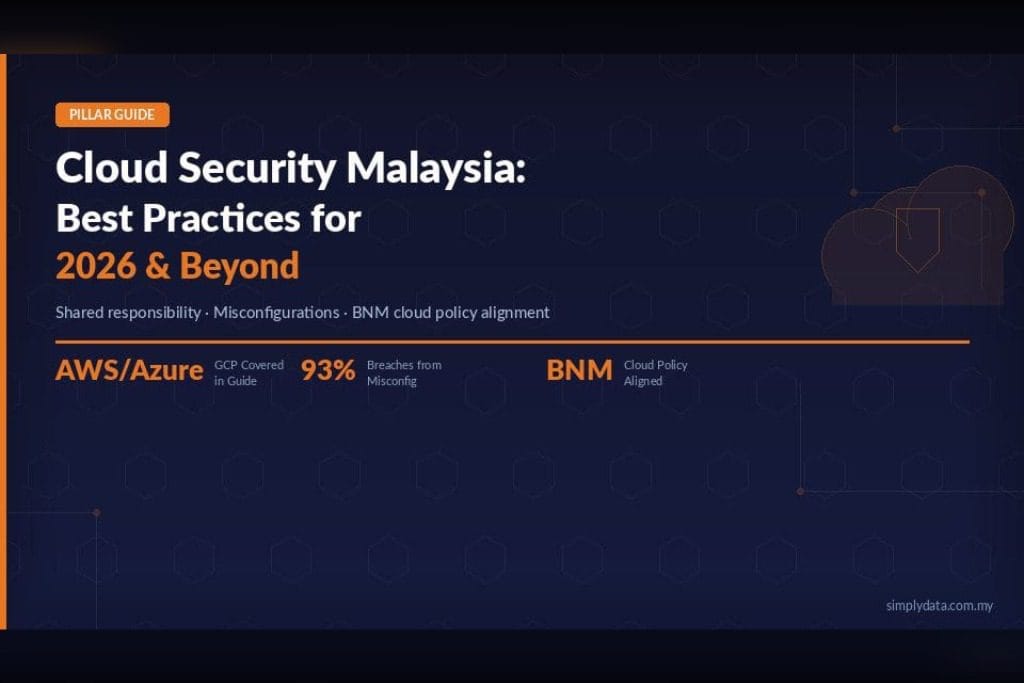
Cloud security refers to the set of policies, technologies, and practices required to protect data, applications, and infrastructure hosted in cloud environments (Amazon AWS, Microsoft Azure, Google Cloud Platform, or private cloud). Cloud security is fundamentally different from traditional on-premises security because you share security responsibility with your cloud provider — the “shared responsibility model.”
The Shared Responsibility Model
Under the shared responsibility model:
- Cloud Provider’s Responsibility: Physical security of datacentres, network infrastructure, hypervisor security, host operating system patching.
- Your Organisation’s Responsibility: Identity and access management (IAM), encryption of data at rest and in transit, network configuration and segmentation, application security, patching of guest operating systems and applications, and data protection.
Confusion about this boundary is a leading cause of cloud security incidents. Many organisations assume the cloud provider protects everything — this is incorrect and dangerous.
Top Cloud Misconfigurations and Risks
1. Public S3 Buckets or Storage Containers
Accidentally misconfiguring cloud storage to allow public read or write access is the #1 cause of cloud data breaches. Hundreds of Malaysian organisations have exposed sensitive data (customer records, financial data, source code) via public S3 buckets.
2. Weak or Default IAM Permissions
Overly permissive IAM policies grant users and applications excessive privileges. If a user’s credentials are stolen, attackers gain broad access to cloud resources. Implement the principle of least privilege — grant only the minimum permissions needed.
3. Unencrypted Data at Rest
Data stored in cloud databases, storage, or backups must be encrypted. Encryption keys must be managed securely — ideally using the cloud provider’s key management service (KMS) or a hardware security module (HSM).
4. Unencrypted Data in Transit
All communication between your systems and the cloud must use TLS/SSL encryption. APIs, database connections, and file transfers must all be encrypted.
5. Insecure Cloud Applications
Applications deployed in the cloud inherit the same security risks as on-premises applications: SQL injection, cross-site scripting (XSS), insecure deserialization, and broken authentication. Regular vulnerability assessment and penetration testing of cloud applications is essential.
6. Inadequate Logging and Monitoring
Cloud environments generate massive volumes of logs. If not properly aggregated and monitored, attackers can hide their activity. Implement comprehensive logging and use a SIEM to detect anomalous cloud activity.
BNM Cloud Computing Policy Alignment
The Bank Negara Malaysia has issued policy guidance on cloud computing for financial institutions. Key requirements:
- Financial institutions must conduct a cloud provider due diligence assessment before moving data.
- Cloud providers must meet specific security, resilience, and regulatory standards.
- Financial institutions remain ultimately responsible for data security and regulatory compliance, even when data is cloud-hosted.
- Customer data must be encrypted and isolated from other customers’ data.
- Regular security assessments of cloud deployments are mandatory.
Cloud Security Best Practices for Malaysian Organisations
1. Cloud Security Posture Management (CSPM)
Deploy a CSPM tool that continuously scans your cloud environment for misconfigurations, overly permissive IAM policies, and non-compliant settings. Examples: Cloudflare Posture, Wiz, Orca Security.
2. Identity and Access Management (IAM)
- Enforce multi-factor authentication (MFA) on all cloud user accounts.
- Use role-based access control (RBAC) — grant permissions based on job role, not individual identity.
- Implement just-in-time (JIT) access for privileged cloud operations.
- Regularly audit who has access to what resources.
3. Data Protection
- Classify data by sensitivity (public, internal, confidential, restricted).
- Encrypt sensitive data at rest using the cloud provider’s KMS.
- Enforce encryption in transit for all API calls and database connections.
- Implement data loss prevention (DLP) rules to block unauthorised exfiltration.
4. Network Security
- Segment your cloud network using security groups and network ACLs.
- Isolate sensitive workloads (databases, API servers) from the internet.
- Use VPN or private connectivity (AWS Direct Connect, Azure ExpressRoute) to connect on-premises networks to the cloud.
- Monitor all ingress and egress traffic.
5. Continuous Vulnerability Assessment
- Conduct regular vulnerability assessments of cloud infrastructure and applications.
- Perform annual penetration testing of critical cloud systems.
- Implement automated patching for guest operating systems and applications.
6. Incident Response and Forensics
- Maintain immutable backups of cloud data in a separate cloud region.
- Enable detailed logging of all cloud API calls (AWS CloudTrail, Azure Audit Logs).
- Develop an incident response plan specific to cloud environments.
Cloud Security Compliance Checklist for Malaysia
- Data is encrypted at rest and in transit.
- IAM policies follow the principle of least privilege.
- MFA is enabled on all user and service accounts.
- All data access is logged and monitored by a SIEM.
- Cloud provider security certifications (ISO 27001, SOC 2) are current.
- Annual vulnerability assessment of cloud infrastructure is completed.
- Incident response procedures for cloud environments are documented and tested.
- Data location and residency requirements (if applicable) are documented.
Cloud security requires a different mindset than traditional IT security — one that assumes shared responsibility and continuous verification. Simply Data cloud security monitoring provides ongoing visibility and threat detection across your cloud infrastructure. Contact us to learn how we can help secure your cloud environment.
NACSA and MyCERT Guidance on Cloud Security in Malaysia
NACSA (National Cyber Security Agency Malaysia) has identified cloud security as a priority area under the Cyber Security Act 2024. NACSA’s guidelines require CNII entities to conduct cloud security risk assessments and ensure cloud service providers meet minimum security standards before deployment. Organisations must maintain data sovereignty — ensuring sensitive data of Malaysian residents stays within approved jurisdictions.
MyCERT (Malaysia Computer Emergency Response Team) regularly publishes advisories on cloud misconfigurations and credential theft attacks targeting Malaysian cloud environments. Common issues include exposed storage buckets, over-privileged service accounts, and insecure API keys. Subscribing to MyCERT advisories helps Malaysian organisations stay ahead of cloud-specific threats.
? Related Reading
What Are the Biggest Cloud Security Risks for Malaysian Businesses?
The top cloud security risks facing Malaysian organisations include misconfigured cloud storage buckets exposing sensitive data, insecure API endpoints, excessive IAM permissions enabling privilege escalation, and inadequate logging that delays breach detection. Malaysia’s PDPA, BNM RMiT, and NACSA guidelines all require organisations to ensure data hosted in cloud environments — including those operated by foreign cloud service providers — is protected to the same standard as on-premises infrastructure. MCMC also requires that certain categories of data remain within Malaysian jurisdiction.
How Should Malaysian Companies Choose a Cloud Security Provider?
When evaluating cloud security providers in Malaysia, look for: NACSA licensing as a Managed Security Service Provider (MSSP), demonstrated experience with Malaysian regulatory requirements (PDPA, BNM RMiT, SC Malaysia guidelines), 24/7 Security Operations Centre (SOC) capabilities, and proven cloud-native security tooling across AWS, Azure, and Google Cloud. Simply Data provides cloud security assessments, cloud SIEM deployment, and ongoing managed cloud security monitoring tailored to the Malaysian regulatory environment.