
APT Cyber Attack Malaysia: Southeast Asia Threats in 2026 — What CISOs Need to Know
What Is an APT Cyber Attack Malaysia Organisations Face?
An APT cyber attack Malaysia incident represents one of the most sophisticated threats facing Malaysian organisations today. An Advanced Persistent Threat (APT) is a targeted, long-term cyber attack campaign typically sponsored by a nation-state, criminal organisation, or sophisticated threat actor. APTs differ from typical ransomware or mass-phishing campaigns in that they:
- Target a specific organisation or sector (not random targets)
- Maintain persistence in the target environment for months or years
- Use sophisticated techniques to avoid detection
- Steal intellectual property, state secrets, or financial data
- Are motivated by geopolitical, financial, or competitive advantage
For Malaysian organisations, understanding APTs targeting Southeast Asia is essential to recognising attack indicators and defending critical systems.
APT Groups Behind APT Cyber Attack Malaysia and Southeast Asia in 2026
Several well-known APT groups have active campaigns against Southeast Asian targets, including Malaysia:
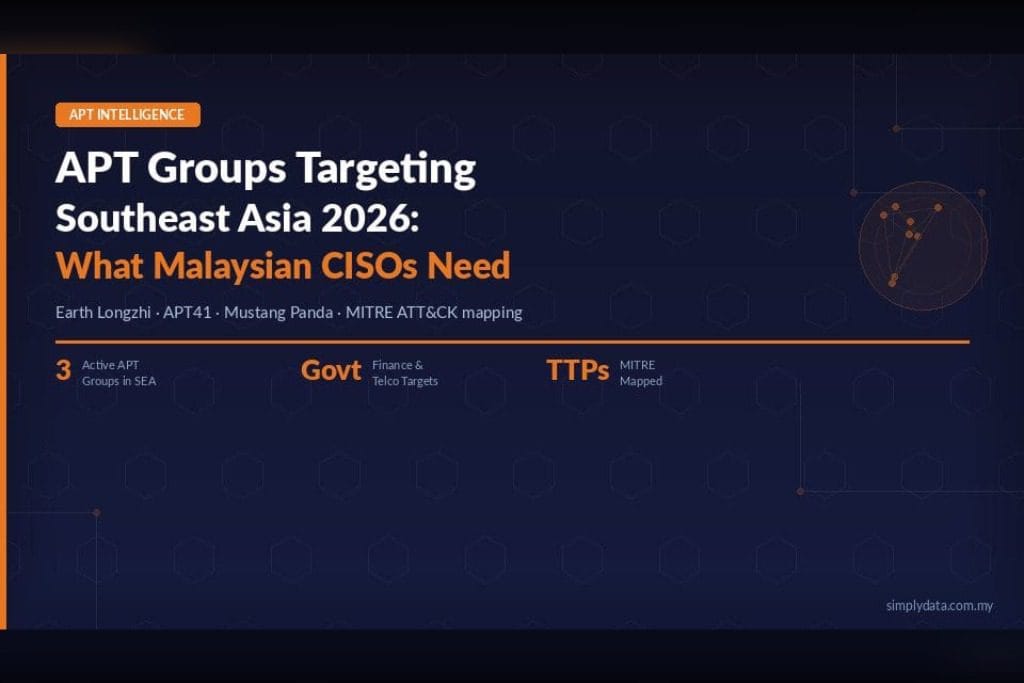
1. Earth Longzhi (Attributed to China)
Earth Longzhi targets energy, telecommunications, and government sectors across APAC. Their typical attack chain: phishing → credential theft → lateral movement → data exfiltration. Malaysian utilities and critical infrastructure are at high risk.
2. APT41 (Attributed to China)
APT41 combines espionage and financially motivated cyber crime. They target healthcare, manufacturing, and financial services. In Malaysia, they have targeted banking institutions and healthcare providers via supply chain compromises.
3. Mustang Panda (Attributed to China)
Mustang Panda focuses on targeted intrusions against government and education sectors. They use spear-phishing with malicious documents and watering hole attacks. Malaysian government and university networks have been targeted.
4. Wizard Spider (Attributed to Russia)
Wizard Spider is primarily financially motivated, operating the Trickbot botnet and conducting ransomware campaigns. Malaysian financial services and government institutions are targets for data theft and extortion.
5. Lazarus Group (Attributed to North Korea)
Lazarus Group conducts both espionage and cyber crime operations. They have conducted high-profile attacks on financial institutions and cryptocurrency exchanges globally. Malaysian fintech and crypto companies are at risk.
MITRE ATT&CK Framework: Understanding APT Tactics
The MITRE ATT&CK framework documents the tactics and techniques used by real-world adversaries. Understanding these helps you detect APT activity in your environment:
- Reconnaissance: Attackers gather information about targets (open source, social engineering, technical scanning).
- Resource Development: Establish infrastructure (C2 servers, malware repositories, phishing domains).
- Initial Access: Gain entry (phishing, supply chain compromise, exploiting public-facing applications).
- Execution: Run malicious code (scripts, executables, in-memory techniques).
- Persistence: Maintain access (backdoors, scheduled tasks, firmware modifications).
- Privilege Escalation: Gain admin rights (exploiting vulnerabilities, credential theft).
- Defence Evasion: Avoid detection (living-off-the-land, encryption, disabling security tools).
- Credential Access: Steal credentials (phishing, keyloggers, credential dumping).
- Discovery: Map the environment (network scanning, system enumeration, application discovery).
- Lateral Movement: Move to other systems (Pass-the-Hash, RDP pivoting, lateral tool transfer).
- Collection: Gather data (screen capture, clipboard data, email exfiltration).
- Exfiltration: Steal data (data compression, encrypted channels, DNS tunnelling).
- Command and Control: Maintain remote access (HTTP beacons, DNS communication).
- Impact: Achieve mission objective (data theft, system destruction, operational disruption).
Malaysian Sectors and Industries at Risk
- Financial Services: Banks, insurers, and fintech companies are high-value targets for theft and fraud.
- Telecommunications: Telcos are targeted for espionage and disruption of critical communications.
- Government and Defence: State-sponsored actors target government networks for intelligence gathering.
- Energy and Utilities: Power generation, water, and gas are critical infrastructure targets.
- Healthcare: Hospital networks are targeted for ransomware and sensitive health data theft.
- Manufacturing: Industrial organisations are targeted for intellectual property theft and operational disruption.
- Semiconductors and High-Tech: Malaysia’s semiconductor industry is a high-value espionage target.
How to Detect APT Activity in Your Environment
Early detection is key to minimising the dwell time (period between initial compromise and discovery). Look for these indicators:
- Unusual Outbound Network Traffic: Large data transfers to unknown IP addresses, especially during off-hours.
- Suspicious Lateral Movement: Unexpected logins on sensitive systems, especially with stolen credentials.
- Living-Off-The-Land Activity: PowerShell, WMI, or command-line activity in admin accounts (normal tools, malicious use).
- Persistence Mechanisms: Scheduled tasks, registry modifications, or service installations that weren’t authorised.
- Anomalous User Behaviour: Users accessing data outside their normal role, unusual times, or from unusual locations.
- Malware or Backdoor Signatures: Known malware samples detected by antivirus or EDR tools.
Malaysian Regulatory Context and APT Defence
NACSA publishes regular APT advisories and threat briefings specifically for Malaysian CNII entities. Additionally:
- BNM RMiT: Requires financial institutions to detect and respond to advanced attacks within defined SLAs.
- Cyber Security Act 2024: CNII entities must undergo penetration testing to validate defences against nation-state actors.
APT Defence Strategy for Malaysian Organisations
- Assume Breach Mentality: Assume attackers have already compromised your environment. Focus on detection and response.
- Implement Defence in Depth: Multiple layers of controls (network, endpoint, application, data) make compromise more difficult.
- Deploy SIEM and EDR: A SIEM correlates logs from across your infrastructure to detect attack patterns. EDR monitors endpoint behaviour for exploitation and lateral movement.
- Threat Intelligence: Subscribe to threat intelligence feeds about APT groups active in your region. Update your detection rules and blocklists regularly.
- Incident Response Plan: Test your ability to detect, contain, and eradicate APT activity quickly.
- Security Awareness Training: APTs often start with phishing. Train employees to recognise spear-phishing targeting your organisation.
Simply Data Managed SOC provides 24/7 threat monitoring and APT detection capability. Contact us to discuss APT defence strategies for your organisation.
Malaysian organisations that have experienced an APT cyber attack Malaysia incident, or suspect active APT intrusion, should immediately engage a certified incident response team and report to both NACSA and MyCERT. Simply Data 24/7 SOC team provides APT detection and response for Malaysian enterprises. Contact us for a confidential assessment.
Protecting your organisation from an APT cyber attack Malaysia requires a layered defence strategy combining threat intelligence, 24/7 SOC monitoring, and regular penetration testing. Contact Simply Data today to assess your exposure to APT cyber attack Malaysia threats.
Malaysian organisations must also ensure APT incident response plans address PDPA (Personal Data Protection Act) breach notification obligations — any APT intrusion that results in data exfiltration may trigger mandatory PDPA reporting requirements.
? Related Reading
How Can Malaysian Organisations Detect APT Activity Early?
Early detection of Advanced Persistent Threats requires layered visibility across endpoints, networks, and cloud environments. Malaysian organisations should deploy Security Information and Event Management (SIEM) solutions with APT-specific detection rules, monitor for indicators of compromise (IoCs) shared by MyCERT and regional threat intelligence communities, and implement User and Entity Behaviour Analytics (UEBA) to spot anomalous lateral movement. Simply Data 24/7 SOC continuously monitors for APT-associated TTPs (Tactics, Techniques and Procedures) mapped to the MITRE ATT&CK framework, providing Malaysian clients with early warning of targeted intrusions.