
Ransomware Malaysia 2026: Latest Attacks, Trends & How to Protect Your Business
Ransomware in Malaysia 2026: The Current Threat Landscape
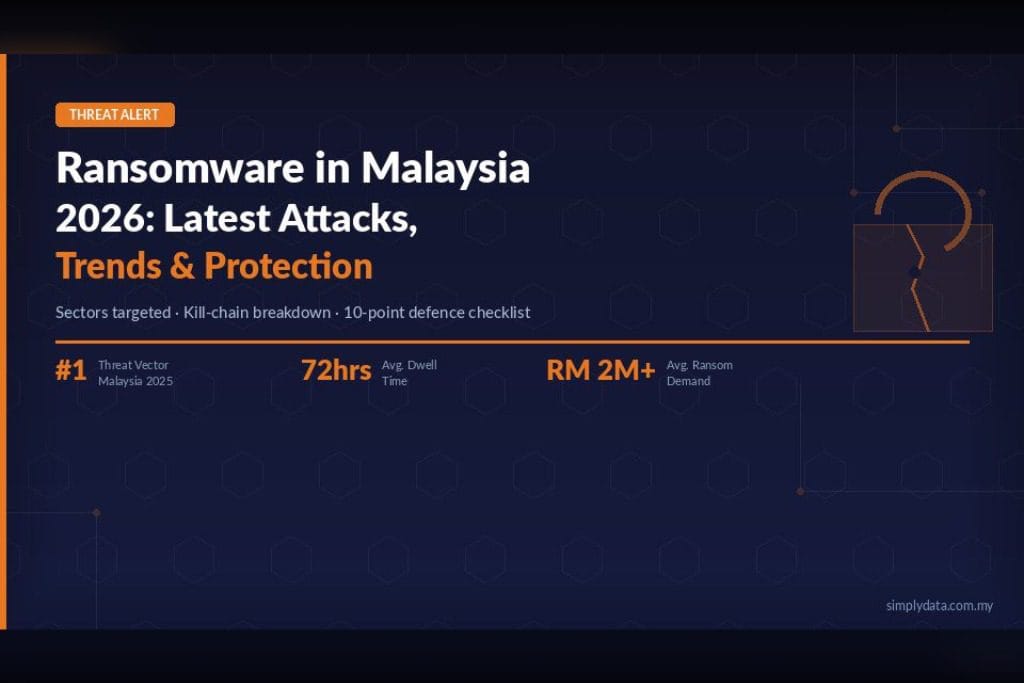
Ransomware Malaysia 2026 — ransomware attacks targeting Malaysian organisations — remains the number one cybersecurity threat to businesses in Malaysia this year. According to NACSA’s cybersecurity incident data, ransomware attacks against Malaysian organisations have increased year-on-year, with manufacturing, healthcare, financial services, and government entities among the hardest-hit sectors.
Unlike earlier generations of ransomware that simply encrypted files, modern double-extortion ransomware exfiltrates sensitive data before encrypting it — then threatens to publish the data on dark web leak sites unless the ransom is paid. This means even organisations with excellent backups face significant reputational and regulatory risk under Malaysia’s PDPA and the Cyber Security Act 2024.
Notable Ransomware Groups Targeting Malaysia in 2026
Several ransomware-as-a-service (RaaS) groups have been observed targeting Malaysian organisations:
- LockBit 3.0: Continues to target manufacturing and logistics companies in Malaysia and across ASEAN. Known for fast encryption speeds and a highly active affiliate network.
- ALPHV/BlackCat: Has targeted healthcare and financial services organisations in the Asia-Pacific region, with double-extortion tactics.
- Cl0p: Responsible for the MOVEit supply chain attack campaign that affected organisations globally, including Malaysian firms using managed file transfer solutions.
- Akira: A newer RaaS group that has been particularly active in targeting SMEs in Southeast Asia, often exploiting unpatched VPN vulnerabilities.
How Ransomware Attacks Work: The Kill Chain
Understanding the ransomware kill chain helps organisations focus their defences on the right stages:
- Initial Access: Attackers gain entry via phishing emails, exposed RDP ports, VPN vulnerabilities (e.g., unpatched Fortinet, Pulse Secure), or compromised credentials purchased on the dark web.
- Persistence: Malware establishes persistence mechanisms (scheduled tasks, registry keys, service installations) to survive reboots and detection attempts.
- Lateral Movement: Attackers use tools like Mimikatz, BloodHound, and Cobalt Strike to move through the network, elevating privileges and accessing critical systems.
- Data Exfiltration: Sensitive data (financial records, customer PII, intellectual property) is exfiltrated to attacker-controlled cloud storage before encryption begins.
- Encryption: The ransomware payload is deployed, encrypting files across mapped drives, network shares, and backup systems if reachable.
- Ransom Demand: Victims receive a ransom note with instructions to contact the group via a Tor-based portal. Demands typically range from USD 50,000 to several million dollars.
Ransomware Compliance Implications in Malaysia
A successful ransomware attack creates immediate regulatory exposure for Malaysian businesses:
- PDPA 2010 (amended): If personal data was exfiltrated, mandatory breach notification to the Personal Data Protection Commissioner (PDPC) is required. Failure to notify carries fines up to RM 500,000.
- Cyber Security Act 2024: CNII entities must report cybersecurity incidents to NACSA within the prescribed timeframe. Ransomware attacks clearly qualify as notifiable incidents.
- BNM RMiT: Financial institutions must notify BNM of significant operational incidents, including ransomware. RMiT Section 10.57 requires documented incident response and post-incident review.
10-Point Ransomware Defence Checklist for Malaysian Businesses
- Patch management: Apply security patches within 72 hours of release for internet-facing systems. Prioritise VPN appliances, RDP gateways, and email servers.
- Multi-factor authentication (MFA): Enforce MFA on all remote access, email, cloud services, and privileged accounts. This single control defeats the majority of credential-based initial access methods.
- Email security: Deploy anti-phishing, anti-spam, DMARC, DKIM, and SPF controls. Consider email sandboxing for suspicious attachments.
- Endpoint detection and response (EDR): Replace legacy antivirus with EDR/XDR solutions capable of detecting behavioural indicators of ransomware activity before encryption begins.
- Network segmentation: Isolate critical systems and backup infrastructure from general user networks. Limit lateral movement paths with least-privilege access controls.
- Immutable backups: Maintain at least one offline or immutable backup copy that ransomware cannot reach. Test restores quarterly.
- Privileged access management (PAM): Restrict Domain Admin and local admin rights. Use just-in-time access for privileged operations.
- Security awareness training: Train all staff to recognise phishing, suspicious links, and social engineering. Conduct simulated phishing exercises quarterly.
- Incident response plan: Document and test your ransomware response procedure. Include NACSA and PDPC notification workflows, legal counsel contacts, and cyber insurance claim processes.
- 24/7 security monitoring: Deploy a SIEM or engage a Managed SOC for round-the-clock threat detection. Many ransomware attacks begin days or weeks before the encryption payload is deployed — early detection stops them.
What to Do If You Are Hit by Ransomware
If ransomware is detected in your environment, act immediately:
- Isolate affected systems: Disconnect infected machines from the network. Do not shut them down (forensic evidence may be lost).
- Activate your incident response plan: Notify your incident response team, legal counsel, and cyber insurance provider.
- Report to authorities: Notify NACSA (for CNII entities) and PDPC (if personal data was involved). Contact CyberSecurity Malaysia’s MyCERT via mycert.org.my.
- Do not pay the ransom without professional advice: Paying does not guarantee data recovery and may have legal implications. Engage a cyber forensics firm to assess your options.
- Preserve evidence: Capture memory dumps, log files, and disk images before any remediation activities.
Simply Data Managed SOC service provides 24/7 ransomware detection and immediate incident response support. Our SIEM-powered monitoring detects pre-encryption indicators — giving your team time to respond before critical systems are locked. Contact us today.
What are the most common ransomware entry points for Malaysian businesses?
The most common ransomware entry points targeting Malaysian businesses in 2026 are phishing emails, exposed Remote Desktop Protocol (RDP) ports, unpatched VPN vulnerabilities (particularly Fortinet and Pulse Secure), and compromised credentials. Many attacks also begin through third-party software supply chains. Implementing multi-factor authentication (MFA), regular patch management, and email security controls addresses the majority of these entry vectors.
Is ransomware in Malaysia increasing in 2026?
Yes. Ransomware attacks against Malaysian organisations have increased year-on-year, with manufacturing, healthcare, financial services, and government entities among the most targeted sectors. Ransomware-as-a-Service (RaaS) groups including LockBit, ALPHV/BlackCat, and Akira have been observed targeting Malaysian and ASEAN organisations. The adoption of double-extortion tactics — where data is stolen before encryption — means even organisations with backups face PDPA breach notification obligations and reputational damage.
What are Malaysian businesses legally required to do after a ransomware attack?
Malaysian businesses that suffer a ransomware attack have several legal obligations. If personal data was accessed or exfiltrated, the Personal Data Protection Act (PDPA) requires notification to the Personal Data Protection Commissioner (PDPC). CNII entities must also report the incident to NACSA under the Cyber Security Act 2024. Financial institutions regulated by Bank Negara Malaysia (BNM) must notify BNM under RMiT Section 10.57. Additionally, MyCERT (mycert.org.my) should be informed. Failure to comply with these notification requirements attracts separate penalties on top of any operational impact.
? Related Reading
Related from SD Unified Platform
Agentic AI SOC — How SDP Automates L1 + L2 in Malaysia
Sub-15-minute MTTD on known ransomware patterns — see how the Agentic AI SOC catches threats early.
Explore Agentic AI SOCAI Threat Hunting — Chat-Driven Investigation
Chase ransomware lateral movement with chat-driven AI threat hunting.
Read more →