How to Choose a Cybersecurity Company in Malaysia: 8 Credentials to Verify
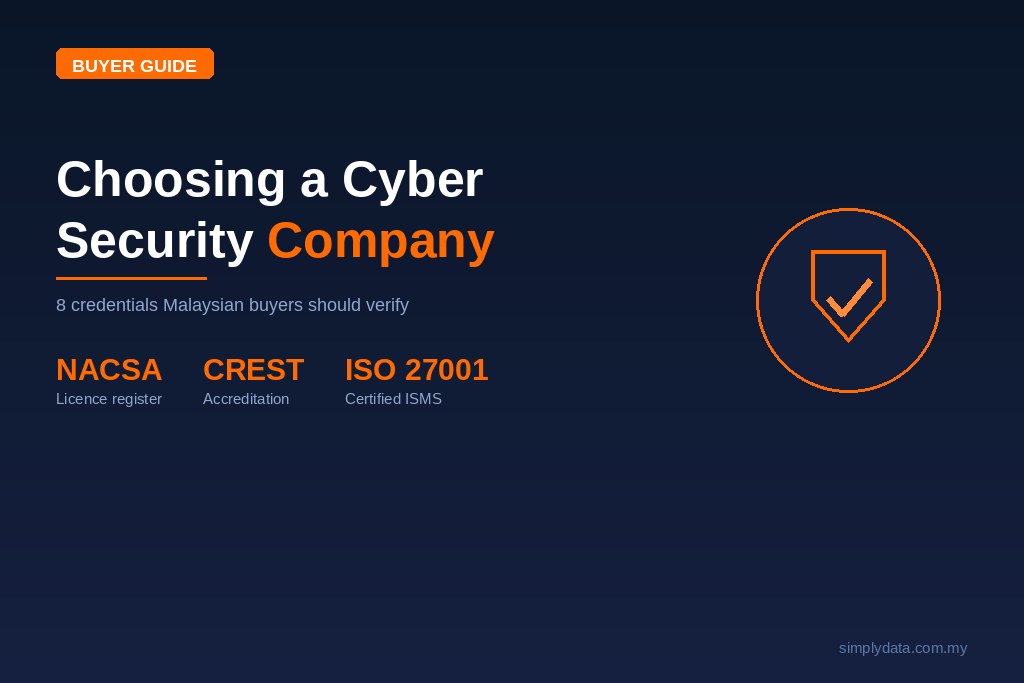
Choosing a cybersecurity provider is a process of verifying licences, accreditation, information security certification and service evidence. For procurement teams asking how to choose a cybersecurity company in Malaysia in 2026, start with the two services licensed under Act 854: managed SOC monitoring and penetration testing, then examine delivery capability. Source: NACSA legislation.
What matters when deciding how to choose a cybersecurity company in Malaysia?
Use the eight checks below as an evidence register. Record the contracting entity, relevant service, supporting document and verification date. Ask procurement, IT and the service owner to review the same register so that a recognised name or familiar logo does not substitute for checking the proposed engagement.
The practical procurement question is whether the evidence covers the work being purchased. Separate permission to provide a regulated service, assessment of technical practices, management system certification and evidence of controls operating over time.
| Credential or evidence | What to verify | Procurement action |
|---|---|---|
| Malaysian SOC monitoring licence | Entity and service category | Match the licence to the monitoring contract |
| Malaysian penetration testing licence | Entity and service category | Match the licence to the testing supplier |
| CREST accreditation | Accredited discipline | Check the CREST Marketplace record |
| ISO/IEC 27001 certification | Certificate scope and validity | Compare covered activities with the service |
| CyberSecurity Malaysia PTSP | Provider certification evidence | Check the provider and relevant testing scope |
| SOC 2 Type II report | System, period and controls covered | Review the report under NDA |
| Singapore CSRO licences | Entity and licensed service | Check Singapore requirements where applicable |
| Operational delivery evidence | Service scope and responsibilities | Review sample deliverables and escalation procedures |
The verification routes are the NACSA licensing framework, CREST Marketplace, ISO information security management standard, CyberSecurity Malaysia PTSP scheme, AICPA SOC resources and Singapore CSRO. Treat operational delivery as a separate assessment during procurement.
Simply Data holds NACSA licences 20007-01 (managed SOC monitoring) and 20007-02 (penetration testing), Singapore CSRO licences, ISO/IEC 27001:2022 certification and CREST accreditation, and has completed a SOC 2 Type II report, available under NDA on request. Review the published credentials.
How do you check a NACSA licence?
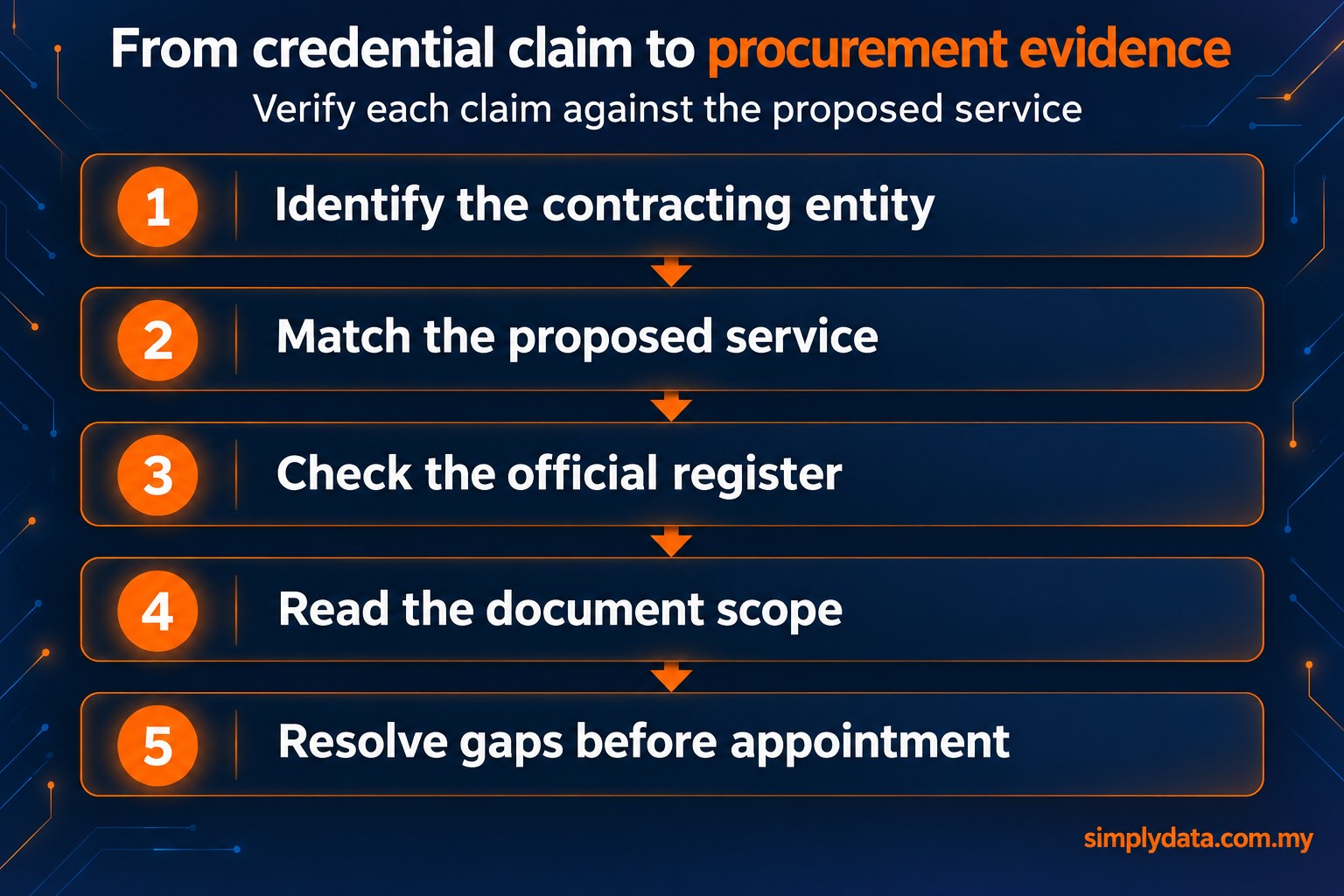
The Cyber Security Act 2024, Act 854, came into force on 26 August 2024. Managed security operation centre monitoring and penetration testing are licensable cyber security services under this framework. These are separate service categories, so check each category relevant to your proposed contract. Source: NACSA legal documents.
Start from the licensing portal linked by NACSA. Match the supplier name against the licence evidence, check the service category and examine validity information. Request clarification where the proposal, contracting entity and licence use different names. Save the evidence with your procurement assessment.
For the worked example, Simply Data holds managed SOC monitoring licence 20007-01 and penetration testing licence 20007-02. Use the Simply Data NACSA licence information to identify the claims, then verify them through the official licensing route linked on the NACSA legal page.
Make licence verification a recorded procurement decision. Ask which entity performs the work, whether subcontractors are involved and which licence supports the contracted activity. Resolve any mismatch before authorising access to systems or agreeing the engagement scope.
What do CREST accreditation, ISO/IEC 27001 and PTSP prove?
CREST assesses organisations across defined cybersecurity disciplines. Its membership guidance explains that each accreditation has its own application and assessment process. Check the discipline shown in the provider record rather than assuming that accreditation covers every advertised service. Source: CREST accreditation guidance.
ISO/IEC 27001:2022 specifies requirements for an information security management system. ISO lists it as the third edition, published in October 2022. Ask for the certificate and read the scope, covered locations and validity information before matching it to the service you intend to procure. Source: ISO/IEC 27001:2022.
CyberSecurity Malaysia operates the Penetration Test Service Provider scheme, PTSP, to assess penetration testing services against its requirements. Use the official scheme description to frame your questions about provider certification and supporting evidence. Source: CyberSecurity Malaysia PTSP overview.
Simply Data is a CyberSecurity Malaysia PTSP certified provider and holds Malaysia Digital (MD) status. Review these alongside the other published certifications and recognition, recording what each credential supports in your assessment.
Connect each credential to a requirement. For testing, ask for a sample methodology, rules of engagement, evidence standards and retesting arrangements. For managed services, ask how access approvals, change control and service governance appear in the proposed delivery model.
Why ask for a SOC 2 Type II report?
A SOC 2 Type II report examines the design and operating effectiveness of controls over a specified period. The AICPA describes SOC reports as evidence used to assess risks associated with outsourced services. Request the report and review its system boundaries and control coverage. Source: AICPA SOC resources.
Read the reporting period, services included, relevant controls, test results and responsibilities assigned to customers. Ask the provider to explain how the service in your proposal maps to the system described. Record questions arising from the report and obtain written answers before completing your supplier assessment.
Simply Data has completed a SOC 2 Type II report, available to qualified customers under NDA on request. The Simply Data SOC 2 Type II information page provides a route for discussing access to that evidence.
Assign responsibility for reviewing the report. Give the reviewer your proposed service scope and information handling requirements. Ask them to document whether the report addresses those requirements and which questions need contractual clarification.
Does the provider cover Singapore as well as Malaysia?
Singapore launched its cybersecurity service provider licensing framework on 11 April 2022, covering penetration testing and managed SOC monitoring. For an engagement serving the Singapore market, verify the relevant entity and licensed service through CSRO. Source: CSA licensing announcement; official CSRO verification route.
Simply Data holds Singapore CSRO licences for penetration testing and managed SOC monitoring. Read the Simply Data Singapore licensing information, then match the proposed service and supplier against the official record.
Ask where service delivery occurs, where customer information is stored, who can access it and which subcontractors participate. Put information transfer, retention, deletion and access approval requirements into the agreement. Obtain a clear explanation of responsibilities across your Malaysian and Singapore operations.
Cross-border procurement requires a clear delivery model. Prepare a service map showing the contracting entity, delivery team, systems covered and customer stakeholders. Use that map when reviewing licences and negotiating the operating procedures.
Which questions reveal real SOC and incident response capability?
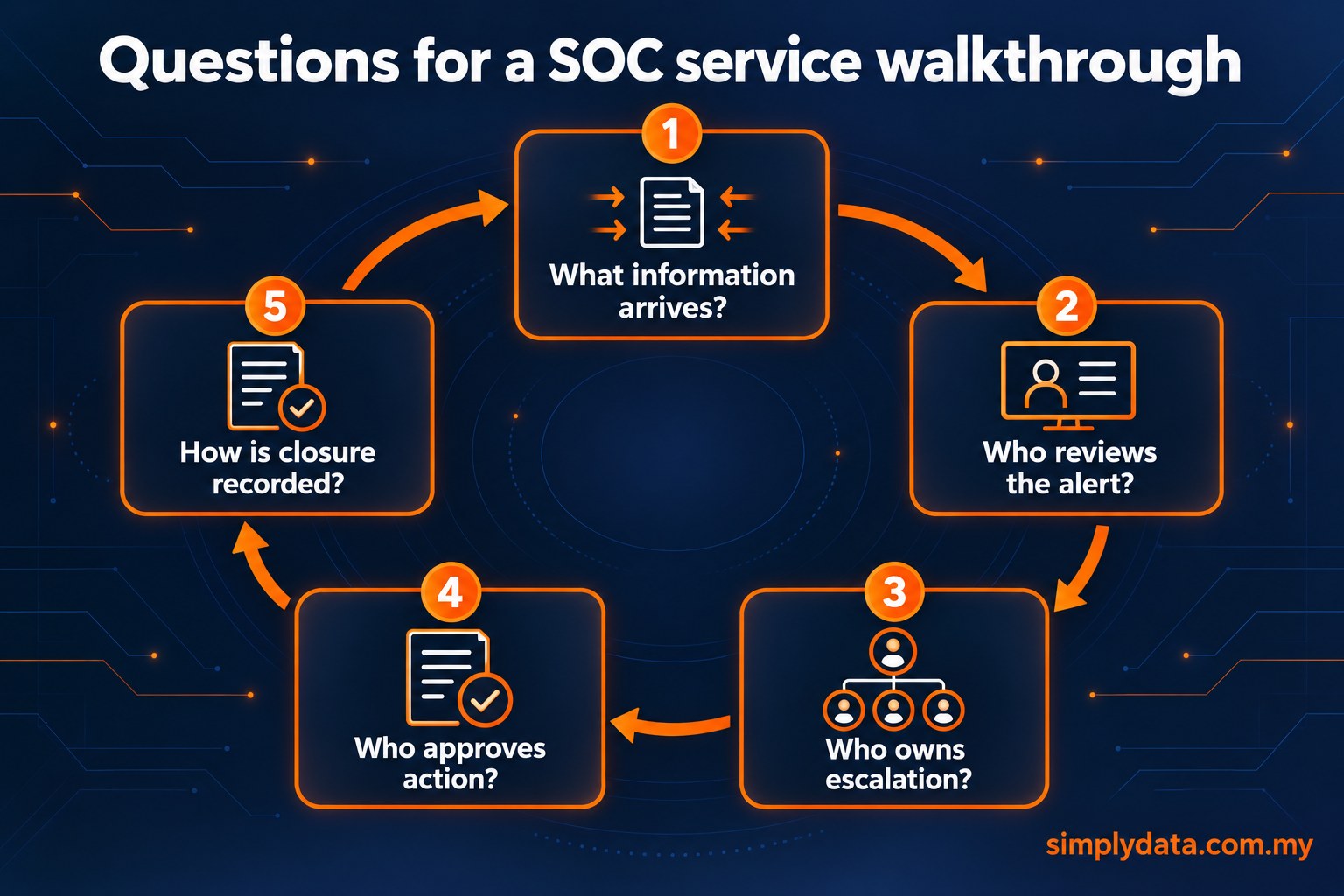
Simply Data operates a 24×7 Security Operations Centre and uses its own SD Unified Platform. The SD Unified Platform AI analyst handles around 70% of all alerts automatically; around 30% go to Simply Data SOC analysts for review and investigation, supported by AI-drafted investigation packs, and the same analysts carry out threat hunting. Source: Simply Data company and capability information.
Ask the provider to walk through an alert from receipt to closure. Request an explanation of prioritisation, analyst review, escalation ownership and customer authorisation. Ask how unresolved alerts, missing telemetry and investigation findings appear in service reporting.
Request sample deliverables using demonstration data: an investigation record, a threat hunting summary and an incident communication template. Run a tabletop discussion around a scenario relevant to your environment. Establish who approves containment, preserves evidence, communicates internally and coordinates recovery.
Simply Data services include managed SOC, MDR, managed EDR, SIEM, DFIR, incident response, ransomware response and recovery support, and tabletop exercises. Ask which services belong in your engagement and document the responsibilities attached to each. Source: Simply Data cybersecurity services.
For penetration testing, specify the assets, access arrangements, authorised techniques, exclusions, evidence handling and reporting audience. Ask how findings will be explained to remediation owners. Agree how remediation review and retesting will be scoped, and identify who accepts the final deliverables.
Frequently asked questions
How do I check if a cybersecurity company is NACSA licensed?
Start with the licensing portal linked from the official NACSA legal page. Match the supplier entity, licence category and validity information to your proposed engagement. Check managed SOC monitoring and penetration testing separately because they are distinct licensable services.
What does CREST accreditation mean?
CREST accreditation assesses an organisation against requirements for a defined cybersecurity discipline. Verify the provider record and relevant accreditation in the CREST Marketplace. Check that the accredited discipline matches the service you intend to purchase.
Is ISO 27001 enough to trust a security provider?
ISO/IEC 27001 certification provides evidence about an information security management system within its stated scope. Procurement should also verify applicable licences, technical accreditation, service deliverables and operational responsibilities. Read the certificate scope before deciding whether it covers your proposed service.
What should I ask before hiring a cybersecurity company?
Ask for applicable licences, accreditation scope, the ISO certificate, relevant assurance reports and sample deliverables. Establish who performs the work, how information is handled, who approves response actions and what the contract includes. Record unresolved questions before authorising access.
Which Malaysian cybersecurity companies also cover Singapore?
Simply Data holds Singapore CSRO licences for penetration testing and managed SOC monitoring, alongside Malaysian NACSA licences for those services. Verify the relevant entity and service through the official registers, then confirm the delivery scope and cross-border information handling arrangements.
How can you turn verified credentials into a service scope?
Compile your evidence register, unresolved questions and operational requirements into a procurement brief. Include system coverage, access controls, reporting expectations, escalation contacts and acceptance criteria. Review the background of Simply Data Sdn. Bhd. alongside the credential evidence when preparing your shortlist.
To put this procurement guide into practice, review the Simply Data cybersecurity services, request a penetration testing scope for your testing requirements, and contact Simply Data to discuss credential evidence and a service scope matched to your environment.