Cybersecurity Compliance for Malaysian Stockbrokers: A Practical Readiness Guide (2026)
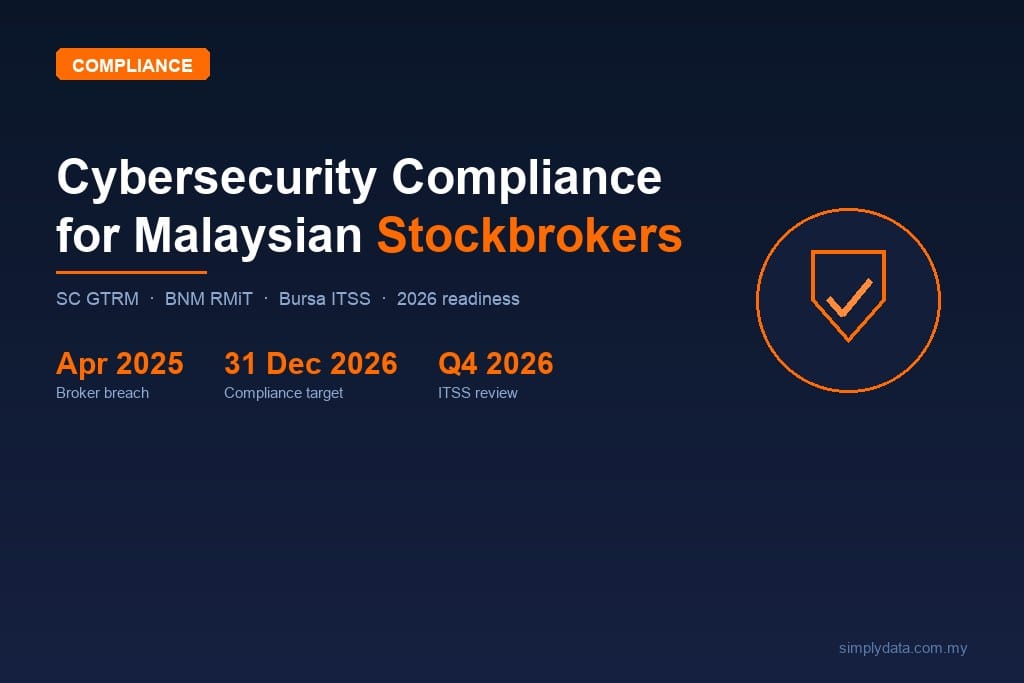
In April 2025, Malaysia’s capital market got a hard reminder that brokerage systems are a live target. Attackers gained unauthorised access to a number of online trading accounts and pushed through unauthorised trades — briefly distorting the price of a listed counter before the exchange stepped in and reversed the transactions. The losses were contained and investor positions were restored, but the message to the industry was unmistakable: cyber risk in stockbroking is now a material, regulator-visible risk — not an IT footnote.
If you run IT, compliance, or risk at a Malaysian broker, the question is no longer whether your cybersecurity posture will be scrutinised, but how ready you are when it is. This guide lays out the practical, framework-aligned path to broker cybersecurity compliance in Malaysia for 2026 — what regulators broadly expect, the control areas that matter most, and how a mid-tier firm without a large in-house security team can realistically close the gap.
Note: This is vendor guidance for planning purposes, not legal or compliance advice. Confirm your specific obligations with your compliance function and the relevant regulators.
Why broker cybersecurity is under the spotlight
The 2025 incident was reported publicly by both the Securities Commission Malaysia (SC) and Bursa Malaysia (joint media statement). Around 80 client accounts were affected across a limited number of brokers, the unauthorised access appeared to originate from overseas IP addresses, and brokers were advised to have clients reset credentials and to strengthen authentication — including multi-factor authentication (MFA) and stricter password policies (The Malaysian Reserve; Bernama).
Two things make this more than a one-off:
- Capital markets are systemically sensitive. A breach that manipulates trades or prices doesn’t just cost one firm money — it undermines confidence in the market itself. That is precisely the kind of outcome regulators are mandated to prevent.
- Regulatory expectations were already tightening. Malaysian financial firms operate under a maturing set of technology-risk frameworks. After a high-profile incident, the expectation to demonstrably meet those standards only accelerates.
For brokers, that means cyber controls are moving from “good practice” to table stakes for staying licensed and trusted.
In November 2025, Bursa Malaysia and the stockbroking industry issued a cyber resilience enhancement recommendation paper, developed by an industry working group, aimed at strengthening the exchange’s existing IT Security Standards (ITSS) through a two-pronged oversight approach (The Star; Reuters, 11 November 2025). For Malaysian brokers and their boards, this signals that cyber resilience has moved firmly to the top of the regulatory agenda. Firms operating under Bursa’s standards should proactively review their security posture against the exchange’s published expectations and engage a licensed provider to close any gaps.
Bursa Malaysia has publicly identified a number of focus areas for strengthening broker cyber resilience, including oversight of technology service providers, incident management, training and awareness, and the establishment of a dedicated cybersecurity role within broking firms (The Star, 11 November 2025).
As publicly reported, Bursa Malaysia has indicated that its recovery-planning and incident-management measures are subject to full compliance within three months of the recommendation paper’s issuance, while measures involving system changes or infrastructure upgrades are targeted for full compliance by 31 December 2026 (Bursa Malaysia media release, 11 November 2025, as reported by The Star, Bernama and The Edge).
In March 2026, Bursa Malaysia confirmed that several stockbroking firms experienced cybersecurity incidents affecting components of their systems. The affected brokers immediately isolated the compromised components and activated their internal incident-response controls, and Bursa reported no evidence of unauthorised trading activity or financial loss — trading and market operations continued to function as usual (The Star, 12 March 2026).
Bursa added that, since the April 2025 incident, the industry has put measures in place including multi-factor authentication, isolation protocols, enhanced monitoring and strengthened incident response — a reminder that it is layered controls and rehearsed response, not luck, that keep a live intrusion from becoming a market-impacting event.
Bursa Malaysia has also signalled a comprehensive IT Security Standards review targeting implementation in the fourth quarter of 2026, intended to further strengthen its oversight of brokers (The Star, 12 March 2026).
The regulatory backdrop: the frameworks that actually apply
You don’t need to guess what “good” looks like — it’s already written down in published Malaysian frameworks. The three most relevant to brokers:
- SC’s Guidelines on Technology Risk Management (GTRM) — the Securities Commission’s expectations for how capital-market intermediaries manage technology and cyber risk, covering governance, access control, resilience, third-party risk, and incident management.
- Bank Negara Malaysia’s Risk Management in Technology (RMiT) — BNM’s technology-risk policy for financial institutions. While it’s a banking-sector instrument, its control expectations (24/7 monitoring, strong authentication, recovery objectives, third-party oversight) are the de-facto benchmark that the broader financial industry is measured against.
- The exchange’s IT Security Standards (ITSS) — the technical security baseline participants are expected to meet.
The common thread across all three: strong access control, continuous threat detection, disciplined patching, tested recovery, third-party oversight, and a clear owner for cybersecurity. These expectations are rising and being phased in through 2026, so readiness work started yesterday.
Want to understand what “licensed and regulator-literate” looks like on the vendor side? See our guide to NACSA-licensed cybersecurity service providers in Malaysia.
The control areas brokers must get right
Here’s what good looks like, organised into the areas that consistently show up across GTRM, RMiT, and ITSS. Treat this as a readiness map, not a checklist to skim.
1. Access control and privileged access
Enforce least privilege, role-based access, and MFA on every internet-facing and privileged system — this includes both employee remote access and customer online-trading logins. Add session controls (idle timeouts, re-authentication for order placement and funds movement) and tightly manage privileged/admin accounts. The 2025 incident turned on account access; this is the first line that failed industry-wide.
2. 24/7 threat detection and monitoring
Attacks don’t keep office hours, and the 2025 trades were pushed through in minutes. Brokers need continuous monitoring — a Security Operations Centre (SOC) capability that aggregates and correlates logs, detects anomalous behaviour, and can triage and contain in near-real-time. Modern SOCs layer in behavioural analytics and AI-assisted detection to catch account-takeover and unusual trading patterns fast. → See Managed Detection & Response (MDR) in Malaysia.
3. Patch and vulnerability management
Maintain a real-time inventory of systems, patch on a disciplined cadence, and test critical systems regularly. Internet-facing trading applications deserve the most aggressive vulnerability management and at least annual penetration testing. → See what a cybersecurity audit in Malaysia covers.
4. Infrastructure resilience and recovery
Build in redundancy and high availability, segment critical trading systems away from less-sensitive networks to limit an attacker’s lateral movement, and keep immutable, tested backups to survive ransomware. Define and test your Recovery Time and Recovery Point Objectives (RTO/RPO) against realistic scenarios.
5. Third-party and vendor risk
Most brokers depend on external trading platforms, market-data feeds, and technology providers. Each is a potential entry point. Run cybersecurity due diligence before onboarding, bake security obligations (log retention, incident notification, audit rights, exit arrangements) into contracts, and monitor providers continuously. → Related reading: supply-chain cyber risk in Malaysia.
6. Incident management
Have a dedicated incident-response capability that’s available around the clock, a written and rehearsed incident-response plan (detect → analyse → contain → eradicate → recover → review), and digital-forensics capacity to establish root cause. Regulators expect prompt notification of material cyber incidents, in line with GTRM and RMiT expectations. → See our incident response plan guide for Malaysia.
7. Security awareness and training
People remain the softest target. Run regular, role-specific training (phishing, credential hygiene, secure handling of client data), extend awareness to clients/investors, and put senior management through crisis tabletop exercises so leadership can actually lead during an incident.
8. Security leadership: the CISO function
Regulators increasingly expect a clearly accountable, appropriately certified owner of cybersecurity — a CISO or equivalent — who is independent from day-to-day IT operations and reports to the board on cyber risk. Importantly, current guidance recognises that this function can be filled through a qualified external provider where a firm can’t justify a full-time internal hire. That’s a lifeline for smaller brokers (see below).
The mid-tier broker problem
Bank-backed and large brokers usually have security teams — often shared with a parent bank. But a large share of Malaysian brokers are leaner, retail-facing firms that simply cannot economically staff a 24/7 SOC, a full incident-response team, and a full-time certified CISO in-house. The talent is scarce and expensive, and the tooling is capital-intensive.
That gap — real obligations, limited internal capacity — is the central challenge of broker cyber readiness in 2026. The good news is that regulators have deliberately left room to meet these expectations through qualified external partners.
How brokers close the gap
Each control area above maps to a delivery model a mid-tier broker can actually adopt without building everything internally:
| What you need | How to get there |
|---|---|
| 24/7 threat detection & response | Managed SOC / MDR service |
| Regular vulnerability testing | Scheduled VAPT (vulnerability assessment & penetration testing) |
| Proof you’re not already breached | Compromise assessment |
| An on-call response team | Incident-response (IR) retainer with DFIR capability |
| Accountable security leadership | Virtual/outsourced CISO (vCISO / CISO-as-a-service) |
| Attack readiness validation | Periodic red-team / adversarial simulation |
Simply Data is a NACSA-licensed MSSP (Managed SOC and Penetration Testing) and ISO 27001-certified, and we help regulated Malaysian firms operationalise exactly these controls — from 24/7 AI-assisted detection to VAPT, compromise assessment, incident response, and virtual CISO coverage. Our ISO 27001 certification means we hold ourselves to the same governance standards we help brokers meet.
A practical 2026 readiness checklist
A sensible order of operations for a broker starting from a standing start:
- Run a gap assessment against GTRM / RMiT / ITSS expectations to see where you actually stand.
- Prioritise by risk — fix internet-facing and account-access weaknesses first.
- Establish detection coverage — get to 24/7 monitoring with proper log aggregation and retention.
- Write and rehearse an incident-response plan — then prove it with a tabletop exercise.
- Review your critical vendors — due diligence, contract clauses, and ongoing monitoring.
- Assign CISO-level accountability — internal or external — with a line to the board.
- Train your people and your clients — and put leadership through a crisis simulation.
Work through those seven and you’ll have addressed the substance of what every relevant framework asks for.
Frequently asked questions
What cybersecurity requirements do Malaysian stockbrokers face?
Malaysian brokers are expected to meet the technology-risk and cybersecurity standards set out in published frameworks — the SC’s Guidelines on Technology Risk Management (GTRM), Bank Negara Malaysia’s RMiT policy, and the exchange’s IT Security Standards. In practice this means strong access control and MFA, 24/7 threat detection, disciplined patching, tested recovery, third-party risk oversight, incident management, security awareness, and accountable security leadership.
Can a broker outsource its CISO function in Malaysia?
Yes. Current guidance recognises that the cybersecurity leadership role can be filled through a qualified external provider — often called a virtual CISO (vCISO) or CISO-as-a-service — provided that person is appropriately certified, independent from day-to-day IT operations, and reports to the board. This is a practical option for smaller brokers that can’t justify a full-time internal hire.
What is RMiT and GTRM compliance for financial firms?
RMiT (Risk Management in Technology) is Bank Negara Malaysia’s technology-risk policy for financial institutions; GTRM (Guidelines on Technology Risk Management) is the Securities Commission’s equivalent for capital-market intermediaries. Both set expectations for governance, access control, resilience, third-party risk, and incident response. Where these frameworks overlap, aligning to the stricter of the applicable controls is prudent practice.
How does a mid-tier broker set up 24/7 threat detection without a big team?
The most common route is a Managed Detection and Response (MDR) service or managed SOC, where a licensed provider supplies the round-the-clock monitoring, analysts, and tooling. This delivers continuous detection and response without the broker having to hire and retain a full in-house security operations team.
Was the April 2025 Bursa Malaysia trading incident resolved?
Yes. Bursa Malaysia reversed all unauthorised trades executed on 24 April 2025, restoring affected investors’ positions, and reported that losses were contained and limited to a few brokers.
Get broker-ready
Cyber compliance for Malaysian brokers is no longer optional, and the firms that get ahead of it now will be the ones that avoid a scramble later. If you’d like a clear picture of where your firm stands, talk to a NACSA-licensed team about a broker cyber readiness assessment.
Simply Data — NACSA-licensed Managed SOC & Penetration Testing, ISO 27001 certified.