
Phishing Attacks Malaysia 2026: How to Spot, Stop & Report Them
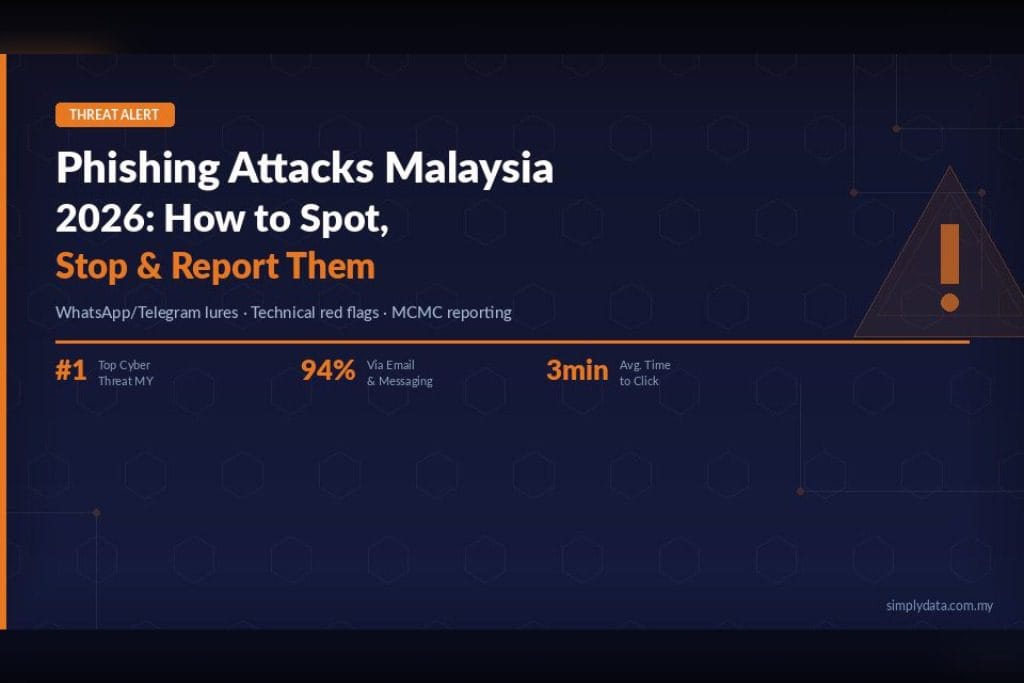
Phishing Attacks Malaysia 2026: The Scale of the Problem
Phishing Attacks Malaysia 2026 remain the number one entry point for cyber attacks against Malaysian organisations in 2026. MyCERT (Malaysian Computer Emergency Response Team) consistently reports phishing as the leading category of cybersecurity incidents in Malaysia, accounting for the majority of reported cases each year.
Modern phishing in Malaysia is no longer limited to poorly-written emails. Attackers now deploy sophisticated spear-phishing, WhatsApp business impersonation, Telegram malicious links, and AI-generated social engineering targeting Malaysian employees across all sectors.
Latest Phishing Trends in Malaysia 2026
1. WhatsApp and Telegram Phishing
Malaysian cybercriminals increasingly use WhatsApp and Telegram to deliver phishing lures — often impersonating banks, government agencies (LHDN, JPJ, MyEG), delivery services, and Malaysian employers. These messages are highly targeted and often arrive from compromised contacts, making them particularly convincing. Common lures include: fake tax refund notifications, parcel tracking links, e-commerce prize alerts, and bank security alerts.
2. Business Email Compromise (BEC)
BEC attacks targeting Malaysian businesses have increased significantly. In a BEC attack, cybercriminals compromise or spoof a business email account (often a senior executive or finance officer) to redirect payments, request fraudulent wire transfers, or extract sensitive data. The Monetary losses from BEC in Malaysia run into millions of ringgit annually.
3. AI-Generated Spear-Phishing
The use of large language models (LLMs) to generate highly personalised phishing emails has lowered the barrier for attackers. AI-generated phishing emails are grammatically perfect, contextually relevant, and contain accurate personal details sourced from social media and data breaches — making them significantly harder to detect than traditional phishing.
4. QR Code Phishing (Quishing)
QR codes bypass traditional email security filters (which cannot parse QR codes for malicious URLs). Attackers embed malicious QR codes in physical locations (cafes, offices, parking systems) and in documents — directing victims to fake banking or corporate login portals.
How to Spot a Phishing Attempt: Red Flags
Train your team to recognise these technical and social red flags:
- Urgency and fear: “Your account will be suspended in 24 hours”, “Immediate action required”, “Final notice”
- Suspicious sender address: Check the actual email domain, not just the display name. “CIMB Bank <no-reply@cimb-secure.net>” is not a legitimate CIMB address.
- Mismatched URLs: Hover over links before clicking. The URL should match the displayed text and the organisation’s official domain.
- Unusual requests: Legitimate organisations will never ask for passwords, OTPs, or credit card numbers via email or chat.
- Grammar and formatting: While AI has improved phishing quality, inconsistent formatting, unusual characters, and generic greetings (“Dear Customer”) remain red flags.
- Unexpected attachments: Be extremely cautious with unexpected attachments, especially .exe, .zip, .pdf, .docx, and .xlsm files from unknown or unexpected senders.
Technical Controls to Stop Phishing
Organisations should implement multiple overlapping technical controls:
- Email authentication (DMARC, DKIM, SPF): Implement SPF, DKIM, and DMARC for your domain with a p=reject DMARC policy. This prevents attackers from spoofing your domain in outbound phishing attacks.
- Advanced email filtering: Deploy AI-powered email security (e.g., Microsoft Defender for Office 365, Proofpoint, Mimecast) that analyses email content, attachment behaviour, and sender reputation.
- URL filtering and web proxy: Implement DNS-layer security (e.g., Cisco Umbrella, Cloudflare Gateway) that blocks connections to known phishing and malware domains before they reach endpoints.
- Multi-factor authentication (MFA): Even if credentials are stolen via phishing, MFA prevents account compromise in the majority of cases. Deploy MFA on all email, Microsoft 365/Google Workspace, VPN, and business applications.
- Endpoint protection (EDR): EDR solutions detect and block phishing payload execution even when emails bypass filtering controls.
How to Report Phishing in Malaysia
Phishing Attacks Malaysia 2026 are actively tracked by government agencies. If you or your employees receive a phishing attempt, report it to the appropriate authorities:
- MyCERT (CyberSecurity Malaysia): Report at mycert.org.my or email cyber999@cybersecurity.my or call 1-300-88-2999
- MCMC (Malaysian Communications and Multimedia Commission): Report scam communications at aduan.skmm.gov.my
- PDRM (Royal Malaysia Police) — Cyber and Multimedia Crime Investigation Division (CCID): For financial fraud resulting from phishing, lodge a police report at your nearest police station or via the CCID portal
- Your bank: For banking-related phishing or if you have accidentally provided banking credentials, contact your bank’s 24/7 fraud hotline immediately
Phishing Attacks Malaysia 2026: NACSA and MyCERT Response
NACSA (National Cyber Security Agency Malaysia) coordinates the national response to phishing campaigns targeting Malaysian government agencies and critical national information infrastructure (CNII). NACSA issues threat advisories and works with sector leads to implement anti-phishing controls across regulated industries. Organisations operating in CNIl sectors must comply with NACSA’s directives when phishing incidents are detected.
MyCERT (Malaysia Computer Emergency Response Team) is the primary incident response body for phishing reports in Malaysia. MyCERT’s Cyber999 helpline processes thousands of phishing reports annually, issuing public alerts and coordinating with ISPs to block malicious domains. Reporting to MyCERT helps protect other Malaysian users from falling victim to the same campaigns.
Phishing Simulation: Test Your Team
Given the surge in Phishing Attacks Malaysia 2026, regular simulated phishing exercises are the most effective way to build employee phishing awareness. A well-designed simulation programme:
- Tests employees with realistic phishing scenarios relevant to their role
- Provides immediate educational feedback when an employee clicks a simulated phishing link
- Tracks improvement over time to measure the effectiveness of training
- Identifies high-risk individuals who require additional training
Simply Data provides phishing simulation services as part of our security awareness training programme. Contact us to learn how we can help reduce your organisation’s phishing susceptibility. Our Managed SOC also monitors for phishing indicators in your email environment in real time. Get in touch today.
Regulatory context: Bank Negara Malaysia (BNM) has issued guidance under RMiT (Risk Management in Technology) requiring financial institutions to implement anti-phishing controls, employee awareness training, and incident response procedures. BNM’s RMiT framework mandates that banks and financial institutions maintain robust defences against phishing attacks in Malaysia. Non-compliance can result in supervisory action from Bank Negara Malaysia.
? Related Reading
How Can Malaysian Employees Recognise and Report Phishing Attempts?
Employee awareness is the single most effective defence against phishing. Malaysian organisations should train staff to: hover over links before clicking to inspect the actual destination URL, verify unexpected requests via a separate communication channel (not reply to the email), report suspicious emails to the IT security team immediately using a dedicated reporting button or mailbox, and never enter credentials into a page reached by clicking an email link. CyberSecurity Malaysia’s MyCERT offers free cybersecurity awareness resources that Malaysian organisations can use to supplement their phishing awareness programmes.