
Binance hack lessons: what Malaysian businesses should learn
Binance hack lessons for Malaysian businesses are broader than phishing emails: protect developer devices, restrict internal AI access and connect the logs a SOC needs. Simply Data examines Binance’s initial report to explain why awareness training must sit alongside technical controls, strong authentication and rehearsed response.
Binance published an initial report on 3 November 2026, and its findings remain subject to further independent review. The incident facts below come from that report. The advice on what your organisation should do is our recommendation, not something Binance has said.
What happened in the Binance incident, according to its initial report?
According to Binance’s initial findings, on 29 October 2026 an attacker exploited unauthorised access to an internal wallet signing service to move hot-wallet assets across several networks. Binance puts the impacted assets at approximately USD 6.34 billion, with approximately USD 2.85 billion frozen or intercepted, subject to reconciliation and market price volatility.
The report describes a multi-stage campaign, not a simple phishing incident. In June 2026, a Wallet DevOps engineer downloaded a tampered Homebrew installation found through a search engine while installing an AI coding tool. Binance replaced the device and rotated credentials, but says the team’s roles were exposed.
In September, another engineer was approached on a legitimate job platform, interviewed by a fake HR representative and a fake chief executive of a fictitious company, then told to download an interview assignment onto a work computer. Malicious code ran during setup, replaced a legitimate pyenv component and was not detected by endpoint protection at the time.
Binance reports that on 20 October the attacker used that compromised computer and an internal AI tool to gain control over two more engineers. The attacker soon discovered a container deployment token on one machine.
On 29 October, the attacker deployed a container with those stolen credentials and launched the attack. Suspending withdrawals did not stop all transfers, because malicious EIP-7702 delegations existed on-chain and needed separate revocation.
Was AI the attacker, or the target, in this incident?
The details matter here. In Binance’s account, AI plays two roles. In June, an engineer downloaded a tampered Homebrew installer while seeking to install an AI coding tool. Later, an internal AI tool was compromised and used as a springboard to reach other engineers.
The report does not say that AI created the interview lures, wrote the malware or ran the attack. We read this as a lesson about AI tools as privileged systems, not about attacks written by AI.
That difference changes your controls. If an internal assistant acts on behalf of staff, can reach other users’ sessions, or touches code and deployment systems, we recommend reviewing it as you would an administrator console.
Ask three questions about every internal AI tool: whose identity does it act as, what can it do without a human confirming, and where are its actions logged?
Which Binance hack lessons matter most for Malaysian businesses?
Your business does not need to handle cryptocurrency to face these risks. Review any developer devices, cloud deployments, pipeline tokens and AI assistants in your own environment. These are the Binance hack lessons we would put first in Malaysia:
- Recruitment is a way in. Public profiles that name an employer tell attackers who may hold valuable access.
- Developer laptops are privileged endpoints. A setup script on an engineer’s machine can reach source code, tokens and cloud consoles.
- Tokens stored on disk are standing access. In Binance’s account, a deployment token on a workstation became the bridge to production.
- Internal AI tools can be attacked. Their permissions, sessions and reach can be borrowed by an attacker.
- Catching one incident does not close the case. Binance detected and fixed the June device, yet reports that team roles had already been exposed.
- Containment must cover every authorisation. Stopping withdrawals did not revoke delegations that already existed on-chain.
For a Malaysian business, the equivalent of those lasting delegations might be OAuth grants, API keys, long-lived cloud tokens or SaaS app consents that still work after a password reset.
How should awareness and developer hygiene change by role?
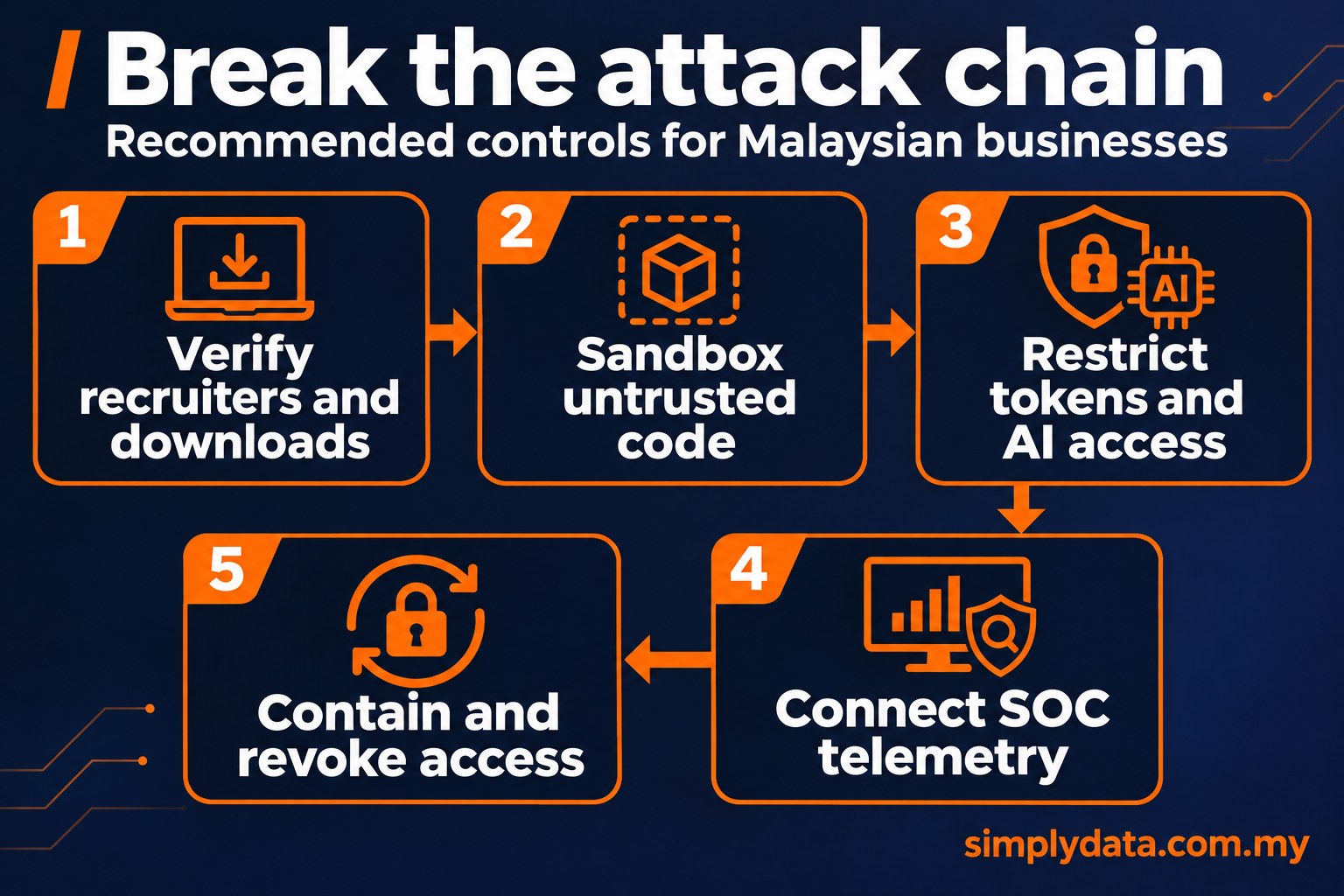
Generic annual training is unlikely to prepare anyone for a two-round fake interview backed by a convincing personal social media trail. We recommend awareness training tailored to each role and backed by technical controls, because training alone cannot stop malicious code once it runs.
- Developers and DevOps: Do not run interview assignments or unknown repositories on a work laptop, including inside a local VM. If organisational policy permits evaluation, use an IT-authorised disposable environment isolated from corporate devices and internal networks, with no corporate credentials, VPN, single sign-on sessions, password manager, shared mounts or clipboard integration.
- HR and hiring managers: explain that staff may be targeted because of where they work, and give them a simple, no-blame way to report suspicious recruiter approaches.
- IT administrators: install developer tools only from approved sources or an internal mirror, and treat installers found through search results as suspect.
- People who approve production changes: expect pressure or unusual requests, and confirm them through a separate channel you already know.
- Leadership: reward early reporting, including reports of one’s own mistakes, so incidents come to light while they are still small.
Simulations let staff practise spotting these lures safely. Phishing email simulation exercises can include recruitment-themed scenarios and should measure how many people report the lure, not just how many click.
What telemetry would reveal a similar attack chain?
We recommend bringing five telemetry layers into one SIEM so analysts can connect device activity, identities and privileged actions:
- Endpoint and process: process creation, command lines, files created, renamed or deleted inside developer toolchains, and new symlinks and shells started by setup scripts.
- Identity and session: sign-ins, tokens issued, sessions reused from unfamiliar devices, and privilege changes.
- Cloud and container: who deployed which container, with which token, from which device, and what it ran.
- Proxy and DNS: domains seen for the first time, and developer tools connecting to unfamiliar external servers.
- AI access and action: who used each internal AI tool, what data it accessed and what actions it took on other users or systems.
Here are some illustrative detections. They are examples to adapt, not proven rules, and each one depends on specific logs:
- A developer tool file is deleted, replaced by a new file and then starts a shell. Needs EDR file and process telemetry from macOS and Linux developer devices.
- Flag unexpected deployment-token use against its approved identity and deployment context. Requires token identifiers and ownership mappings, container audit logs, and sufficient identity and endpoint telemetry to attribute the originating device or workload. Account for approved service identities and automation.
- An internal AI tool acts on accounts other than those of the user who invoked it. Needs the AI tool to send its access and action logs to the SIEM.
- A developer device contacts a domain seen for the first time soon after an external repository is set up. Needs proxy or DNS logs plus endpoint telemetry.
Any response, such as isolating a device or revoking a token, should run only under response authority the customer has approved in advance, with named owners and an escalation path. Without that agreement, detection only gives you a faster alert.
Phishing-resistant authentication still matters. NIST SP 800-63B explains phishing resistance through cryptographic binding and identifies WebAuthn/FIDO2 as an example. MFA does not fix endpoint or session theft. Malware on a signed-in device can reuse existing sessions and stored tokens. Pair strong authentication with device checks, short-lived tokens and fast session revocation.
What should management do first, and who owns each step?
We recommend a staged checklist that turns the Binance hack lessons into actions with named owners.
Stage 1: this month
- IT head: find where deployment, cloud and API tokens are stored on endpoints, then move them to a vault and make them short-lived.
- Engineering lead: enforce the isolation requirements above: external or interview code must not run on work laptops; use only an IT-authorised disposable environment without corporate access or host integrations.
- HR lead: add recruitment-scam guidance to onboarding, and brief staff whose professional profiles are public.
Stage 2: this quarter
- SOC owner: confirm that all five telemetry layers reach the SIEM, including internal AI tool logs.
- Platform owner: require approval and logging for container deployments to sensitive environments.
- AI tool owner: write down what each internal AI tool can access and do, and remove standing permissions it does not need.
Stage 3: ongoing
- Leadership: run a tabletop exercise on this attack chain, including who may authorise isolation and revocation.
- SOC and IT: test detections safely with harmless simulations in a non-production environment and with written approval. Never use live malware or real production tokens.
Contain and revoke promptly while preserving evidence
If you suspect a similar compromise, use your approved incident plan to isolate affected devices and revoke compromised sessions and tokens promptly.
Preserve evidence alongside containment without delaying urgent action: export endpoint, identity, cloud and AI tool logs, record a timeline, and have trained responders capture memory or disk images where appropriate.
Rotate credentials the device could reach and hunt for authorisations that still work outside the system you shut down. Where you can no longer trust a system, rebuild it rather than clean it, as Binance reports doing for its wallet system and AI tool.
Frequently asked questions
Did Binance say AI was used to create the attack?
Binance’s initial report describes an internal AI tool being used as a springboard and an AI coding tool being sought when an engineer downloaded a tampered installer. It does not establish that AI created the lures, wrote the malware or ran the attack.
Would MFA have stopped this kind of attack?
Not on its own. Phishing-resistant MFA helps stop credential phishing, but malware on a signed-in device can reuse existing sessions and stored tokens. Combine strong authentication with endpoint detection, short-lived tokens, device checks and fast session revocation.
How can developers complete interview tasks safely?
Do not run interview code on a work laptop, even in a local VM. If policy permits evaluation, use an IT-authorised disposable environment isolated from corporate devices and networks, with no corporate credentials, VPN, SSO sessions, password manager, shared mounts or clipboard integration. Verify the recruiter independently first.
What logs should a SOC collect to spot a similar attack chain?
Collect five kinds of logs: endpoint and process, identity and session, cloud and container, proxy and DNS, and internal AI tool access and action. Bring them together in one SIEM so analysts can link a compromised device to token use and container deployments.
Is Binance’s report on the October 2026 incident final?
No. Binance calls it an initial report, published on 3 November 2026. The investigation is ongoing and the findings will be subject to further independent review, so details may change.
Discuss your readiness
Simply Data provides managed SOC, managed EDR and phishing email simulation services. If you want to test your own environment against the Binance hack lessons above, our security operations team can go through your telemetry coverage, AI tool logging and pre-approved response authority with you. Contact us to arrange a readiness discussion.
Sources (reviewed 4 November 2026; research cut-off 4 November 2026 MYT). Prepared by Simply Data Sdn. Bhd. from public primary sources. Incident details come from Binance’s initial report and may change as the investigation and further independent review progress.
- Binance, 29 October 2026 Binance Security Incident: Initial Findings and Response Update (3 November 2026): https://www.binance.bh/en/blog/community/3229153443759566763
- NIST SP 800-63B, Authentication and Authenticator Management: https://pages.nist.gov/800-63-4/sp800-63b.html