PDPA Malaysia 2024 Amendment: What Every Malaysian Business Must Do Before You Get Fined
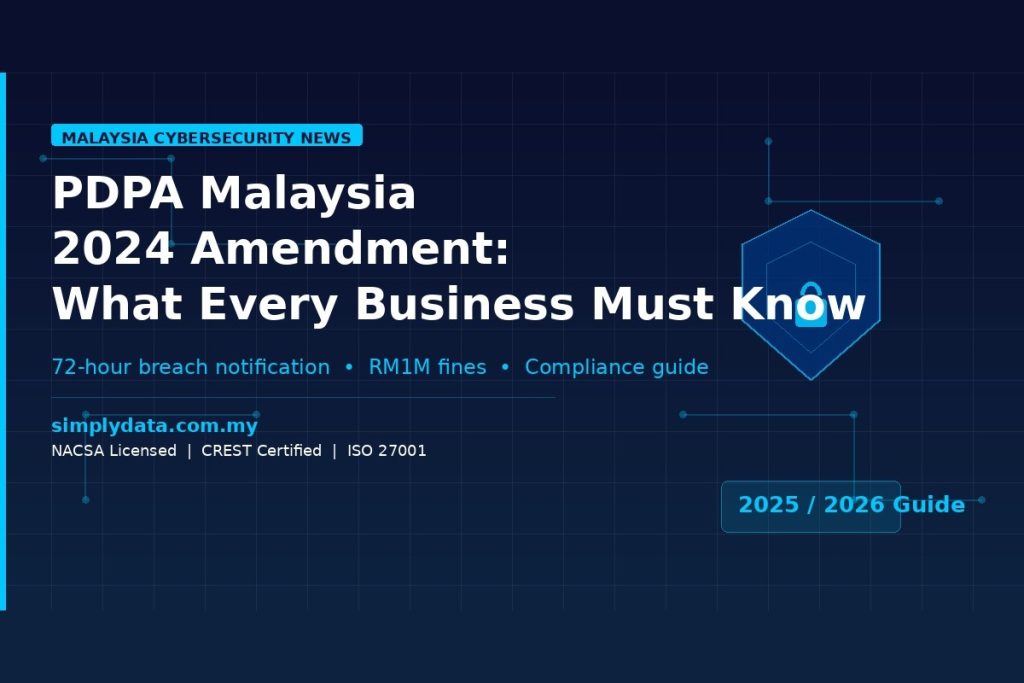
PDPA Malaysia 2024 brings the most significant changes to data protection law since the Act was introduced. With mandatory breach notifications, expanded data subject rights, and fines up to RM1 million, every Malaysian business must act now to ensure compliance.
What Changed in the PDPA Malaysia Amendment 2024?
Malaysia’s Personal Data Protection Act (PDPA) 2010 was long overdue for a major overhaul. The Personal Data Protection (Amendment) Act 2024 was passed by Parliament and has reshaped how Malaysian businesses must handle personal data. The amendments introduce stricter obligations, larger fines, and — most critically — a mandatory breach notification requirement that many Malaysian organisations are still unprepared for.
If your business collects, processes, or stores personal data of Malaysian individuals — and virtually every business does — this is not optional reading. Non-compliance now carries penalties that can cripple an SME overnight.
The 5 Most Important PDPA Changes Malaysian Businesses Must Know
1. Mandatory Data Breach Notification (72 Hours)
This is arguably the biggest change. Under the amended PDPA, organisations that suffer a personal data breach must now notify the Personal Data Protection Commissioner within 72 hours of becoming aware of the breach — and notify affected data subjects as soon as practicable.
Previously, there was no mandatory notification timeline. Many breaches went unreported. Now, silence equals liability.
What counts as a notifiable breach?
- Unauthorised access to personal data (e.g. from a cyberattack, phishing, or insider threat)
- Accidental disclosure of personal data (e.g. emailing a database to the wrong party)
- Loss or destruction of personal data (e.g. an unencrypted laptop stolen from a car)
- Any breach likely to result in harm to data subjects (financial loss, discrimination, identity theft)
The implication: Your organisation needs a documented Incident Response Plan that specifically covers data breach scenarios. Without one, meeting the 72-hour clock is nearly impossible.
2. Increased Penalties — Up to RM1 Million Per Offence
Under the old PDPA, the maximum fine for a data breach was RM300,000. The 2024 amendment increases the penalty ceiling to RM1 million per offence for organisations, with additional provisions for imprisonment of responsible officers.
For context: Simply Data Malaysia Cybersecurity Threat Report 2025 found that the average cost of a data breach in Malaysia has risen to RM3.2 million — factoring in regulatory fines, legal costs, reputational damage, and customer churn. The PDPA fine is just one component of that total exposure.
3. Expanded Definition of Sensitive Personal Data
The amendment expands what qualifies as sensitive personal data — the category requiring the highest level of protection. It now explicitly includes:
- Biometric data (fingerprints, facial recognition data)
- Genetic data
- Location data (persistent tracking of an individual’s whereabouts)
- Financial transaction data
Businesses in fintech, healthcare, e-commerce, and HR technology are particularly affected by this expansion.
4. Data Processor Accountability
Previously, PDPA obligations primarily fell on the data user (the organisation that decided why and how personal data was processed). The amendment now extends direct accountability to data processors — third-party vendors, SaaS providers, and outsourced IT teams that handle data on behalf of another organisation.
This means: if you are a vendor processing customer data on behalf of a client, you can now be directly fined under PDPA, not just the client. And if you engage vendors who process your customer data, your vendor contracts must now include proper data processing agreements.
5. Right to Data Portability and Erasure
The amendment strengthens data subject rights by introducing a clearer right to erasure (the “right to be forgotten”) and the principle of data portability, allowing individuals to request their data in a machine-readable format to transfer to another service provider.
This is a significant operational change for e-commerce, fintech, and subscription-based businesses that manage large customer databases.
Who Is Most at Risk Under the New PDPA?
While PDPA applies to all organisations processing personal data of Malaysian residents, these sectors face the highest enforcement risk under the amendments:
- Financial services (banks, insurers, fintech) — Already subject to BNM RMiT; PDPA adds another compliance layer
- Healthcare and medical clinics — Patient data is sensitive personal data under the expanded definition
- E-commerce and retail — Large customer databases with payment data exposure
- HR and recruitment firms — Process extensive employee and candidate personal data
- Cloud SaaS providers and IT vendors — Now directly accountable as data processors
Is Your Business Ready? A 7-Point PDPA Compliance Checklist
Use this checklist to assess your current readiness against the PDPA Amendment 2024 requirements:
- Data Inventory — Have you mapped all personal data your organisation collects, where it is stored, who has access, and how long it is retained?
- Privacy Notice — Is your privacy notice updated to reflect the expanded data subject rights (erasure, portability) and the new processing categories?
- Breach Notification SOP — Do you have a documented, tested procedure to detect, assess, and notify a data breach within 72 hours?
- Vendor Agreements — Do your contracts with IT vendors, cloud providers, and outsourced teams include proper Data Processing Agreements (DPAs)?
- Security Controls — Are your technical controls — encryption, access management, endpoint protection — sufficient to demonstrate “appropriate measures” under PDPA?
- Staff Training — Have all staff who handle personal data received PDPA awareness training in the past 12 months?
- Incident Response Plan — Does your IRP include a specific section for personal data breach response, with defined escalation paths and notification templates?
If you answered “no” or “unsure” to any of the above, your organisation has a compliance gap that carries real legal and financial risk.
The Connection Between PDPA Compliance and Cybersecurity
Here is the critical insight that many compliance officers miss: PDPA compliance is fundamentally a cybersecurity problem.
The reason a 72-hour breach notification requirement is challenging is not legal — it is technical. To notify within 72 hours, you must:
- Detect the breach quickly (requires security monitoring)
- Contain it before further data is exposed (requires incident response capability)
- Investigate what data was compromised (requires forensics and logging)
- Notify the Commissioner and affected users with accurate details
According to Simply Data 2025 Malaysia Cybersecurity Threat Report, the average dwell time (time between a breach occurring and it being detected) for Malaysian organisations without managed security monitoring is over 200 days. That is 200 days before you even start the 72-hour clock.
A Managed SOC (Security Operations Centre) with 24/7 monitoring is one of the most direct ways to close this gap — not just for PDPA compliance, but for BNM RMiT, ISO 27001, and your organisation’s overall resilience.
What Simply Data Recommends
PDPA compliance is not a one-time project — it is an ongoing operational discipline. The organisations that handle breaches best are not those with the thickest policy documents; they are the ones with live security monitoring, tested incident response plans, and a clear chain of accountability.
At Simply Data, we help Malaysian organisations achieve PDPA readiness through:
- Security Posture Assessment (SPA) — Identify gaps in your current controls against PDPA and ISO 27001 requirements
- Managed SOC / MDR — 24/7 threat monitoring that enables rapid breach detection and the evidence base for notification
- Cybersecurity Consultancy — PDPA gap analysis, DPA templates, breach response SOP development, and staff training
If you are unsure where your organisation stands, contact us for a free initial consultation. We will help you understand your PDPA risk exposure and the practical steps to address it.
Simply Data Sdn. Bhd. is a NACSA-licensed, CREST-certified cybersecurity company headquartered in Puchong, Selangor. We provide managed SOC, VAPT, and cybersecurity consultancy services to Malaysian organisations across finance, healthcare, manufacturing, and government sectors.
Resources and Further Reading on Pdpa Malaysia 2024
For organisations looking to strengthen their cybersecurity posture, the following authoritative resources provide valuable guidance: Malaysia Personal Data Protection Department | NACSA Malaysia.
Simply Data offers a full suite of cybersecurity and technology solutions tailored for Malaysian businesses. Explore our services: Cybersecurity Consultancy Services | SOC Managed Services. Ready to get started? Contact our cybersecurity experts for a free consultation today. For end-to-end PDPA compliance support, Simply Data is a leading cybersecurity company in Malaysia helping businesses implement the right data protection controls. For end-to-end PDPA compliance support, Simply Data is a leading cybersecurity company in Malaysia helping businesses implement the right data protection controls.
What are the key changes in the PDPA 2024 amendment for Malaysian businesses?
The 2024 amendment strengthens data protection requirements including stricter consent management, enhanced breach notification timelines, and increased penalties for non-compliance, reaching up to RM1 million in fines.
What must Malaysian businesses do to comply with the PDPA amendment?
Businesses must audit their data handling practices, update privacy policies, implement secure data storage, establish breach notification procedures, and ensure staff understand the new requirements through regular training.
When does the PDPA 2024 amendment take effect?
The amendment has specific implementation phases. Malaysian businesses should verify current compliance deadlines with the Commissioner of Law Enforcement to avoid hefty penalties and protect customer trust.