
CVE-2026-119618: Is the Apache HTTP/2 Flaw Urgent for Malaysian Origins?
Simply Data recommends urgent action on CVE-2026-119618 if your Apache origin runs an affected mod_http2 build, has HTTP/2 enabled and can be reached by untrusted clients. The issue is not a universal emergency: servers on HTTP/1.1 only, or already on a vendor-fixed package, are not exposed in the same way. This advisory is dated 13 November 2026.
Apache describes CVE-2026-119618 as a critical concurrency flaw in mod_http2 that causes heap corruption and can lead to remote code execution, and fixed it in Apache HTTP Server 2.4.71, released on 11 November 2026 (Apache security advisory; oss-security announcement).
Red Hat adds that an unauthenticated remote attacker who can reach the web server could execute arbitrary commands, and that servers configured to serve only HTTP/1.1 are not vulnerable (Red Hat CVE page). The notes below are for Malaysian teams running WordPress, hosting panels or other Apache origins.
Is CVE-2026-119618 urgent for every Apache server?
No. Urgency depends on three conditions being true at the same time. First, the installed module must be an affected build. Second, HTTP/2 must be enabled: Red Hat states that the issue affects servers with HTTP/2 (h2 or h2c) enabled through the Protocols directive (Red Hat). Third, an attacker must be able to reach that listener, whether from the internet or from a network segment you do not fully trust.
Where all three hold, treat it as a priority change. Red Hat rates the flaw Critical and says public research has demonstrated a reliable exploit against a default-configured server with the mod_http2 module enabled (Red Hat). We have not verified in-the-wild exploitation in the primary sources reviewed for this advisory, but that is not evidence that attacks are not happening.
Severity also differs by platform. Red Hat rates its Red Hat Enterprise Linux 9 and 10 packages Important instead of Critical, because each HTTP/2 stream is allocated from a separate allocator, which substantially increases the complexity of exploitation. It also says Red Hat Enterprise Linux 8 and earlier are not affected (Red Hat). A lower rating is still a reason to patch, not a reason to wait indefinitely.
Which Apache builds and packages are affected?
For CVE-2026-119618, Apache lists Apache HTTP Server 2.4.55 through 2.4.70 as affected, along with standalone mod_h2 releases from GitHub 2.0.8 through 2.0.42 (Apache). For upstream Apache HTTP Server source builds, 2.4.71 is the confirmed fixed release. For standalone GitHub mod_h2, we have not verified a fixed standalone release. Follow the applicable vendor or maintainer advisory and verify that the running server loads the corrected module; an httpd update alone does not prove that a separately installed module was replaced.
Distribution packages need more care, because the version string alone can mislead in both directions. Ubuntu notes that newer versions of the module have been backported to its stable releases, so its 22.04 LTS package was affected despite carrying a 2.4.52 version number, and its fixed packages keep their older-looking numbers (Ubuntu). Compare your exact package version with your vendor advisory, not with the upstream range.
| Branch | Fixed version or status | Primary source |
|---|---|---|
| Apache HTTP Server (upstream) | 2.4.71, released 11 November 2026 | Apache |
| Ubuntu 26.10 | 2.4.68-1ubuntu6.2 | Ubuntu |
| Ubuntu 26.04 LTS | 2.4.66-2ubuntu2.8 | Ubuntu |
| Ubuntu 24.04 LTS | 2.4.58-1ubuntu8.19 | Ubuntu |
| Ubuntu 22.04 LTS | 2.4.52-1ubuntu4.27 | Ubuntu |
| Ubuntu 20.04 LTS | 2.4.41-4ubuntu3.23+esm11, available with Ubuntu Pro | Ubuntu |
| Debian bookworm (security) | 2.4.71-1~deb12u1 | Debian |
| Debian trixie (security) | 2.4.71-1~deb13u1 | Debian |
| cPanel EasyApache 4 | ea-apache24 updated to 2.4.71 in version 25.96, 12 November 2026 | cPanel |
| Red Hat Enterprise Linux 9 and 10 | Affected, rated Important; see the vendor affected packages table | Red Hat |
| Red Hat Enterprise Linux 8 and earlier | Not affected | Red Hat |
Ubuntu also lists 18.04 LTS, 16.04 LTS and 14.04 LTS as not affected (Ubuntu). Vendor pages change, so recheck the status on the day you patch.
How do you confirm HTTP/2 is enabled and reachable on the origin?
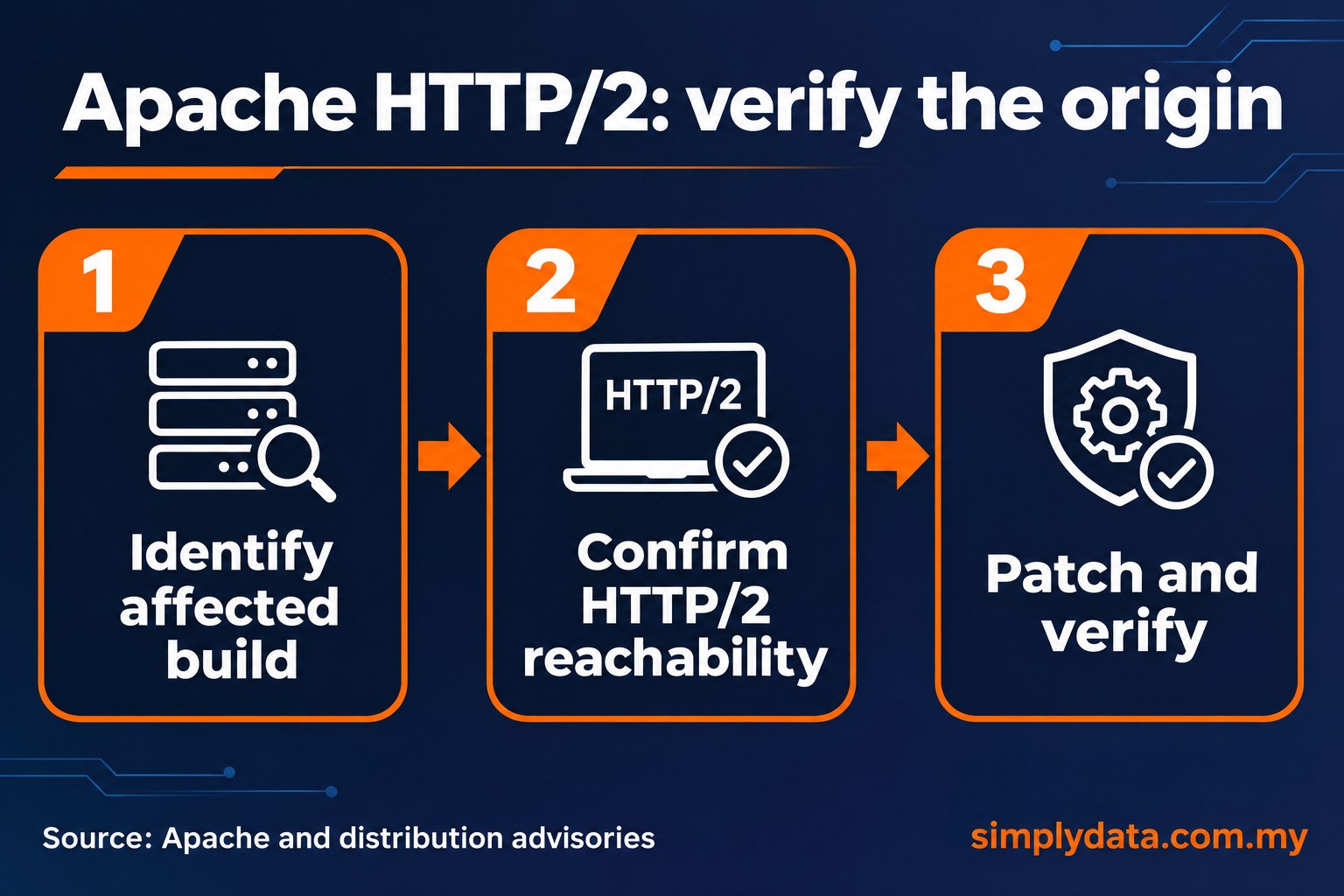
Work from the origin outwards. Review the effective Apache configuration, including every virtual host and any panel-generated include files, for a Protocols directive that lists h2 or h2c. Confirm whether the HTTP/2 module is loaded in the running server, since a module that is installed but not loaded, or loaded but not enabled, is a different risk from one that is serving traffic.
Then test reachability from outside. An authorised external check against the origin address, not just the public hostname, shows whether the listener negotiates HTTP/2 with clients that bypass your CDN or load balancer. Remember h2c, the cleartext variant, which can be enabled on internal ports that are assumed to be private. Record what you found, when and from where, because that record becomes the baseline for your retest.
Does a CDN or a WordPress update fix the problem?
Neither is proof. A CDN that serves HTTP/2 to visitors tells you about the edge, not the origin. The edge-to-origin connection may use a different protocol, and the origin may still accept direct connections if its address is known and its firewall allows them. Equally, seeing HTTP/2 in a browser does not prove that your origin speaks it. Check the origin itself.
WordPress updates are a separate layer. Updating WordPress core, themes or plugins does not patch CVE-2026-119618, because the Apache package is maintained by the operating system, the hosting panel or your hosting provider. On shared or managed hosting, ask the provider in writing which Apache build is running, whether HTTP/2 is enabled on the origin and when the fixed package was applied.
For cPanel servers, the EasyApache 4 change log shows ea-apache24 moving from 2.4.70 to 2.4.71 in version 25.96, dated 12 November 2026 (cPanel change log). Confirm that your own server has actually received that update.
What should the remediation checklist include?
The commands for patching CVE-2026-119618 differ by distribution, panel and build, so follow your vendor documentation and your own change process. The sequence below is the part that stays the same.
- Inventory every Apache origin, including staging, legacy and panel-managed servers, and record the exact package version.
- Compare each version with the vendor advisory for that platform and mark it affected, fixed or not affected.
- Record whether h2 or h2c is enabled and whether the listener is reachable from untrusted networks.
- Prioritise servers where all three conditions are true and raise a change request for each.
- If the patch cannot be applied promptly, consider temporarily disabling HTTP/2 on the affected origin under change control, after testing the effect on your sites.
- Take a backup or snapshot, then apply the vendor-patched package.
- Restart the service as your vendor instructs, so that the running processes load the fixed module.
- Verify afterwards, restore HTTP/2 if you disabled it, and keep the evidence with the change record.
On the temporary measure: Red Hat states that servers configured to serve only HTTP/1.1 are not vulnerable (Red Hat). Disabling HTTP/2 can change performance and behaviour for some clients, and it has to cover every virtual host and port. Treat it as a tested, approved and reversible change, not a quick edit. It reduces exposure until the patch lands; it does not replace the patch.
What proves the fix is really in place?
A successful package installation is not proof on its own. Evidence that CVE-2026-119618 is remediated should cover four points:
- The vendor identifies the installed package as fixed for your exact distribution release, package and supported update branch.
- The service was restarted after the update in the way your vendor requires, so no old process is still running the previous module.
- The configuration is in its intended state on every virtual host.
- An external retest shows the expected protocol behaviour on the origin.
Keep the outputs, timestamps and change ticket together. If a hosting provider did the work, ask for the same evidence, not a one-line confirmation. An authorised retest by a party that did not make the change adds independent assurance. It should confirm version, configuration and reachability without running exploit code against a production server.
How should you hunt for signs of compromise?
If an origin affected by CVE-2026-119618 was reachable with HTTP/2 enabled before it was patched, a proportionate review is sensible. Keep two kinds of evidence apart, because they answer different questions.
- Web server telemetry. Access logs and HTTP/2-related entries in the error log can show unusual connection patterns, protocol errors or unexpected worker exits during the exposure window. They show what reached the server, not what ran on it, and a memory corruption attempt may leave little or no trace there.
- Endpoint process evidence. EDR or audit telemetry can show the web server account starting unexpected child processes, writing new files or opening outbound connections. This is closer to evidence of code execution, but it depends on what was collected and retained.
Neither source can prove that a server is clean. Missing indicators may mean no attack, or they may mean limited logging, short retention or an attacker who removed traces. State what you checked, the period covered and the gaps. If you find something suspicious, preserve the evidence before rebuilding and consider a formal compromise assessment.
How can Simply Data help?
Simply Data provides VAPT and managed SOC services for Malaysian organisations. For this issue, an authorised penetration testing engagement or retest can validate build, configuration and origin reachability within an agreed scope, and report the evidence in a form that management and auditors can use.
For monitoring, the Security Operations Centre team can support telemetry-based hunting with the logs and endpoint data you already send.
We are not claiming a deployed detection specific to this CVE; the work described here is scoped review and hunting. Simply Data Sdn. Bhd. holds NACSA licences for penetration testing and managed SOC monitoring under the Cyber Security Act 2024.
To scope a VAPT or retest of your Apache origins for CVE-2026-119618, contact Simply Data with your server list and hosting details.
Frequently asked questions
Is CVE-2026-119618 urgent for every Apache server?
No. It is urgent where an affected mod_http2 build is installed, HTTP/2 (h2 or h2c) is enabled and the listener is reachable by untrusted clients. Red Hat states that servers serving only HTTP/1.1 are not vulnerable. Check each origin against your vendor advisory before deciding priority.
Does updating WordPress fix the Apache HTTP/2 flaw?
No. WordPress core, theme and plugin updates do not change the Apache package. The fix comes from the operating system vendor, the hosting panel or your hosting provider. On shared or managed hosting, ask the provider to confirm the Apache build, the HTTP/2 setting on the origin and the date the fixed package was applied.
If my CDN serves HTTP/2, is my origin affected?
Not necessarily, and the reverse is also true. HTTP/2 at the CDN edge describes the visitor connection, not the origin. The origin may use a different protocol, or may accept direct connections that bypass the CDN. Review the origin configuration and test origin reachability directly, with authorisation.
What evidence shows the fix has been applied?
Keep four items: the installed package version matched against the vendor fixed version, proof that the service was restarted as the vendor requires, the reviewed configuration, and an external retest result. Store them with the change record. A package update alone does not show that running processes loaded the fixed module.