
Vulnerability Assessment Malaysia vs Penetration Testing: Key Differences Explained
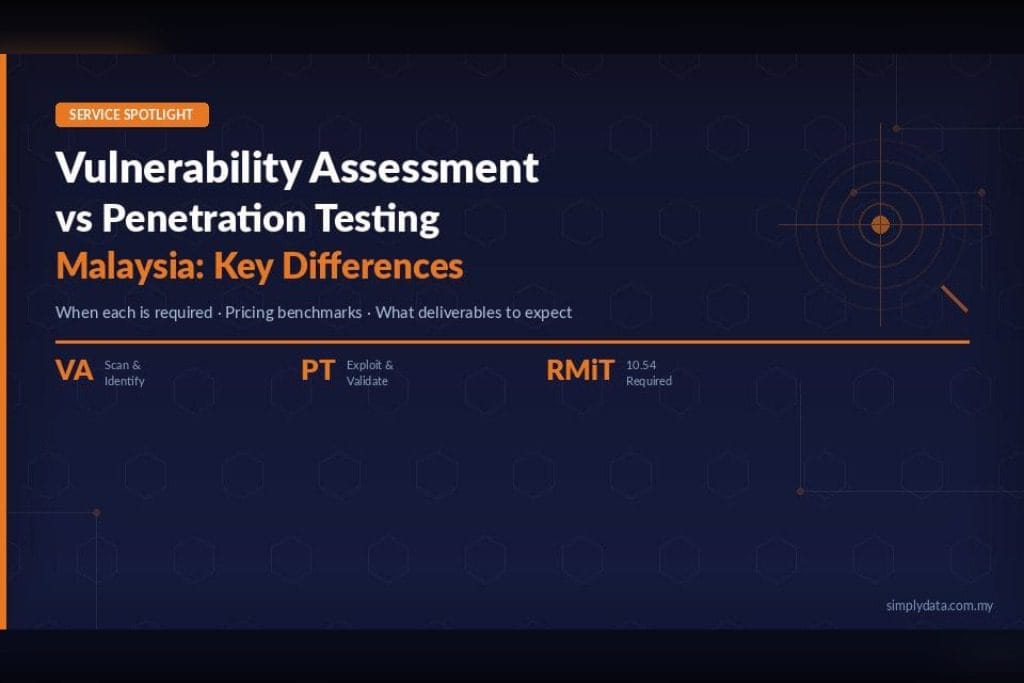
Understanding vulnerability assessment Malaysia requirements is essential for every Malaysian organisation planning its cybersecurity programme. A vulnerability assessment Malaysia exercise systematically identifies weaknesses in your IT environment, while a penetration test actively exploits those weaknesses to demonstrate real-world risk. Both are required under key Malaysian regulations — Bank Negara Malaysia (BNM) RMiT mandates annual penetration testing for financial institutions, and NACSA’s guidelines recommend regular vulnerability assessments for all CNII entities. Knowing when to use each helps you allocate budget effectively and meet compliance obligations.
What Is a Vulnerability Assessment Malaysia Exercise?
A Vulnerability Assessment (VA) is a systematic examination of your IT systems, networks, and applications to identify security weaknesses — unpatched systems, misconfigurations, weak credentials, insecure protocols, and known vulnerabilities. A VA produces a prioritised list of vulnerabilities with severity ratings, allowing you to focus remediation efforts on the highest-risk issues first.
What Is Penetration Testing?
A Penetration Test (PT), or “pentest,” goes beyond vulnerability identification. A pentest simulates a real-world attack — a qualified ethical hacker attempts to exploit the vulnerabilities discovered during a VA (or finds new ones) to gain unauthorised access to systems, steal data, or move laterally through your network. The goal is to demonstrate the business impact of vulnerabilities and validate your organisation’s ability to detect and respond to attacks.
Side-by-Side Comparison: VA vs PT
| Aspect | Vulnerability Assessment | Penetration Test |
|---|---|---|
| Scope | Comprehensive scan of all systems, networks, applications | Targeted exploitation of specific systems or attack vectors |
| Method | Automated scanning tools + manual review | Manual testing simulating real attacker tactics |
| Focus | Identification and inventory of weaknesses | Demonstration of exploitability and business impact |
| Output | Vulnerability list with CVSS scores | Evidence of compromise + detailed attack narrative |
| Skill Level | Can be performed by junior security engineers | Requires expert-level hacking skills |
| Cost (Malaysia) | RM 10,000–50,000 depending on scope | RM 30,000–150,000+ depending on depth |
| Timeline | 1–2 weeks | 2–4 weeks |
| Frequency | Quarterly or bi-annually | Annually (minimum) |
When You Need Each
Vulnerability Assessment Is Required When:
- Initial Security Baseline: You are establishing a baseline understanding of your security posture.
- Network Monitoring: You need regular scanning to detect new vulnerabilities introduced by system changes or patches.
- Compliance with BNM RMiT: Section 10.54 requires regular vulnerability assessments for financial institutions.
- NACSA Guidelines: NACSA (National Cyber Security Agency Malaysia) recommends vulnerability assessments as part of the cybersecurity baseline for all CNII entities under the Cyber Security Act 2024.
- MyCERT Advisories: MyCERT (Malaysia Computer Emergency Response Team) regularly publishes technical advisories on newly discovered vulnerabilities affecting Malaysian organisations — making regular VA cycles essential to staying ahead of known threats.
- Compliance with PDPA: The Security Principle requires organisations to identify and remediate security weaknesses.
- Budget-Constrained: You have limited budget and need the most cost-effective security testing option.
Penetration Testing Is Required When:
- Compliance Mandate: Cyber Security Act 2024, BNM RMiT, PDPA, and ISO 27001 all reference penetration testing as a key control validation mechanism.
- High-Risk Application: You run mission-critical systems handling sensitive data (banking, healthcare, government).
- Regulatory Audit: Your external auditors (BNM, SC, PDPC) have mandated penetration testing as part of your audit scope.
- Incident Investigation: Following a security incident, a pentest validates that your remediation efforts are effective.
- Third-Party Risk Assessment: Before engaging a new cloud provider or critical vendor, a pentest validates their security.
- Security Control Validation: You need proof that your detective and preventive controls (WAF, IDS, EDR) actually work.
Malaysian Regulatory Context for Vulnerability Assessment Malaysia
BNM RMiT (Risk Management in Technology): Section 10.54 requires financial institutions to conduct vulnerability assessments at least annually. Section 10.55 requires periodic penetration testing (frequency depends on risk rating of the institution).
Cyber Security Act 2024: All CNII entities must undergo regular cybersecurity assessments, which include vulnerability identification and penetration testing. NACSA-approved assessors conduct these assessments.
PDPA (Personal Data Protection Act): The Security Principle requires organisations to implement “practical steps” to protect personal data. Both VA and PT are considered industry-standard practical steps.
ISO 27001: Control A.14.2.5 requires vulnerability testing before a system is deployed into production, and A.14.2.6 requires regular vulnerability testing of released systems.
Choosing Your Vulnerability Assessment Malaysia or Penetration Testing Provider
Look For:
- Relevant Certifications: Testers should hold OSCP, GWAPT, GPEN, or equivalent certifications.
- Industry Experience: Ensure the provider understands Malaysian industries (banking, telco, healthcare) and their compliance requirements.
- Regulatory Alignment: The provider should be familiar with BNM RMiT, Cyber Security Act 2024, PDPA, and NACSA frameworks.
- Local Presence: A provider with local offices in Malaysia ensures on-site testing, faster turnaround, and support with regulatory engagement.
- Post-Testing Support: The engagement should include remediation guidance and optional re-testing after fixes are applied.
Average Costs in Malaysia (2026):
- Vulnerability Assessment: RM 15,000–50,000 (depending on network size and complexity)
- Penetration Test (external): RM 40,000–100,000 (1–2 week engagement)
- Penetration Test (internal + external): RM 80,000–150,000+ (comprehensive engagement)
- Application Penetration Test: RM 30,000–80,000 (per application)
Simply Data provides both vulnerability assessment and penetration testing services tailored to Malaysian regulatory requirements. Learn more about our VAPT offerings or contact us to discuss your security testing needs.
Whether you need a vulnerability assessment Malaysia service, a full penetration test, or a combined VAPT programme, Simply Data licensed cybersecurity team can help you meet your compliance obligations and reduce risk. Contact us for a free consultation.