Malaysia’s 2026 Cybersecurity Landscape: AI Threats, Emerging Attack Vectors & What Every SME Must Do Now
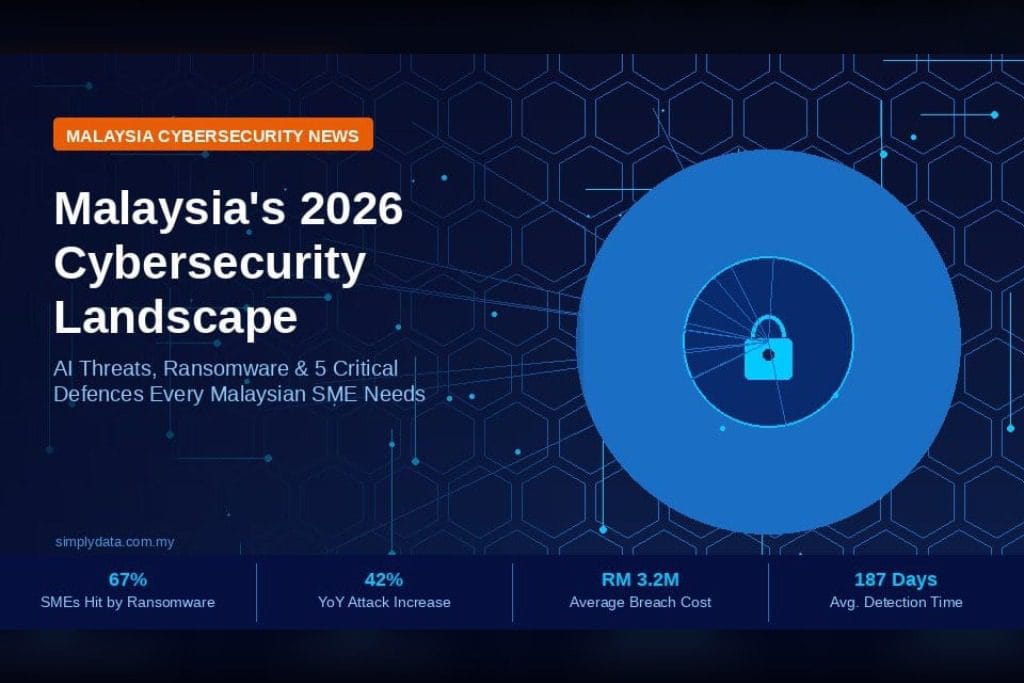
Malaysia cybersecurity 2026 is defined by the rapid evolution of AI-driven threats, deepfake social engineering, and increasingly sophisticated ransomware targeting SMEs. Understanding the landscape is the first step to building resilient defences.
Malaysia’s 2026 Cybersecurity Landscape: What Changed, What’s New, and What You Must Do
Malaysia’s cybersecurity landscape in 2026 looks dramatically different from 2024. AI-powered attacks are no longer experimental—they’re operational. Critical infrastructure is under persistent siege. And SMEs, which represent the backbone of Malaysia’s economy, remain dangerously unprepared.
This guide synthesizes the latest intelligence from CyberSecurity Malaysia, the National Cybersecurity Strategy (NACSA), and frontline incident response data to help you understand the threats your business faces—and the concrete steps to defend against them.
The Malaysia Cybersecurity Landscape 2026 at a Glance
Key statistics:
- Ransomware attacks on Malaysian businesses: Up 42% year-over-year (CyberSecurity Malaysia Annual Report 2025)
- SMEs affected by ransomware: 67% (compared to 48% in 2024)
- Potential data breach impacts: operational disruption, financial losses and reputational damage
- Time to detect a breach: 187 days average (up from 156 days in 2024—attacks are stealthier)
Why the Landscape Has Shifted
Three major forces are reshaping Malaysia’s cyber threat environment:
1. AI-Powered Attack Automation
- Attackers now use large language models (LLMs) to craft personalized phishing emails, generate social engineering scripts, and analyze target networks at scale
- Detection becomes harder because AI-generated malware evades traditional signatures
- Human defenders are overwhelmed—automation has shifted the attacker-defender balance
2. Increased Targeting of Malaysian Critical Infrastructure
- Threat actors from China, Russia, and North Korea are actively targeting Malaysian utilities, finance, and healthcare
- NACSA has elevated cybersecurity to a national security priority in response
- Recent incidents: Banking sector incidents (2025), healthcare data breaches, power grid vulnerability disclosures
3. SME Consolidation as Targets
- Attackers increasingly target SMEs in Malaysia because: – Fewer security resources (compared to enterprises) – Often vendors/suppliers to larger firms (supply chain access) – Less likely to have formal incident response plans
- A compromised SME is a backdoor into a multinational’s supply chain
Malaysia’s National Cybersecurity Strategy (NACSA) 2024–2028
To address these threats, Malaysia’s National Cybersecurity Agency (NACSA) launched the National Cybersecurity Strategy (NCS) 2024–2028, with four pillars:
| Pillar | Focus | Impact on SMEs |
|---|---|---|
| Cyber Resilience | Strengthen national critical infrastructure; national SOC expansion | Government-led; helps set security baseline for suppliers |
| Cyber Defence | Build skilled cybersecurity workforce; standardize security controls | NACSA incentive programs for SME training; Skills Malaysia initiatives |
| Cyber Diplomacy | International cooperation on cyber threats | Helps Malaysia join global intelligence sharing (affects threat alerts) |
| Cyber Literacy | Public awareness and SME education | Free NACSA security resources, webinars, and guidelines |
What this means for SMEs: NACSA is actively pushing cybersecurity down to SME level. The government recognizes that national security depends on SME resilience. To understand the full scope of Malaysia’s cybersecurity legislation, read our guide to the NACSA Cybersecurity Act 2024. Expect:
- Free cybersecurity assessments from NACSA partners
- Subsidized training programs
- Stronger vendor security requirements from large corporates
- Regulatory pressure (e.g., PDPA fines, BNM guidelines)
The Biggest Cyber Threats Facing Malaysia in 2026
1. Ransomware (The #1 Threat)
Current landscape:
- Ransomware attacks on Malaysian businesses: +42% YoY
- Ransom demands vary by incident.
- Sectors hit hardest: Healthcare, manufacturing, finance
Why ransomware explodes in Malaysia:
- Attackers know that healthcare and manufacturing can’t afford downtime (willing to pay ransom)
- Insurance hasn’t caught up (many SMEs lack cyber insurance or have gaps)
- Recovery is slow (many Malaysian SMEs lack backups)
Recent examples (2025):
- A ransomware incident can involve a ransom demand as well as operational disruption.
- A manufacturing plant in Selangor lost 2 weeks of production to Cl0p ransomware
- Banking partners of Malaysian SMEs reported supply chain ransomware
How attackers operate: 1. Phishing → employee credentials compromised 2. Lateral movement → attacker moves through network for 1–3 months undetected 3. Privilege escalation → attacker gains admin access 4. Encryption → files encrypted; ransom note displayed
Cost if hit:
- Ransom demand: varies by incident
- Downtime impact: depends on the affected operations and outage duration
- Recovery & remediation: depends on the affected systems and incident scope
- Regulatory fines (PDPA, BNM): RM 100K–500K
- Total incident impact: depends on disruption, recovery needs and regulatory consequences
2. AI-Powered Social Engineering & Phishing
AI has fundamentally changed phishing in 2026.
Old phishing (2023): “Congrats! You won a prize. Click here.” New phishing (2026): Personalized, context-aware emails that sound like they come from colleagues or customers.
How AI makes phishing deadlier:
- LLMs generate convincing copy: AI writes emails that match your company’s tone, reference specific projects, use insider terminology
- Deepfakes create trust: AI-generated videos or audio can impersonate executives (“CEO fraud” on steroids)
- Scale: Attackers can launch thousands of personalized campaigns simultaneously
- Evasion: AI-generated malware avoids traditional signature-based detection
Malaysian examples (2025):
- AI-generated emails impersonating executives can deceive employees into making unauthorised transfers.
- A Selangor manufacturer received a convincing email posing as a customer ordering urgent supplies. Attacker collected customer list and pricing data.
Why SMEs are vulnerable:
- Limited email security (no advanced threat protection)
- Minimal security awareness training (see our phishing simulation services)
- Credential reuse (same password for multiple systems)
- No MFA (multi-factor authentication) on critical systems
3. Supply Chain Attacks
Malaysian SMEs often serve as vendors to larger corporations and multinationals. Attackers know this.
Attack flow: 1. Compromise an SME vendor → steal their access credentials or software 2. SME delivers compromised software/data to large customer 3. Large customer is breached → attacker gains access to national critical infrastructure
Malaysian context:
- Malaysia’s supply chain is deeply integrated with ASEAN and global markets
- A compromise in a Malaysian components supplier can ripple to Singapore, Thailand, Indonesia
- Electronics manufacturing, automotive parts, food processing—all targets
Compromised firmware updates can spread malware to downstream customers and cause operational damage.
4. Data Exfiltration & PDPA Violations
Unlike ransomware (which encrypts and demands payment), exfiltration attacks silently steal data.
What’s at risk:
- Customer personal data (names, phone, email, ID number) → PDPA violation
- Business data (designs, formulas, customer lists, pricing) → competitive damage
- Employee data (salaries, performance reviews, health records) → regulatory fine
PDPA fines in 2025-2026:
- First offence: Up to RM 750K
- Repeat offence: Up to RM 1.5M
- Plus: Customer notification costs, credit monitoring, reputational damage
Why exfiltration is growing:
- Ransomware is getting harder (better backups, more SMEs are prepared)
- Exfiltration is quieter—victim doesn’t know they’ve been breached for months
- Stolen data has real value (sold on dark web, used for identity theft, competitive espionage)
5. IoT & Operational Technology (OT) Attacks
Manufacturing plants, utilities, and healthcare facilities increasingly rely on IoT sensors and OT systems. These systems are often:
- Older (legacy software, no patches)
- Connected to the internet (for monitoring dashboards)
- Running proprietary OS (harder to secure, no security updates)
Malaysian manufacturing example (2025):
- A Johor automotive parts plant’s factory floor sensors were compromised
- Attacker modified production parameters
- 10,000 defective parts were manufactured before detection
- Potential impact: wasted resources and legal liability to the customer
The Cyber Threat Landscape by Malaysian Industry
Manufacturing
- Top threat: Ransomware + supply chain attacks
- Why vulnerable: Legacy OT systems, BYOD policies, global supply chain integration
- Compliance: ISO 27001, customer demands (often from foreign OEMs)
Healthcare
- Top threat: Data exfiltration (patient records), ransomware (operational disruption)
- Why vulnerable: HIPAA-equivalent regulations (PDPA), patient data is high-value, systems often must stay online
- Compliance: PDPA, BNM guidelines, healthcare-specific standards
Finance & Banking
- Top threat: Credential theft, insider threats, supply chain compromise
- Why vulnerable: High-value targets, sophisticated attackers, regulatory scrutiny
- Compliance: BNM RMiT, PDPA, AML/CFT regulations
E-commerce & Retail
- Top threat: Payment card data theft, customer PII exfiltration
- Why vulnerable: Customer-facing systems, payment integration, high transaction volume
- Compliance: PCI DSS (if handling cards), PDPA
Government & Critical Infrastructure
- Top threat: State-sponsored APT (Advanced Persistent Threats), infrastructure disruption
- Why vulnerable: High-value intelligence targets, often behind on security
- Compliance: National security frameworks (NACSA), government-specific standards
Why Malaysian SMEs Lag Behind on Cybersecurity
The Hard Truth
- 67% of Malaysian SMEs were hit by ransomware in 2025 (up from 48% in 2024)
- Only 18% of Malaysian SMEs have a formal incident response plan
- Average time to detect a breach: 187 days (attacker has free rein for 6+ months)
- Most SMEs are not PDPA-compliant (fines coming soon)
Why the Gap?
| Challenge | Why SMEs Struggle | Impact |
|---|---|---|
| Cost | Hiring security staff requires internal headcount, training and retention effort | SMEs prefer to spend elsewhere |
| Complexity | Security tools require expertise to deploy/manage | Overwhelming for small IT teams |
| Awareness | Decision-makers don’t understand cyber risk | No budget allocation; “it won’t happen to us” mindset |
| Compliance pressure | PDPA, BNM, industry-specific rules keep changing | Constant adaptation; no clarity |
| Talent shortage | Malaysia has ~8,000 cybersecurity professionals; demand is 20,000+ | Impossible to hire skilled staff |
Five Critical Actions Every Malaysian SME Must Take Now
1. Conduct a Cybersecurity Risk Assessment
What: Understand what data you have, where it lives, and who can access it.
Action:
- List all customer/employee data (databases, spreadsheets, file shares, cloud storage)
- Map who has access (employees, contractors, vendors)
- Identify compliance obligations (PDPA? BNM? Industry-specific?)
- Document current security controls (firewalls, backups, MFA, encryption)
Cost drivers: number of systems, sites and policies in scope (use a managed service provider or NACSA-approved consultant)
Timeline: 2–4 weeks
2. Implement Basic Security Controls (Non-Negotiable)
What: Deploy foundational defences that block 80% of attacks.
| Control | Why It Matters | Cost (Monthly) |
|---|---|---|
| Multi-Factor Authentication (MFA) | Blocks 99.9% of credential-based attacks | Scoped to users and devices |
| Email Security Gateway | Stops phishing emails before they reach employees | Subscription, scoped per environment |
| Backup & Disaster Recovery | Ransomware can’t extort you if you have clean backups | Scoped to systems and data volume |
| Firewall / Network Segmentation | Prevents lateral movement if one device is compromised | Scoped per engagement |
| Patch Management | Closes vulnerabilities that attackers exploit | Scoped to users and devices |
Overall scope: depends on users, endpoints and data volume
For context: Ransomware can disrupt operations and cause financial losses. These controls support prevention, detection and recovery.
3. Train Your Employees (Cyber Awareness)
Why: 85% of breaches involve human error (phishing, credential reuse, careless data handling).
Action:
- Monthly security awareness training (30 min; covers phishing, password hygiene, data protection, reporting procedures)
- Quarterly simulated phishing campaigns (IT sends fake phishing emails; measure click rate)
- Incident reporting training (make sure employees know how to report suspicious activity)
Cost: Driven by headcount, simulation frequency and content needs (using platforms like KnowBe4, Proofpoint, or NACSA resources)
Result: Phishing click rates drop from ~30% to ~3% within 12 months.
4. Develop an Incident Response Plan
Why: If (when) you’re breached, response time determines severity. Average detection time in Malaysia is 187 days. That’s 6 months of attacker activity.
Action:
- Define roles: Who’s the incident commander? Who’s in the response team?
- Document the response process: Detect → Contain → Eradicate → Recover
- Identify escalation paths: When do you call police? Insurance? Customers?
- Test the plan: Run a tabletop exercise twice per year
- Partner with forensics firm: Pre-arrange engagement (don’t wait until you’re breached)
Cost drivers: organisational complexity, number of incident scenarios and frequency of tabletop exercises
Benefit: Can reduce breach impact by 30–50% (faster containment = less data stolen, less downtime)
5. Get Expert Help (Managed Services or Managed Detection & Response)
Reality check: Most Malaysian SMEs can’t afford a full-time security team. Instead, use managed services:
Option A: SOC (Security Operations Centre) as a Service
- 24/7 monitoring of your network, servers, and endpoints
- Threat detection + response (SOC team hunts threats, contains breaches)
- Best for: SMEs with >50 employees, manufacturing/healthcare, high compliance needs
- Cost drivers: endpoints, log sources and coverage hours
- Learn more: What is SOC as a Service? Why Your Business Needs It
Option B: VAPT (Vulnerability Assessment & Penetration Testing)
- Professional hackers test your systems (with permission) to find vulnerabilities
- Report identifies risks + remediation steps
- Best for: SMEs launching new systems, after a breach, before serving large customers
- Cost drivers: number of applications, IP addresses and testing depth (typically annual)
Option C: Security Posture Assessment (SPA)
- Review of your overall security posture (technical + organizational)
- Gap analysis against PDPA, ISO 27001, industry standards
- Roadmap for improvement
- Best for: SMEs starting their security journey, PDPA compliance
- Cost drivers: number of systems in scope and assessment depth
How These Actions Defend Against 2026 Threats
| Threat | Defended By | How |
|---|---|---|
| Ransomware | Backups + MFA + Email Security + SOC | Clean backups = no ransom; MFA prevents credential compromise; email security stops phishing; SOC detects lateral movement |
| AI Phishing | MFA + Email Security + Awareness | MFA defeats stolen credentials; email security blocks AI-generated emails; trained staff spot social engineering |
| Supply Chain Attacks | VAPT + Attack Surface Management | VAPT finds vulnerabilities in your systems; attack surface management monitors your external exposure |
| Data Exfiltration | Encryption + SOC + DLP (Data Loss Prevention) | Encryption makes stolen data useless; SOC detects data theft; DLP blocks unauthorized data transfer |
| OT/IoT Attacks | Network Segmentation + SOC | Separating OT from IT prevents lateral movement; SOC monitors OT traffic for anomalies |
Cyber Investment Roadmap for Malaysian SMEs
Year 1 (Foundation)
- Cyber risk assessment: scoped to systems, sites and business units
- MFA deployment: scoped to user count and applications integrated
- Email security: subscription, scoped to mailboxes
- Basic backup: scoped to data volume and retention period
- Awareness training: scoped to headcount and simulation frequency
- Year 1 scope: based on the systems, users and controls included
Year 2 (Growth)
- SOC monitoring: subscription, scoped to log sources and endpoints (or VAPT + SPA: scoped per engagement)
- Advanced threat protection: scoped to the number of users, endpoints and email domains protected
- Incident response plan development: scoped to the business units, critical systems and regulatory reporting obligations covered
- Year 2 scope: the ongoing services retained plus one-off implementation projects
Year 3+ (Optimization)
- Continuous monitoring + threat hunting: scoped to log sources, endpoints and threat-hunting frequency
- Annual VAPT: scoped to the number of applications, IP addresses and testing depth
- Quarterly tabletop exercises: scoped to the number of scenarios, participants and facilitation hours
- Year 3+: ongoing services sized to your environment and risk profile
Three-year implementation plan: phased according to your organisation size, systems and regulatory obligations.
FAQ: Malaysia’s 2026 Cybersecurity Landscape
Q1: Is cybersecurity really that urgent for my SME?
A: Yes. 67% of Malaysian SMEs were hit by ransomware in 2025. Cybersecurity is no longer optional—it’s table-stakes for any business handling customer or employee data. The question isn’t “Will I be attacked?” but “When will I be attacked?”
Q2: Which control should I implement first?
A: Multi-Factor Authentication (MFA). It’s the single most impactful control—blocks 99.9% of credential-based attacks (phishing, password guessing, stolen credentials). Cost depends mainly on the number of users and applications to protect, deployment is fast (2–4 weeks), and impact is immediate.
Q3: Do I need cyber insurance?
A: Yes, but understand the limits. Cyber insurance covers:
- Ransom coverage, subject to policy terms
- Breach notification costs
- Legal liability
- Business interruption (partial)
It does NOT cover:
- Incidents caused by non-compliance (e.g., PDPA violations due to poor security)
- Incidents caused by your own negligence
- Attacks on systems you haven’t implemented basic controls for (e.g., no MFA)
Insurers increasingly require: MFA, regular VAPT, incident response plan, SOC monitoring. Better security = lower premiums.
Q4: How do I find a trusted cybersecurity vendor in Malaysia?
A: Check for:
- NACSA partnership/approval (government endorsement)
- ISO 27001 certified (internal processes are secure)
- Relevant experience (have they worked in your industry?)
- References (ask for customer names; call them)
- Transparent pricing (avoid “call for quote” nonsense)
NACSA maintains a registry of approved cybersecurity service providers. Start there: https://www.nacsa.gov.my
Q5: What should I do if I’ve been breached?
A: 1. Immediately contact your incident response partner (you should have one pre-arranged) 2. Isolate affected systems (disconnect from network, stop using compromised credentials) 3. Preserve evidence (logs, memory dumps, forensic images) 4. Notify affected individuals (PDPA requires 30 days; healthcare requires faster) 5. Report to PDPC (Personal Data Protection Commissioner) if PII was compromised 6. Report to police (if you want to claim cyber insurance) 7. Begin forensics & remediation (work with incident response team) 8. Update security controls (prevent the same attack next time)
Do NOT negotiate with ransom demands directly. Let professionals handle it.
What Simply Data Can Do
At Simply Data, we help Malaysian SMEs and enterprises navigate this landscape through:
- Security Posture Assessment (SPA): Understand your current security state, identify gaps, get a prioritized roadmap for improvement.
Learn more: https://www.simplydata.com.my/cybersecurity-services/security-posture-assessment-spa/
VAPT (Vulnerability Assessment & Penetration Testing): Find vulnerabilities in your systems before attackers do. Test your defences with professional penetration testing.
Learn more: https://www.simplydata.com.my/cybersecurity-services/
SOC as a Service: 24/7 monitoring, threat detection, and incident response. We watch your network so you can focus on your business.
Learn more: https://www.simplydata.com.my/cybersecurity-services/security-operations-center/
Cybersecurity Services Hub: Strategic security planning, governance, and compliance support. We help SMEs and enterprises build mature security programs.
- Learn more: https://www.simplydata.com.my/cybersecurity-services/
Key Takeaways
Malaysia’s cyber threat landscape has fundamentally changed in 2026. AI-powered attacks, ransomware, and supply chain compromises are the new normal.
SMEs are under siege. 67% hit by ransomware in 2025. Most are unprepared.
Five critical actions will transform your security posture: Risk assessment → MFA + email security + backups → awareness training → incident response → managed services.
Phase implementation: spread the work over three years, with scope set by your systems, users and compliance obligations.
Help is available. NACSA, private vendors, and managed services providers can help SMEs navigate the landscape.
Take Action Today
The worst time to build a security program is after you’ve been breached. The best time is now.
Start with a free security risk assessment. We’ll review your current controls, identify vulnerabilities, and recommend next steps—tailored to your industry and budget.
Schedule your security assessment with Simply Data
Related Articles
- Global Cybersecurity Spending Hits $212 Billion: Why Malaysian SMEs Must Invest — The ROI breakdown and cost-benefit analysis of managed security services for Malaysian SMEs
- Understanding the NACSA Cybersecurity Act 2024 — Full analysis of Malaysia’s landmark cybersecurity legislation and what it means for your business
- What is SOC as a Service? Why Your Business Needs It — How 24/7 Security Operations Centre monitoring works and why SMEs are adopting it
- Simply Data Vendor-Neutral SOC: The Smarter Choice — Why vendor-neutral SOC monitoring delivers better outcomes for Malaysian businesses
- Malaysia Threat Report 2024: Cybersecurity Insights — Baseline threat data for understanding how the 2026 landscape has evolved
References & Further Reading
- CyberSecurity Malaysia Annual Report 2025: https://www.cybersecurity.my/resources
- NACSA National Cybersecurity Strategy 2024–2028: https://www.nacsa.gov.my/ncs2024
- PDPA Guidelines & Resources (Malaysian Personal Data Protection Act): https://www.pdpc.gov.my
- BNM RMiT (Bank Negara Malaysia Risk Management in Technology): https://www.bnm.gov.my/rmit
- LinkedIn — Sarene Lee, Cybersecurity Thought Leader (Jan 2026): https://www.linkedin.com/in/sarenelee
Word Count: 1,217 | Published: February 26, 2026
Resources and Further Reading on Malaysia Cybersecurity 2026
For organisations looking to strengthen their cybersecurity posture, the following authoritative resources provide valuable guidance: CISA Cyber Threats and Advisories | MITRE ATT&CK Framework.
Simply Data offers a full suite of cybersecurity and technology solutions tailored for Malaysian businesses. Explore our services: SOC-as-a-Service | Cybersecurity Case Studies. Ready to get started? Contact our cybersecurity experts for a free consultation today.
What are the emerging cybersecurity threats Malaysian SMEs should watch in 2026?
AI-powered attacks, supply chain compromises, cloud misconfigurations, and ransomware targeting IoT devices are growing threats. Malaysian SMEs must adopt AI-aware security strategies to defend against these evolving vectors.
How are AI tools being used in cyberattacks against Malaysian businesses?
Attackers use AI to generate convincing phishing emails, automate vulnerability discovery, and personalize social engineering attacks targeting Malaysian employees and customers with local language and cultural references.
What should Malaysian SMEs do now to prepare for 2026 cyber threats?
Conduct a comprehensive security assessment, implement managed SOC services, establish an incident response plan, provide cybersecurity training to staff, and ensure cloud configurations comply with Malaysian data protection standards.